
Police brutalized a non-compliant motorist at a routine stop. Why? | Opinion
Split-second shooting simulators are one of the most effective public relations tactics police departments have ever dreamed up.
Officers put fake guns in the hands of civilians, such as journalists or local activists who have complained about police shootings, and send them through these simulators. Participants must walk through the course and decide within seconds whether to pull their gun or Taser, and whether to pull the trigger, when an unexpected threat appears along their path.
A former colleague of mine went through the virtual training in 2015, as have many other journalists around the country. (I once went through a firefighting simulator to “walk” in the shoes of firefighters.) Just about every time, the result is the same. A civilian either “shoots” — sometimes killing the wrong person — or gets “killed” by a threat that wasn’t fired upon fast enough.
The message becomes clear, that a police officer’s job is so difficult, so dangerous, it should not — must not — be questioned because officers are forced to make split-second decisions.
The public has largely bought into that trope. It’s why it is so hard to hold police officers accountable when they shoot innocent people, kill someone when they didn’t have to, or treat a person with disrespect instead of as a fellow child of God.
Here’s what is missing from the simulators: The perspective of the person on the other side of the barrel of the gun in the cop’s hand.
There is little thought, if any, given to how it must feel when you are staring down the barrel of a gun as someone barks orders at you. Or when you are on the side of a road and a man or woman armed with a gun and Taser and baton and pepper spray and the backing of an entire police apparatus approaches and treats you like a declared enemy.
If a trained police officer can be forgiven for making a mistake in a split-second — mistakes that sometimes lead to someone’s death — why do we expect the person on the wrong end of the barrel to be perfect?
The latest video of a violent police interaction to go viral is out of Jacksonville, Florida.
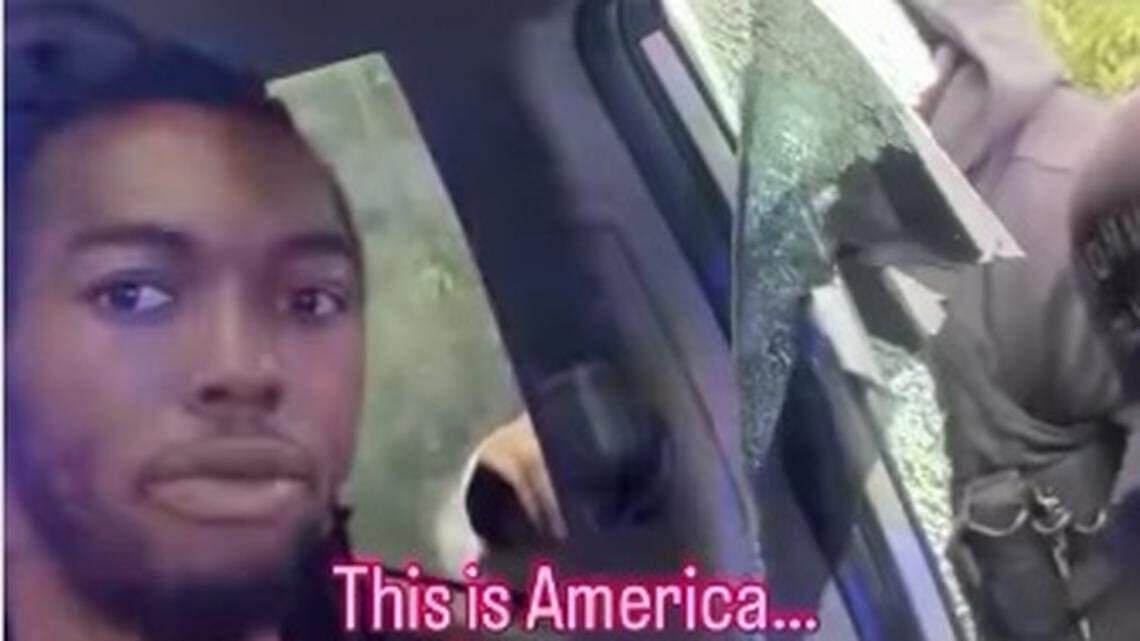
Jacksonville police say they pulled William McNeil Jr. over on Feb. 19 for not having his headlights on and not wearing a seat belt. In a video circulating on Instagram this month, he is speaking with an officer through his passenger side window. His driver side window wasn’t functional. The 22-year-old Black man asked for a police supervisor as another officer tells him several times he’s under arrest and must exit the car.
McNeil doesn’t exit. An officer breaks the driver’s side window and punches McNeil in the jaw, telling him to show him his hands. McNeil does. The officer pulls him out, and a couple of other officers help wrestle him to the ground, but not before punching him a couple more times.
Police claim in an arrest report that McNeil was “reaching for the floor board of the vehicle where a large knife was sitting,” though neither the video nor bodycam footage shows any such movement. He later pleaded guilty to resisting an officer without violence and driving with a suspended license.
His primary offense was that he did not comply with the officer’s clear demands to exit the car. He also had a small amount of marijuana, a drug that’s legal in 40 states for medical use and 24 for recreational purposes.
When asked if the officer’s punch to McNeil’s jaw met departmental protocol, Jacksonville Sheriff T.K. Waters, a Black man, said, “It depends on the context.”
It speaks volumes that Waters couldn’t simply say no, it didn’t. Because it shouldn’t.
McNeil should have complied. He should have gotten out of his car when asked.
That’s the easy part.
That doesn’t mean police should be allowed to brutalize a motorist for non-compliance — especially when the traffic stop was for failing to turn on his headlights, not running a drug cartel.
McNeil was making split-second decisions as much as the officers. He likely knew the story of George Floyd and so many others and could have feared being added to that all-too-long list.
He was the untrained person in that real-life scenario and should have been treated as such.
Issac J. Bailey is a McClatchy opinion writer in North Carolina and South Carolina.
This story was originally published July 30, 2025 at 4:00 AM with the headline "Police brutalized a non-compliant motorist at a routine stop. Why? | Opinion."