KC organizations address period poverty and stigma of paying for costly products | Opinion
Nicole Springer did not have a permanent home when she was 19. And like others experiencing housing and financial instability, purchasing feminine hygiene products was not possible. She had no choice but to steal products from a storeroom at work and rely on co-workers.
Now 20 years later, she is helping people in Kansas City get access to the products she didn’t have.
“People are already having to go through this survival mode situation in their life,” Springer said. “But on top of it, there’s shame about even needing a pad or tampon.”
Her organization, No Shame, is one of many organizations in KC that aims to support people who can’t afford these products, and destigmatize the shame associated with normal health.
“I just decided to start helping collect supplies and try to heal in my own way, because I didn’t realize how much that was haunting me,” Springer said, “that shame and embarrassment and not knowing if I’d have period products when I’m at work, it’s just nobody should have to deal with that.”
Period poverty, a term used by the United Nations, UNICEF and other health organizations, is when persons who menstruate do not have access to proper hygiene education or supplies, and it affects over two-thirds of low-income women. Many are unable to afford products because of the high tax, commonly known as a tampon tax.
Taking the lead from other states, Kansas and Missouri should remove the tax on these hygiene products and make them free in public schools.
Both Missouri and Kansas have attempted to pass bills requiring schools to provide no cost hygiene products for students. None have passed yet, something that Lindsay Kinney, director of I Support the Girls KC, thinks is a result of a male-dominated government.
“I think it’s still such a patriarchal system. I think it’s still, you know, old school, in a lot of ways,” said Kinney. “I think they think they’re saving money or trying to make good decisions for the state of the people when they’re not necessarily listening to the people.”
I Support the Girls and No Shame work with businesses to run supply drives and provide products for local schools and domestic violence shelters, among other community places. They have also teamed up with other aid organizations like Giving Hope & Help.
“We need to normalize the period, it’s not anything the (school) nurse needs to know about,” said Giving Hope & Help founder Jessica L. McClellan when describing why period products should be available in the classroom.
McClellan witnessed period poverty while growing up and knew that she wanted to support students, but also provide them with resources to better their futures.
“I saw girls soil their pants in seventh grade. I was mortified for them, messing up their pants at school. And so I had a pad in my backpack, I had it in my locker, I had it in my purse, I had a pad for me and another girl. I was the girl that had a pad,” McClellan said.
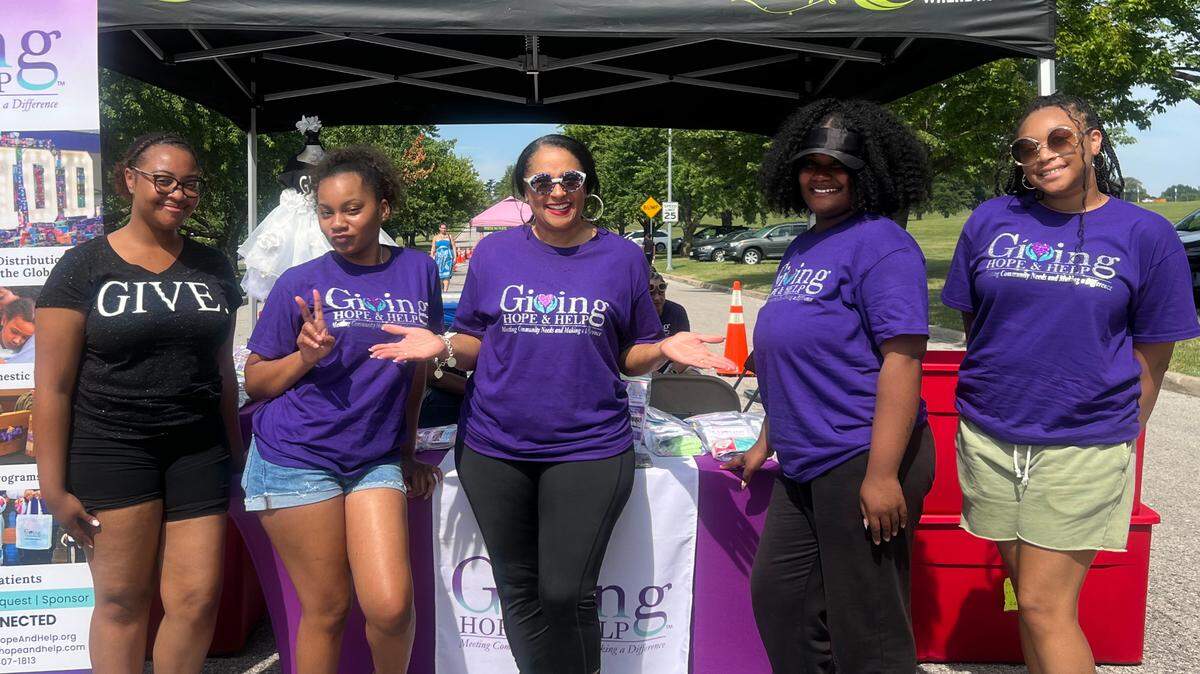
In early August, Giving Hope & Help partnered with Operation Backpack, giving out period products. The event was started by Mayor Pro Tem Ryana Parks-Shaw five years ago to give students school supplies for the school year.
McClellan was joined by four college students who were recipients of the Education is Your Passport Scholarship from Giving Hope & Help. These young women are Kansas City locals who received money to further their education at college.
Kaicey McKenzie, an incoming college freshman at the University of Missouri, said she saw a decline in sexual and menstrual education at her old schools in KC.
“I still have my teal bag that had pads or baggies with stuff that they gave us at school,” said McKenzie, “but my sister never came home with one.”
McKenzie said her younger sister did not get the period education she was granted in middle school.
School districts should provide menstrual education and period products. And although these organizations are providing incredible support in KC, they shouldn’t have to. Kansas and Missouri need to remove the tax on these hygiene products and provide them for free at schools.
Divya Gupta is a Kansas City Star Opinion intern. She is a Leawood native and a journalism and economics student at Northwestern University in Evanston, Illinois.
This story was originally published August 16, 2024 at 5:09 AM.