
Old 210 Highway: The lure of a road less-traveled
Back roads have become my main roads, but there’s one I can only follow by imagining.
It’s Old 210 Highway, a road that begins near storage units, a junkyard and a catfish restaurant with a Fiberglas shark outside, then continues past a grain elevator from yesteryear.
There’s a sports complex and farms, the stench of a mulch-producing recycling center, a dusty hillside mining operation and, eventually, a grass landing strip with aluminum hangars for planes inside and birds perched on the roof outside.
It takes me a while to get to Old 210 — the new road would be more direct — but I don’t really care. I’ve driven the old road long enough to know where every pothole, rut and steel plate is, and I zigzag accordingly. And there’s another big plus: My weaving and tendency to stop for photos are reasonably safe because the road is so lightly traveled.
Some mornings, trial and error have taught me that a stick of gum, rolled-down windows and music can combine with Old 210’s quiet mystique to dissolve any anxiety getting ready for work has produced.
Compared to some of the winding, hilly back roads I travel, the surviving stretch of Old 210 is generally straight and — not counting the potholes, dips and ruts — flat.
Fields of corn and beans, wild flowers beside the road and the occasional hill or interesting tree are certainly pleasing, but this backwater route won’t show up on any must-see list.
I figure the road still exists only as a necessity to serve the sports complex, an animal shelter and a few homes, businesses and farm roads along the way.
Even with its bumpy surface, Old 210 attracts a solitary bicyclist now and then, as well as furtive types who use it to dump old sofas, console televisions and bathroom fixtures.
Yet the 45-mph speed limit, pervasive silence and absence of other humans appeal to me.
This section of road isn’t very long and runs parallel to the new highway, maybe a third of a mile to the north, and to a train track just south.
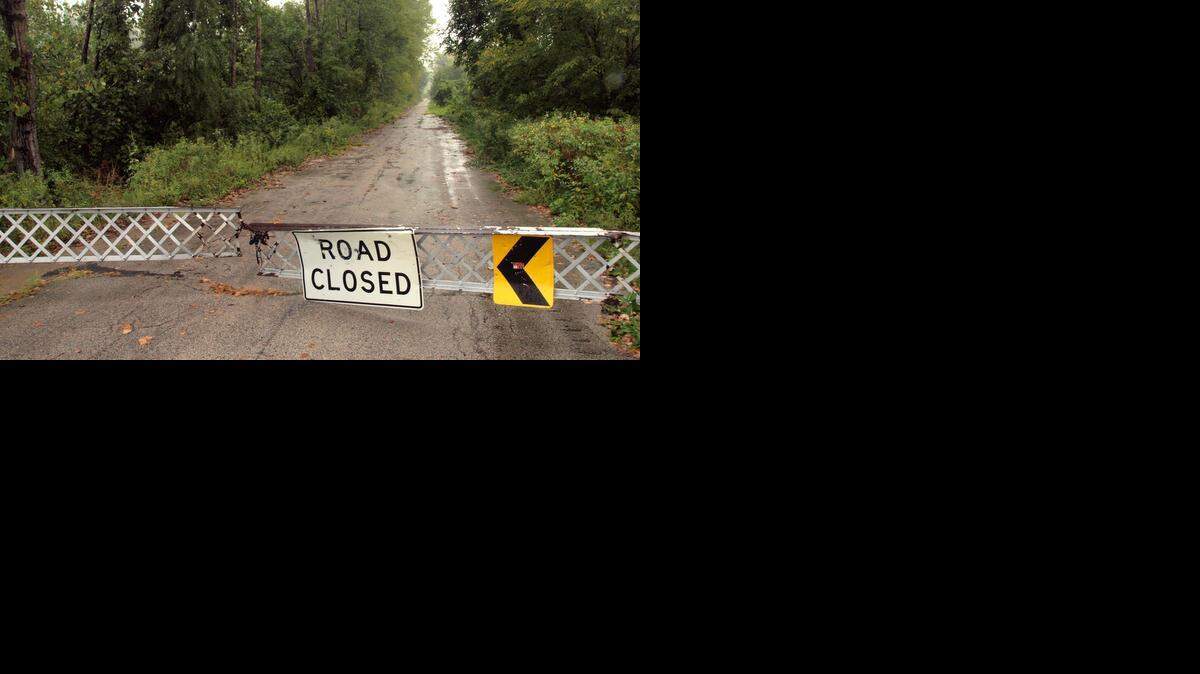
Not long after passing the air strip and a mighty tree I’ve taken pictures of so often it has its own folder, there’s a rusted one-lane bridge that crosses a creek. Beyond that is a gate and warning sign that says “Road Closed.”
It’s tantalizing to see the old road and not be able to drive on it.
Every time I take Old 210, I wonder what I might’ve seen beyond the sign, and it leaves me frustrated. The road once continued along the train tracks and Missouri River to Missouri City, a town with a colorful history and a stubbornly surviving K-8 school that sends its graduates to Liberty, the big neighbor.
When Old 210 closed, the flow of traffic through Missouri City’s main street dried up. Now there are no retail businesses left, just a post office and brick buildings, including a two-story corner one that’s been turned into living quarters.
A couple of people who lived along the old road told me it closed maybe 20 years ago.
Parts of it are still drivable — in one stretch it’s now called Route T — but the new Highway 210 is faster, smoother and straighter. It starts near North Kansas City Hospital and in some busier stretches is a four-lane.
I’ll never know what the severed part of the highway was like in its heyday, but someday I do plan to hop the fence and walk it. Until then, I’ve written a song about it, and now this.
That’ll have to do.
Have stories about Old 210, photos or a favorite back road? Share them with me at davidknopf48@gmail.com.