
How Kansas Citians braved the bluffs between downtown, West Bottoms: A KCQ answered
On his way to and from work at the revitalized Golden Ox restaurant, reader Wayne Moots had plenty of time to ponder how people once traveled up and down the rocky bluffs that separate downtown from the West Bottoms.
Moots recently submitted a question about it to our “What’s Your KCQ?” series: “How did people get up and down the big hill between downtown and the stockyards district before the viaduct? I’ve been wondering for years.”
So have we. And here’s our answer.
Prior to the automobile boom, many Kansas Citians relied on public transportation or the power of their own two feet. With downtown serving as a business hub surrounded by a variety of bustling neighborhoods, some means of reaching industry and jobs in the West Bottoms was a necessity.
Moreover, Union Depot, the city’s first major passenger rail hub, was situated at 9th Street and Union Avenue near the foot of the bluffs.
An early effort to get rail passengers to and from Union Depot and commuters to and from the West Bottoms was conceived in the late 1870s by civil engineer Robert Gillham.
Gillham had recently relocated to Kansas City from the East Coast and saw the bluffs as a worthy challenge. At that time, the only transit route connecting downtown to Union Depot required passengers to ride a horse-drawn streetcar, or “hayburner,” north along Main Street, west along 5th Street around the bluffs, and back south again to finally reach the station.
Gillham proposed a radical change — an elevated cable car line along 9th Street, running straight over the bluffs.
Following Gillham’s initial proposal in 1879, he and his investors organized the Kansas City Cable Railway Company in 1883. The first cable car traveled up the incline on June 15, 1885.
Operations went smoothly at first, but a problem associated with the ramp’s impressive 18.5% grade soon became apparent. On its second day of operation, a group of nervous dignitaries bailed out of the cable car at Jefferson Street just before it made its steep and sudden drop, with the car’s crew and a single brave newsboy safely arriving at their destination moments later.
Gillham’s bridge was not for the faint of heart.
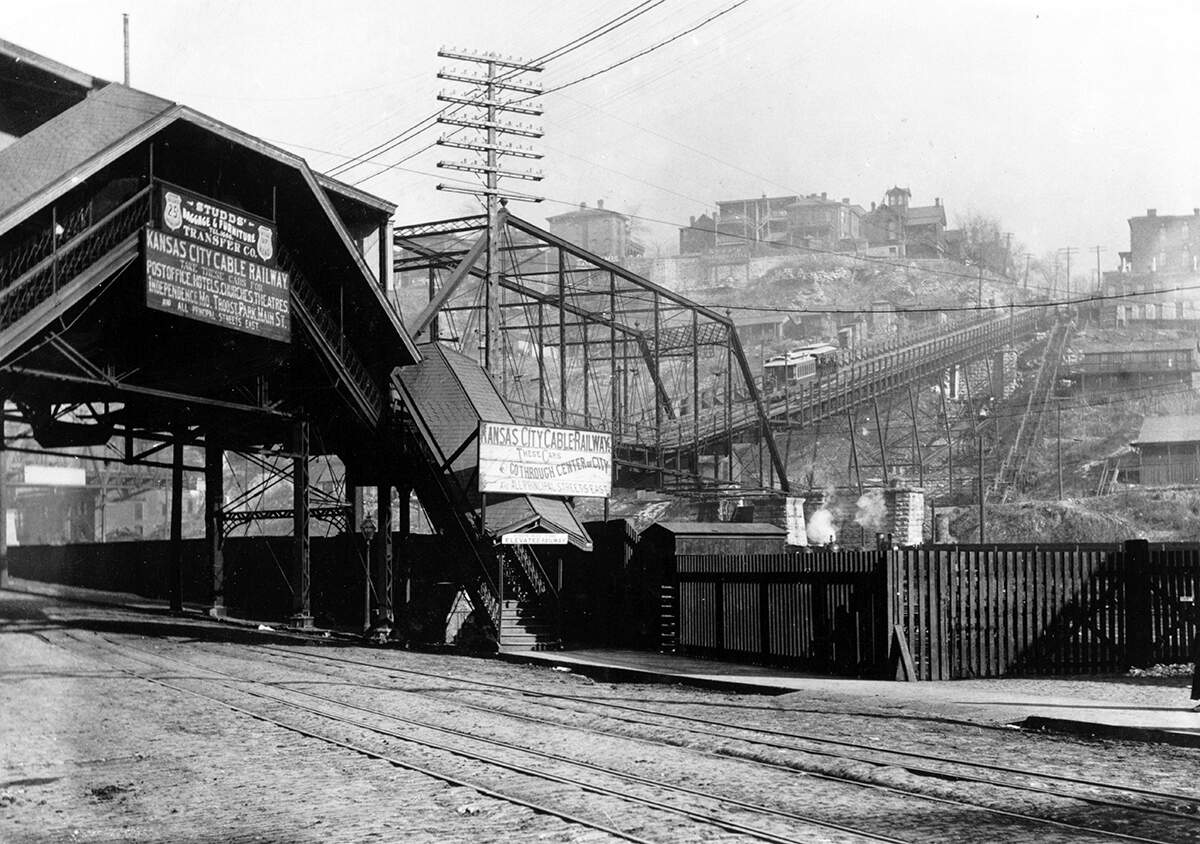
In direct competition with Gillham’s 9th Street route was the Metropolitan Street Railway’s 12th Street Incline. Completed in 1888, riders had to endure an even steeper 20% grade during trips to the bottom of the hill. The line ran until 1913 and had an impressive safety record despite its daring design.
Although accidents did occur on the Ninth Street Incline, it did operate without a fatal accident for many years.
During a routine trip in 1902, however, a two-car train preparing to descend the bluffs slipped from the cable controlling its descent and plummeted down the hill and into another train. Only a few passengers were seriously injured, but one member of the runaway train’s crew perished.
Though there was outcry for the ramp’s immediate closure, the Metropolitan Street Railway Company, which had assumed control of the line in 1895, lacked a viable alternative for moving customers between downtown and the West Bottoms and decided to keep service running. Its officials would have to wait for work to be completed on another of Gillham’s daring plans.
Construction on his first Eighth Street tunnel began in 1887, just two years after the Incline was opened. The logistics of drilling through the bluffs was considered audacious at the time, but Gillham theorized that the work would pay off because the line could travel at a more comfortable grade.
The first tunnel began at the base of the bluffs and exited near Jefferson Street, which put it at a modestly lower grade than the 9th Street option.
It opened for service in 1888, and operators swiftly realized that the grade still left something to be desired. Plans to redesign the tunnel were drawn up, and work began in 1903 to extend its exit closer to Broadway and reduce the grade to an acceptable 5.5 percent.
The clock was ticking for the Ninth Street Incline. Tunnel work was completed in 1904 and on April 6 of that year, cable cars made their final trips up and down the tracks. The Ninth Street Incline was closed off and demolished the following year.
A final note concerning the Incline: Despite its flaws, Gillham was meticulous in his plans, making sure to include a staircase stretching from Quality Hill to the foot of the bluffs. This option would come in handy over the years, offering a walking option during lapses in cable car service or for those reluctant to part with a fare.
Alternate footpaths were available to pedestrians. From downtown, it was possible to walk along 5th or 6th streets to the Bluff Street Bridge and over to Union Avenue in the West Bottoms.
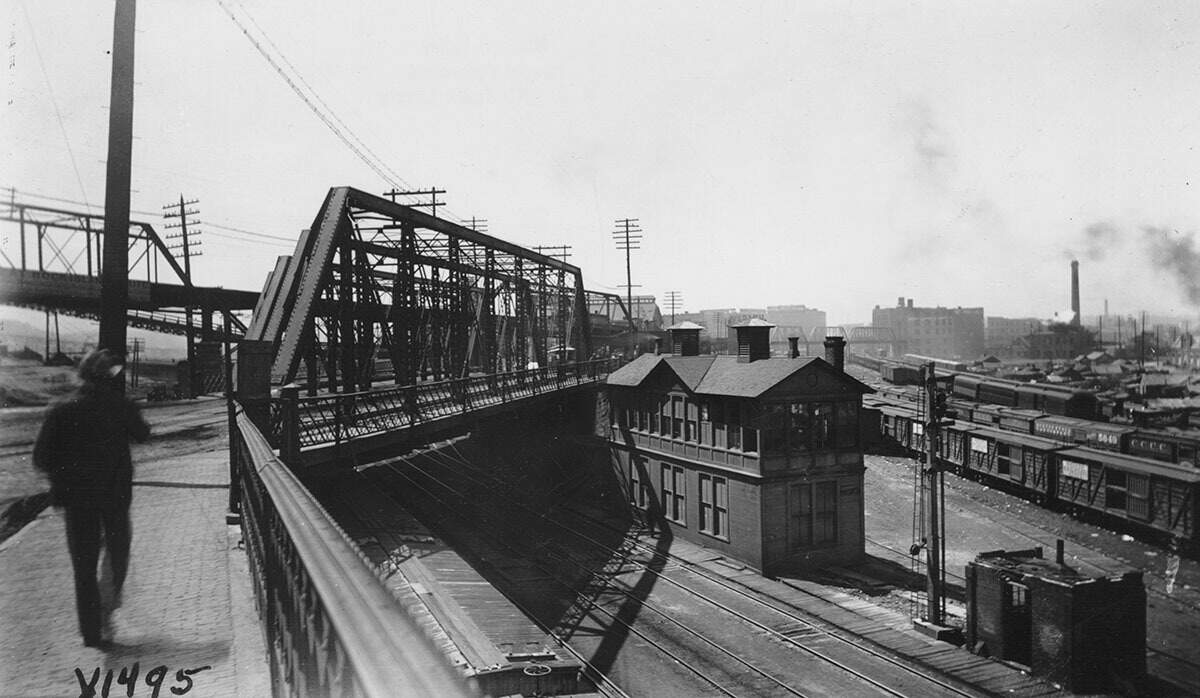
Also, long before the area was redeveloped as a park and then cleared to make room for Interstate 35, many small homes lined Bluff and Lincoln streets between Quality Hill and the West Bottoms. Not willing to wait for modern sidewalks, residents of the area wore an assortment of well-trod trails up and down the hill.
Long dissatisfied with the shack-dotted hillside greeting arriving visitors at Union Depot, city officials began planning a park along the bluffs in the early 1890s.
Following lengthy legal challenges from property owners and hillside residents, West Terrace Park was opened in stages beginning in about 1900. The park’s centerpiece was a massive, stone tower-capped retaining wall with a staircase leading to a secluded grotto and the new Kersey Coates Drive. The new road served as a scenic path along the bluffs until the 1960s, when the western end of the Downtown Loop pushed through and divided the park.
While it is true that much of downtown’s connectivity with the West Bottoms was disrupted by I-35, it is worth noting that adventurous pedestrians still can make their way between the two areas using the 12th Street Viaduct or by following in the footsteps of earlier Kansas Citians.
By skirting the bluffs through the River Market, it’s possible to connect to Beardsley Road. From there, it’s a short walk down into the West Bottoms.
Ironically, the route is nearly identical to the old, out-of-the-way, horse-drawn streetcar line that inspired Gillham to first build over and later bore through the bluffs.
How we found it
Historical information related to the development of Kansas City’s transit infrastructure was found in Monroe Dodd’s book “A Splendid Ride: The Streetcars of Kansas City, 1870-1957” and James Shortridge’s “Kansas City and How it Grew: 1822-2011,” both available for checkout from the Kansas City Public Library. The featured photographs can be found in the Missouri Valley Special Collections on the fifth floor of the Central Library. Additional details came from an Oct. 13, 1953, article in The Kansas City Times, “Hair-Raising Ninth Street Incline is Recalled by Cable Car Anniversary.”
BEHIND THE STORY
MOREHow does KCQ work?
The Star and the Kansas City Public Library are interested in answering your questions about the Kansas City region. Submit your questions on The Star’s or the Library’s website. (See the module below.) Then we will investigate and report out the answers to your KC curiosities. We’ll show you who we talked to and how we found the answer. We’ll also teach you about the available resources. Read more by clicking the arrow in the upper right.
How did KCQ get started?
The Star started its relationship with the Kansas City Public Library through its work with the News Co/Lab at Arizona State’s Walter Cronkite School of Journalism and Mass Communication. We are working with ASU to educate the public on how journalism happens, how stories are reported and the importance of transparency in our work.
Do you have a question?
Wayne Moots asked this question as part of our ongoing “What’s Your KCQ?” series in partnership with the Kansas City Library. Do you have a burning question about the Kansas City area? Visit kansascity.com/kcq to submit your questions.
This story was originally published June 7, 2019 at 5:00 AM.