Did a tornado touch down in North Kansas City? Here’s what the weather service says
Was it a tornado that moved through the Kansas City metro early Monday?
The powerful early-morning thunderstorm that knocked down large trees in North Kansas City on Monday brought straight-line and downburst winds.
But not a twister, according to the National Weather Service.
The weather service sent a survey team to North Kansas City on Monday to investigate whether a tornado touched down there as the storms moved through the metro with brilliant lightning and booming thunder.
While there was rotation with the storm that struck the city, the survey team found no evidence that a twister ever reached the ground.
“Therefore, all damage with this supercell was associated with either straight-line winds along the rear flank or downdraft, or downburst winds within the heavy precipitation core,” the weather service said.
Kansas City area storms
Multiple thunderstorms developed on the northwest side of the Kansas City metro early Monday. Those storms eventually merged into a supercell, a rotating severe thunderstorm, the weather service said.
The supercell split into two storms: one veered left into northern Clay and southern Clinton counties with large hail, while the other tracked across the north metro into North Kansas City and parts of Kansas City near downtown.
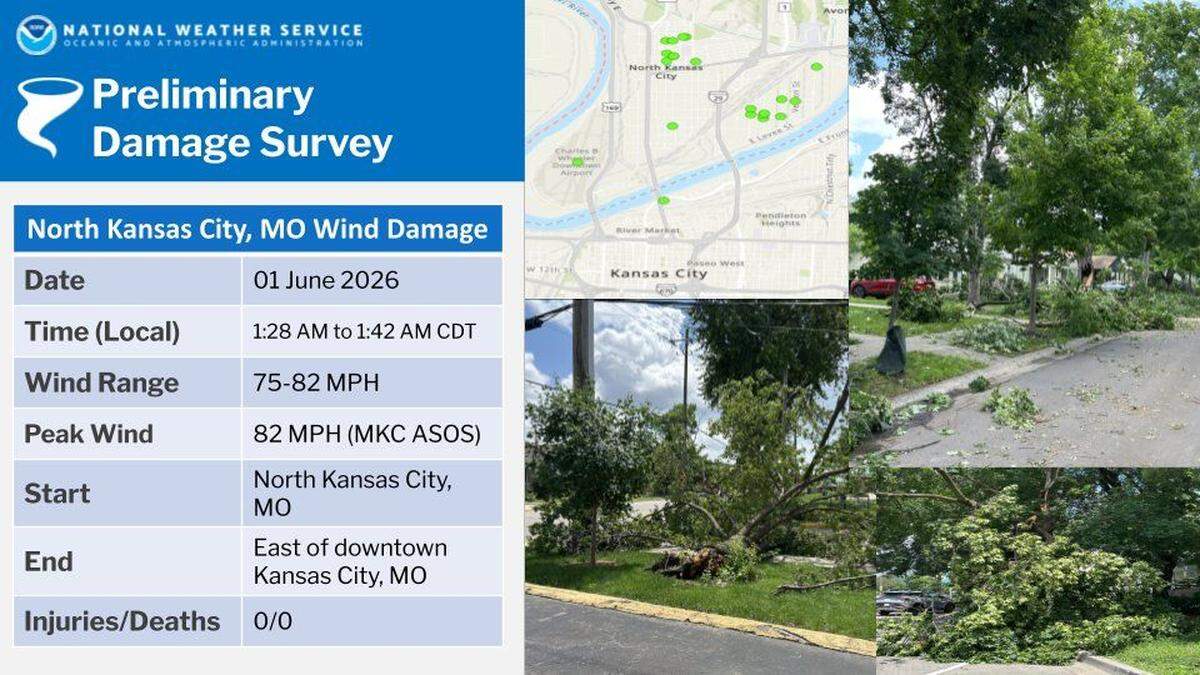
The storm blew through about 1:28 a.m., with the strongest winds occurring in North Kansas City. Several large trees were knocked down, and a wind gust of 82 mph was recorded at the Kansas City Downtown Airport — Wheeler Field.
The survey team examined the damage pattern and determined that it wasn’t consistent with the type of damage produced by a tornado. Rather, the damage was more typical of a strong downburst with winds between 75 mph and 82 mph. There was also straight-line wind damage along the rear flank downdraft surge.
The weather service said the downburst ended about 1:42 a.m. east of downtown Kansas City, noting that the start and end times only reflected the swath of winds over 75 mph.
“Damaging winds under 75 mph did occur further southeast as the supercell thunderstorm exited the Kansas City metro, including wind damage in parts of Independence,” the weather service said.
Here’s a map of storm damage reported to the weather service.
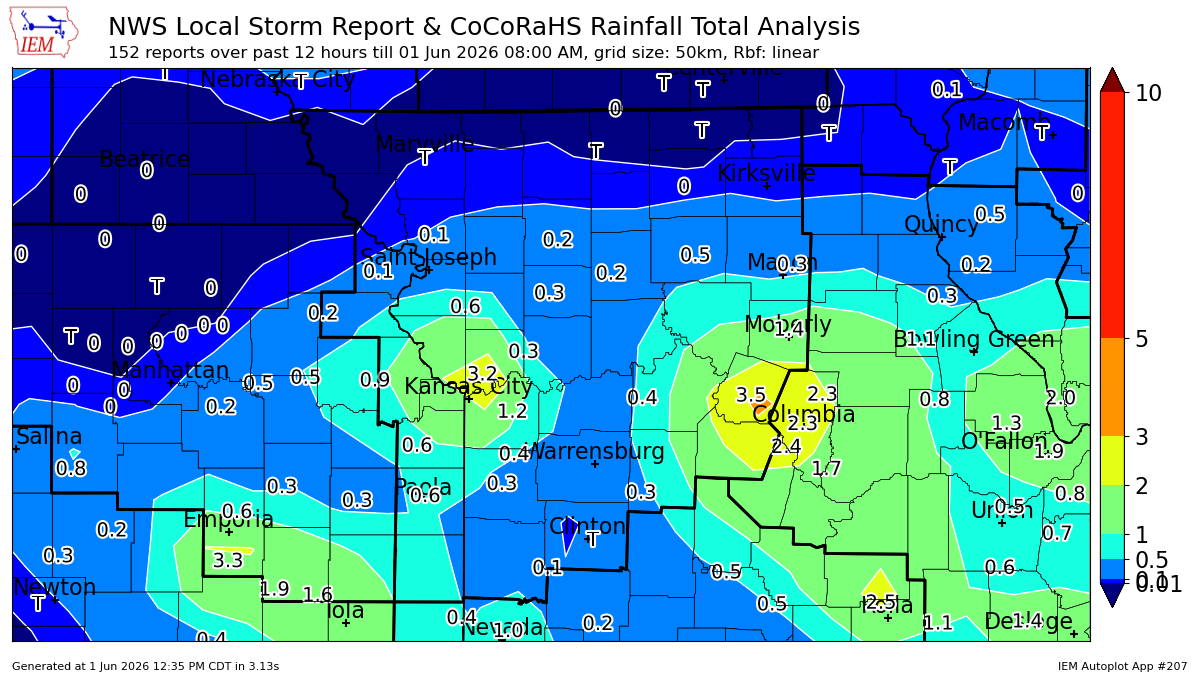
Rainfall totals in the Kansas City area
The storms packed a powerful punch, producing frequent lighting and thunder, prompting a tornado warning for parts of Clay and Jackson counties, and drenching some parts of the metro. More than 3 inches of rain fell in the Northland.
The National Weather Service issued a flash flood warning, which has since expired, for parts of northeastern Wyandotte County, southeastern Platte County, and southwestern Clay County after the thunderstorms dumped 3 inches or more. “Areas that do not typically flood are reporting to have flooded with lots of running water,” the weather service said.
The heaviest rainfall, 3.32 inches, fell at North Brighton Avenue and Upper Shoal Creek in Kansas City during a 12-hour period that ended at 8 a.m. Monday, according to StormWatch.com, a collection of rain gauges in the metropolitan area.
Meanwhile, 2.92 inches of rain fell at Northeast Englewood Road and Mill Creek, 2.76 inches fell at Interstate 29 and Line Creek, and 2.64 inches fell at Northeast Barry Road at the East Fork of Shoal Creek, and at Northwest Barry Road at Upper Shoal Creek.
Here’s a map of rainfall totals reported by StormWatch.com.