KC-region tornado count rises, weather service confirms 2 more. One lasted 25 minutes
AI-generated summary reviewed by our newsroom.
- NWS confirmed two additional tornadoes, raising the KC-region total to eight.
- A newly confirmed tornado tracked nearly 24.5 miles; an EF1 tracked about 8.6 miles.
- The KC/Pleasant Hill forecast area has recorded 20 confirmed tornadoes so far this year.
The National Weather Service has confirmed two more tornadoes from Sunday and Monday’s storms, bringing the total in the Kansas City forecast region to eight, according to survey results released Thursday.
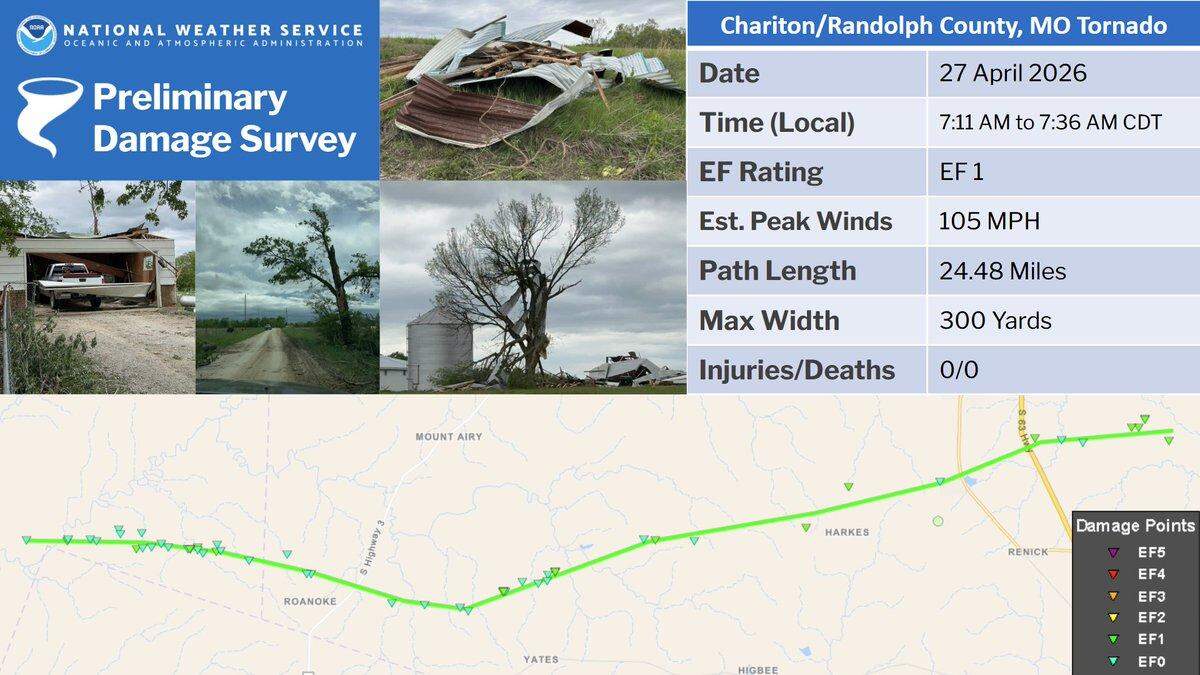
One of the newly confirmed tornadoes tracked nearly 24.5 miles, from south of Salisbury to near Moberly in central Missouri. The longest, a previously reported EF2, carved a roughly 36.5-mile path through Slater, Gilliam and Glasgow, crossing the Missouri River three times.
So far this year, the weather service has confirmed 20 tornadoes in its Kansas City/Pleasant Hill forecast area. That total doesn’t include tornadoes counted by the NWS office in Topeka, such as the EF2 that hit Ottawa on April 13.
At about 7:11 a.m. on Monday, an EF1 tornado touched down near Rascal Flats Road, about 5 miles south of Salisbury in Chariton County, Missouri, according to the latest survey. The tornado scarred tree groves along Switzer Mill Road, with the tops of hundreds of trees chopped.
Outbuildings and power poles were also damaged before the tornado crossed Missouri 129. There, it damaged two homes, a couple of outbuildings and more tree groves south of Hickory Road.
The tornado continued east-southeastward to just north and east of Roanoke in Randolph County, where numerous trees and power poles were damaged along County Road 2405. The tornado moved eastward across County Road 2410, where more damage was found.
The tornado shifted to the east-northeast just north of Yates and continued to an area between Renick and Moberly. On County Road 2480, the roof was lifted from a home and surrounding trees fell in multiple directions.
The tornado lifted near County Road 2735 southeast of Moberly. The survey noted that there was substantial straight-line wind damage to outside of the tornado’s path, including in Roanoke, Yates and Higbee, as well as east of U.S. 63 between Moberly and Renick.
At its peak, the tornado had an estimated wind speed of 105 mph and a maximum width of 300 yards. The tornado was on the ground for about 25 minutes. No injuries were reported.
Another, smaller tornado strikes nearby
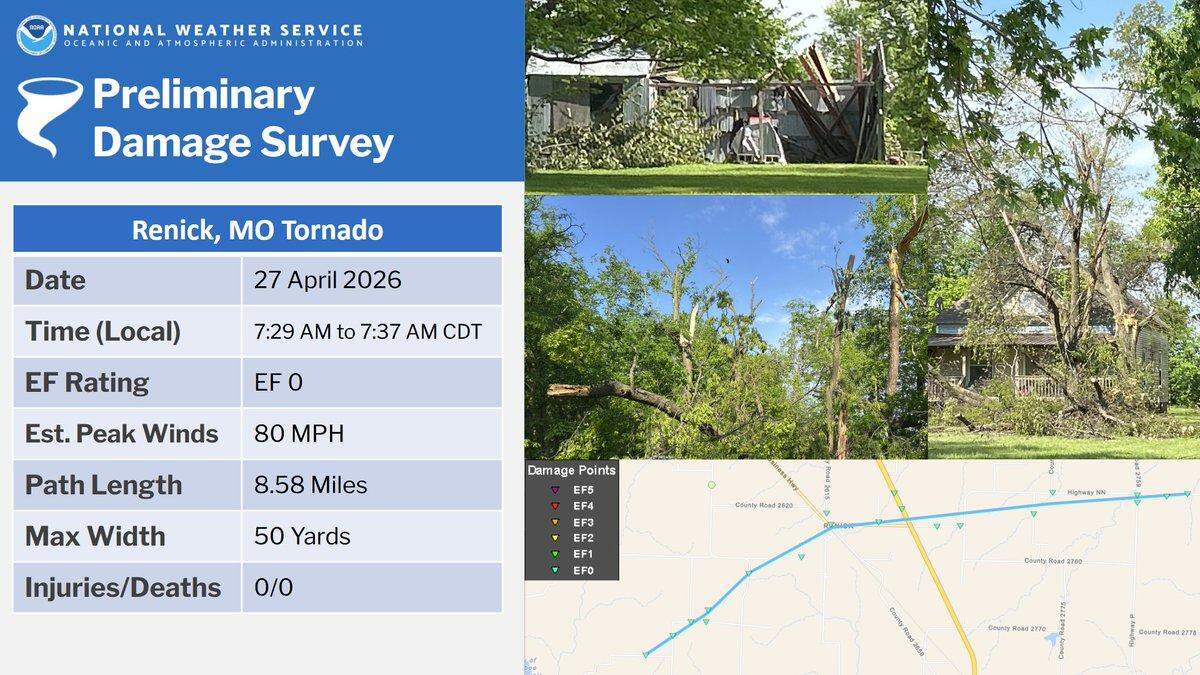
While that tornado was on the ground, another smaller one, an EF0, touched down about 7:29 a.m. nearby, about 3 miles northeast of Higbee in Randolph County, according to the weather service..
The tornado caused mostly tree damage as it tracked northeast toward Renick. An outbuilding’s roof was damaged, possibly from a fallen tree. The most severe damage occurred in Renick, with numerous trees downed along the business route of U.S. 63, between the railroad tracks and the highway. Several homes also sustained damage, mostly from fallen trees.
The tornado continued eastward along Missouri NN, where it chopped tree groves in several areas before weakening and lifting about 5 miles east of Renick, as it approached Monroe County.
At its peak, the tornado had estimated wind speeds of 80 mph and a maximum width of 50 yards. It traveled about 8.6 miles and was on the ground for about 8 minutes. No injuries were reported.
The other tornadoes from the storms were an EF1 at about 4:20 p.m. Sunday near Wellsville in Miami County, Kansas, and EF0 at about 4:38 p.m. near Parker in Linn County, Kansas, an EF1 at about 3:31 a.m. Monday near Tonganoxie in Leavenworth County, Kansas, an EF0 at about 5:38 a.m. Monday near Spring Hill in Johnson County, Kansas, an EF1 at about 5:45 a.m. Monday near Bucyrus in Johnson County, an EF2 at about 6:52 a.m. Monday that touched down near Slater in Saline County, Missouri.
This year’s severe weather season has gotten off to a rapid start, with a record number of severe thunderstorm and tornado warnings issued so far. The peak severe storm activity is in May, but severe weather can continue through the summer and into the fall.