Why are Kansas City’s skies so hazy? Here’s the reason, and when they should clear
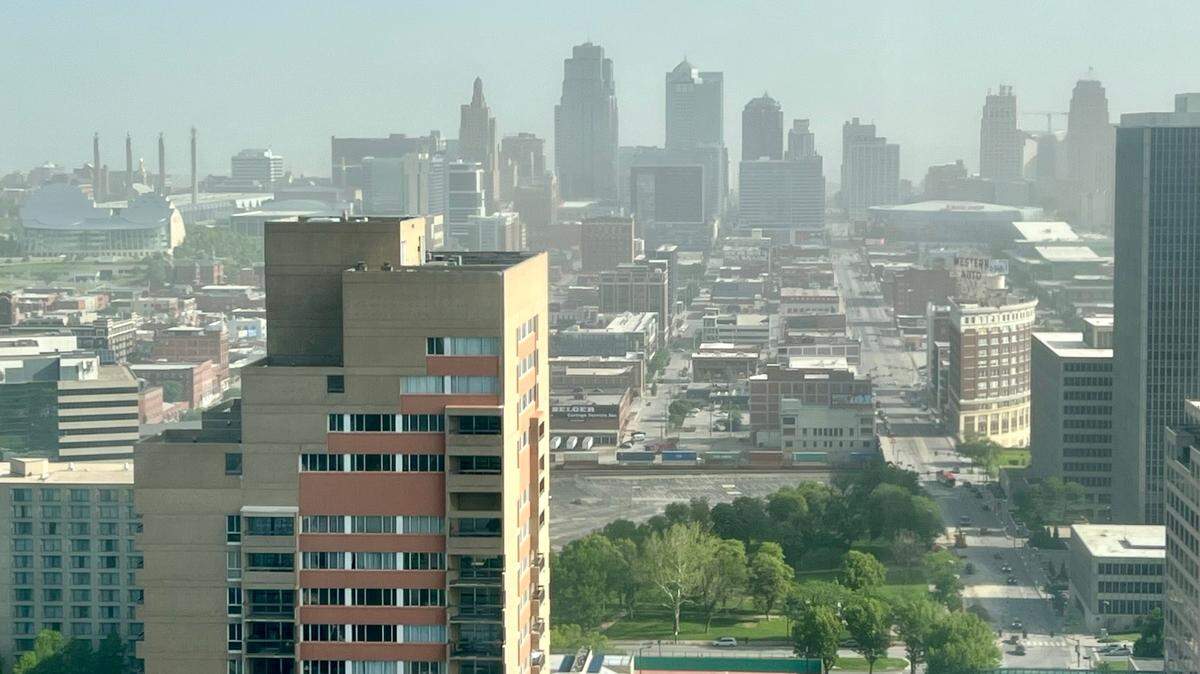
Those headed about their morning commutes and errands might have noticed a mysterious haze blanketing the Kansas City skyline Thursday.
Doug Norsby, senior environmental planner with the Mid-America Regional Council, helped clear the air, so to speak, about why the skies over the metro were so dirty.
“It’s dust that’s been brought to us from the process of a real strong cold front moving through,” Norsby said.
Western Kansas has been experiencing an ongoing drought, which has led to low soil moisture for quite a while, Norsby said. Winds from the strong cold front kicked up the surface soil into the air, creating a lot of dust.
The dust became so bad that it forced the Kansas Department of Transportation to shut down Interstate 70 between Colby and the Colorado state line Wednesday night.
The blowing dust reduced visibility and created hazardous travel conditions. The highway was shut down for hours and reopened around 11:30 p.m.
The dust continued to move across the state; by Thursday morning, it reached the Kansas City area, Norsby said. Shortly before 10 a.m., the dust had moved east of the metro.
Although the metro is still experiencing the dust, he said conditions are expected to improve over the next hour or two.
“We’ve seen the worst of it,” Norsby said.
Norsby said Thursday will become more pleasant as the skies clear, with cooler temperatures and lower humidity.
Haze not related to spring burns in Flint Hills
The haze was unrelated to this year’s burn season in Kansas’ Flint Hills, which typically can last through the end of May.
“This year, we’ve actually had an early green-up — we’re two to three weeks ahead of schedule as far as the grass popping and the trees starting to leaf out,” Norsby said.
Once that happens, the fires are harder to keep going and you start burning the vegetation you want to keep to support the cattle, Norsby said.
“We shouldn’t see any more Flint Hill smoke issues,” Norsby said.
Air quality unhealthy in metro
The dust has caused Kansas City’s air quality to suffer.
The metro’s Air Quality Index as of 10 a.m. was listed as “very unhealthy,” with fine particulate matter being the primary pollutant, according to AirNow.Gov.
There are two different levels of fine particulate matter — PM10 and particulate PM2.5, which is very fine particulate matter, Norsby said.
“If there’s a problem with some, you’ll typically see that in that PM2.5 range,” Norsby said. “And if it’s dust, you’ll see that in the PM10, a little bit larger-sized particles.”
They both can cause people to wheeze and make breathing harder, but the smaller the particles, the easier they are passed into the bloodstream.
“Not that dust is good, but it’s better than having the really very fine particulates that can cause a lot of circulatory problems as well as breathing problems,” Norsby said.
For now, it might be better for people with breathing issues to stay inside until the skies clear. People with breathing problems should also ensure they take their medications and have an inhaler.
“If they can wait and postpone what they need to do for a little bit, by this afternoon, conditions should be much improved,” said Norsby, who added that people can watch AirNow.Gov to see when the metro’s air quality improves. “It’s not something that’ll keep us kind of cooped up inside like we’ve had in the past years with wildfires. So it’ll be a short-lived event.”