As Thanksgiving travel returns to pre-pandemic levels, weather may cause disruptions
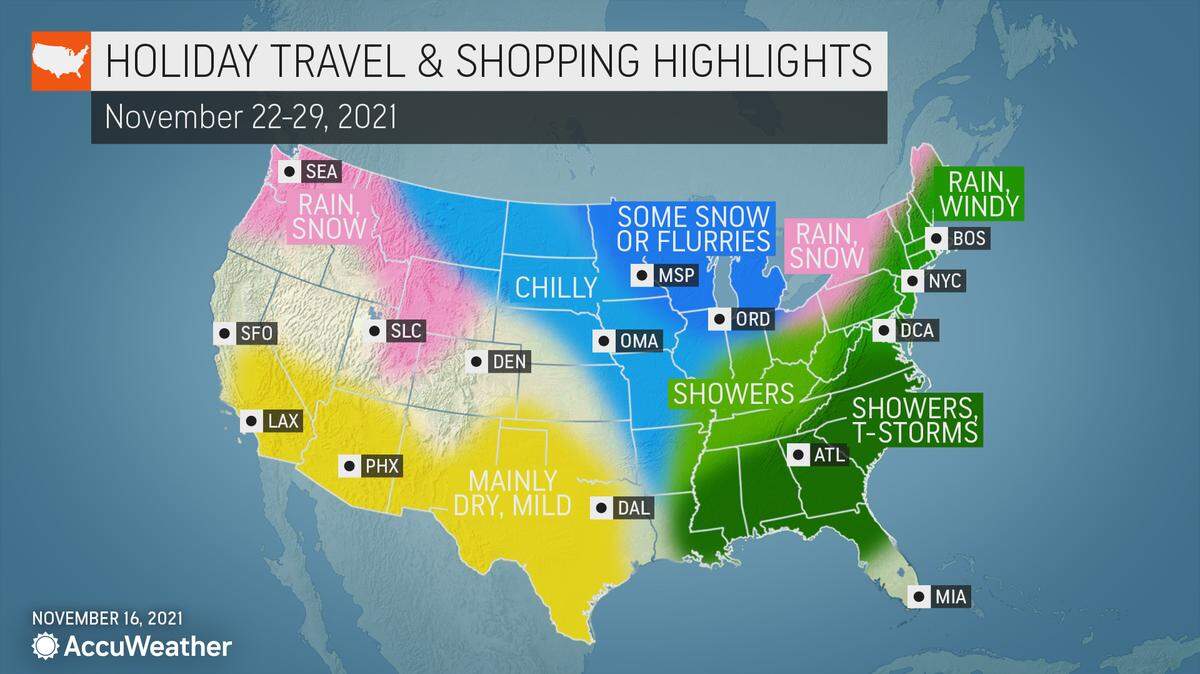
Headed out of town for Thanksgiving? Airports and roads are expected to be jammed with holiday travelers, reaching near pre-pandemic levels, according to AAA.
As many as 53.4 million people are expected to drive or fly over the long holiday. That’s up 6.4 million more people this Thanksgiving, bringing travel volumes within 5% of 2019 levels. Air travel will almost completely recover from its decline during the pandemic, according to AAA.
For many, this will be their first trip to connect with loved ones in months, if not years.
“This Thanksgiving, travel will look a lot different than last year,” Paula Twidale, senior vice president of AAA Travel, said in a news release. “Now that the borders are open and new health and safety guidelines are in place, travel is once again high on the list for Americans who are ready to reunite with their loved ones for the holiday.”
Passenger traffic at Kansas City International Airport is expected to be 85% of pre-COVID-19 levels and 40% busier than 2020, said Justin Meyer, deputy director of aviation for the Kansas City Aviation Department.
An estimated 312,000 passengers, both arrivals and departures are expected to pass through the gates at KCI from Friday through Nov. 29. The busiest days are expected to be the Tuesday and Wednesday before Thanksgiving, and Saturday and Sunday following the holiday.
The Christmas and New Year holiday period are expected to be busy as well, with traffic expected to be 85% of pre-COVID-19 levels and 45% busier than 2020. An estimated 470,000 passengers are expected to travel through the airport between Dec. 17 and Jan. 3. The busiest travel days are expected to be Dec. 23 and 26 and Jan. 2 and 3, he said.
The recent opening of the U.S. borders to fully vaccinated international travelers also may make roads and airports more crowded.
“International travel re-opening will allow people to reconnect with friends and family and explore new places, while also giving a much-needed boost to the economy,” Twidale said. “But it also means airports will be busier than we’ve seen, so travelers must plan for longer lines and extra time for TSA checks.”
The preferred mode of travel will by car, accounting for 90% of all trips this holiday. That’s down from 95% in 2020. An estimated 4.2 million Americans will take to the skies this year, up 80% from 2.3 million in 2020, according to AAA.
For Kansas City travelers headed outside the region, weather could disrupt their travel plans as storms could bring rain and snow to the Northwest and eastern Great Lakes region and showers and thunderstorms along the east coast.
“There’s some uncertainty still, you know, as far as the actual details in the week,” said Paul Walker, senior meteorologist with AccuWeather.
Part of the uncertainty has to deal with a storm that’s expected to cross the Canadian Prairies in western Canada on Saturday, Walker said.
That storm will drag a cold front eastward across the Great Plains and through the Kansas City area Saturday night before continuing eastward into the Great Lakes and Ohio Valley regions on Sunday.
There will be some snow on the backside of the front up across the Midwest on Sunday into Monday, Walker said. With that there could be periods of rain and gusty winds across the Great Lakes which could cause some travel delays, he said.
Travelers to Florida could encounter heavy rains on Sunday.
The forecast becomes complicated on Monday as the cold front continues to move east. If it slips right on through, then there will be one period of rain.
If the front stalls near the coast, another storm could develop off the eastern seaboard. If that storm develops, it could move off to the northeast towards eastern Canada.
Or it could move northward towards New England, bringing accumulating snow across the eastern Great Lakes and parts of interior New England and prolonged rain along the east coast, Walker said.
In the Kansas City region, temperatures will start off the holiday week pretty cool with temperatures in the lower 40s.
“It’s not terrible, but it’s still chiller weather,” Walker said.
Milder conditions return on Tuesday and Wednesday before another cold front passes through and crimps temperatures for Thanksgiving Day into Friday, he said.
Drivers are expected to experience the worst congestion the Wednesday before Thanksgiving as commuters leave work early and mix with holiday travelers, according to INRIX, in collaboration with AAA.
Major metro areas that could see more than double the delays versus typical drive times. Meanwhile, those in Atlanta, Chicago, Houston, Los Angeles and New York City will likely see more than three times the delays.
“Thanksgiving is one of the busiest holidays for road trips and this year will be no different even during the pandemic,” said Bob Pishue, transportation analyst with INRIX, a transportation analytics company.
“Drivers around major metros must be prepared for significant delays, especially Wednesday afternoon. Knowing when and where congestion will build can help drivers avoid the stress of sitting in traffic.”
According to INRIX, the worst times to be driving this holiday is between noon and 8 p.m. Wednesday; noon and 3 p.m. Thanksgiving Day; 1 and 4 p.m. Friday, 2 and 7 p.m. Saturday and 1 and 7 p.m. Sunday.
The best times will be after 9 p.m. Wednesday; before 11 a.m. Thanksgiving Day and Friday and before noon on Saturday and Sunday.
This story was originally published November 17, 2021 at 11:01 AM.