Meet the centenarian tortoises of the St. Louis Zoo — and the Belleville man who cares for them
The Saint Louis Zoo is home to more than 14,000 animals, but at more than 84 years old, two stick out in particular.
Othello and Ray, both Aldabra tortoises, came to the U.S. in 1938, and may be well over 100 years old, according to zoo staff.
They were full adults when they emigrated, although zookeepers don’t know how old they were exactly when they made the move. Another facility in the U.S. gave Othello and Ray to the Saint Louis Zoo in 2004.
“Zoos here in the United States, we often will take animals from one another, especially for breeding recommendations or conservation-oriented projects, and that’s how they came here,” zoological manager of herpetology Justin Elden said.

Elden lives in Belleville, and he said he has known the tortoises since his 18th birthday celebration.
His girlfriend at the time paid for him to participate in a tortoise tour at the zoo, which he was ecstatic about. Elden hoped to get some face time with the animals, as well as make future zoological connections.
His strategy worked. Elden soon became an intern at the zoo and developed the herpetology career he’s still passionate about to this day.
Elden said he loves being able to get up close to incredible animals such as the Aldabra tortoise, and the animals reciprocate the feeling by nudging him for attention.
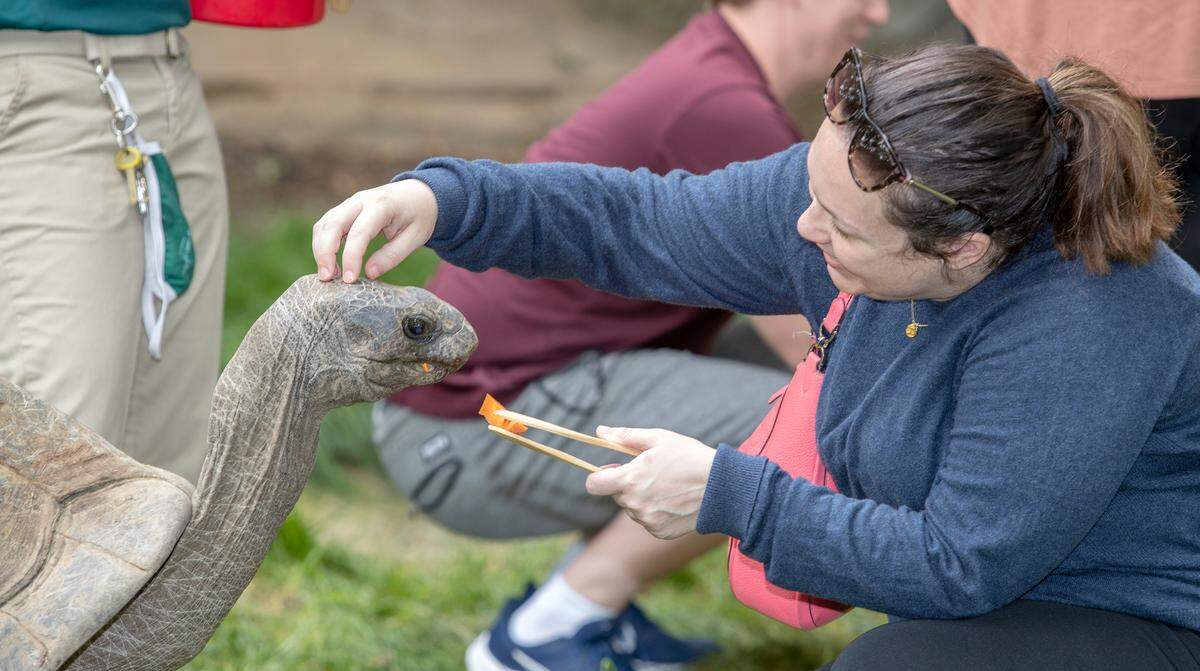
If you ever get the chance to touch a giant tortoise, Elden recommends petting them at the back of their neck almost up in their shell. They can’t reach this area of their body, so it’s sort of like rubbing your dog’s belly.
More about the Aldabra tortoise
While the tortoises’ attention-seeking methods mirror that of a dog’s, the resemblance seems to end there. An Aldabra tortoise can make it to its 150th birthday and then some, according to the Smithsonian’s National Zoo & Conservation Biology Institute.
Elden said Othello and Ray could have been more than 50 years old in 1938, an estimation based on their full-grown size at that time. It can take 50 years to 70 years for an Aldabra tortoise to reach full physical maturity.
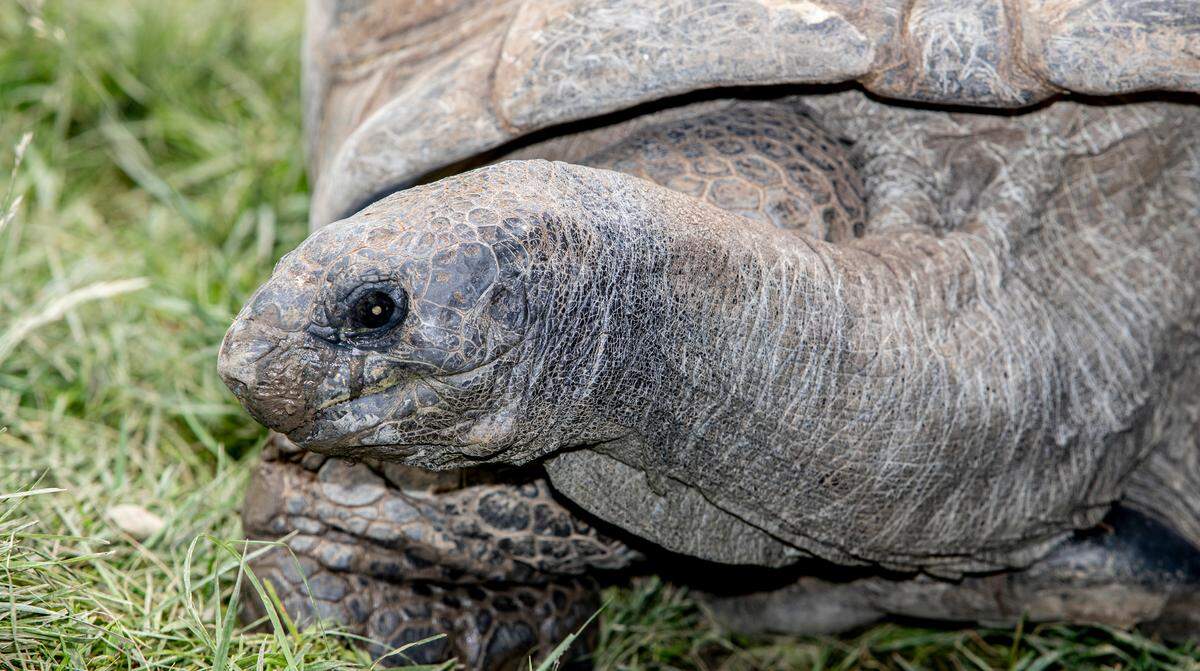
Ray and Othello are likely well over 100 years old, Elden said, and could have decades left in their lifespans. If you don’t feel like doing the math, if the two were 50 years old when they came to America, they would have been born in 1888.
Although zoological experts cannot know with certainty the tortoises’ birth dates, there’s plenty known about the large creatures.
The average adult male Aldabra tortoise weighs around 300 pounds with a 3-foot-long shell, Elden said. They can surpass 500 pounds, and the shell grows proportionally to the animal’s weight.
Othello’s shell is just more than 3 feet across, and he weighs 332 pounds. Ray is even heftier, weighing in at 350 pounds.
Aldabra tortoises can fit in an adult’s palm when they’re born and tend to act their size in terms of survival instincts.
“When they’re babies, they spend a lot of time hiding. They’ll hide underneath grasses and bushes and stuff like that, mostly to get away from some of the bigger guys and also because it’s a little harder for them to thermoregulate,” Elden said.
A day in the life of an Aldabra
The Aldabra tortoises at the Saint Louis Zoo, especially the oldest ones, are friendly to adults and small children alike.
“They’re very used to people, and one thing that they’ll do is they’ll actually come towards keeper staff and also people who are here interviewing us to try to get pets and rubs and whatnot. So that’s something that we see a lot of times with older animals in particular,” Elden said. “When they get a little bigger, they spend more time out and about. They’re basking more often.”
The tortoises enjoy midday naps and doting from zookeepers, frequently walking over to people during tours and extending their heads out for petting.

They even receive spa days. There is a muddy area in their habitat where they take rejuvenating “baths,” and their caretakers provide oil treatments to keep their skin moisturized.
Maintaining adequate humidity is really important for tortoises, especially the older ones, Elden said. There’s not currently a tortoise “lotion” on the market, but the zookeepers apply a special oil to the shell and parts of the skin to hydrate the tortoise.
“Not only do they benefit from it, they seem to enjoy, as much as a tortoise can enjoy anything. They seem to enjoy the massage,” Elden said.
While there are human grandparents half the tortoises’ estimated ages, they’re not currently facing many serious health issues, Elden said.
“Our two oldest guys, they don’t have the greatest vision. That said, they get the food just fine, they get the keeper staff just fine, without issue,” Elden said. “We do keep a super close eye on them because they are so old, just to make sure that there aren’t any issues that might develop.”
The zookeepers perform regular physical examinations and weigh-ins for the animals to maintain health.
Aldabra ambassadors
One of the Aldabra tortoises’ greatest contributions to the Saint Louis Zoo is the education they provide, Elden said.
“These guys act as a great ambassador for island ecosystems and the conservation of islands, as well as reptiles,” Elden said. “We get around 3 million visitors a year, and these guys have done a great job of showing kids the variety and diversity of reptiles.”
The Aldabra tortoise is the last known survivor of giant tortoises from the Madagascar and the Seychelles islands.
“Aldabra tortoises are listed as vulnerable by the IUCN (International Union for Conservation of Nature). There were formally considered to be four different subspecies of Aldabra tortoise; all but one of them are now extinct,” Elden said.
The wild Aldabra tortoise population is estimated to include more than 100,000 animals, Elden said, but the limited size of their habitat contributes to a possibility of population decline.
“The Aldabra Atoll, where these guys live, along with being formally protected by the Seychelles government, it is a UNESCO World Heritage Site,” Elden said. “So we’re protecting the animals, we’re protecting the habitat and making sure that they’re around for hundreds and hundreds and hundreds, if not thousands, of more years.”
The United Nations Educational, Scientific and Cultural Organization seeks to encourage the identification, protection and preservation of cultural and natural heritage around the world considered to be of outstanding value to humanity, its website says.
There are 1,154 properties on the UNESCO World Heritage list, and the Aldabra Atoll in Seychelles is one of 218 natural sites with the designation. The Seychelles Islands are located off the east coast of Africa.
You can check out the Aldabra tortoises anytime at the Saint Louis Zoo. They are outside on exhibit all day during the summer, and when they are moved inside for the winter, you can still see them at the Herpetarium.
If you’re looking for an up-close and personal experience with Othello, Ray and their friends, check out the Tour de Tortoise. It’s $55 per person for a 30 to 45 minute experience, and you get to pet and feed carrots to the tortoises.
The tours book up fast though, so you may want to take that into account if you’re planning for a special event.
This story was originally published June 8, 2022 at 5:00 AM with the headline "Meet the centenarian tortoises of the St. Louis Zoo — and the Belleville man who cares for them."