Girls tell of terror, abuse at Missouri Christian boarding school under investigation
Their daughter was nearly 2,000 miles away in a Christian boarding school in southwest Missouri and Brian and Michelle Stoddard knew they needed to get her out.
The couple had been reading social media posts from women who had once been at Circle of Hope. And they had watched a video taken in March that appeared to capture Boyd Householder — who runs the school with his wife, Stephanie — endorsing the use of violence between the girls.
“We were going to bed one night, and just both of us, in our hearts we knew,” said Michelle Stoddard, of the Seattle area. “God was like, ‘Get up and start driving.’ And we did. We dumped everything in our refrigerator into a cooler and drove 32 hours straight.”
That was in late July. About two weeks later, after their 17-year-old daughter Emily told a Cedar County Sheriff’s deputy stories from inside Circle of Hope, authorities removed 25 girls from the reform school.
Now, emboldened by recent events and the involvement of local and state officials, more former residents are coming forward to share similar horror stories they say have played out at the school that has close ties to the independent fundamental Baptist church.
“I can confirm there is an ongoing investigation in this matter,” Ty Gaither, Cedar County prosecuting attorney, told The Star.
Gaither said his office expected to receive “investigative” reports from local law enforcement and state departments “in the near future.”
On Thursday, Gaither announced that a search warrant was executed at Circle of Hope on Tuesday “pursuant to an ongoing investigation.” A source with knowledge of the investigation said items authorities were seeking included computers and electronics, such as hidden cameras and surveillance equipment.
The boarding school has been investigated many times before. In fact, it has had four substantiated reports of abuse and neglect since it opened in 2006, The Star has learned.
But because faith-based Circle of Hope Girls’ Ranch is exempt from state licensure, the Missouri Department of Social Services “does not have authority” over the facility’s operations, said Rebecca Woelfel, an agency spokeswoman.
In response to questions from The Star, Woelfel said the boarding school has had one substantiated report of neglect, one substantiated report of physical abuse and neglect, and two substantiated reports of sexual abuse recorded in the state’s central registry. She did not say when the reports were made or whom the allegations were against.
The Star talked to several young women who have lived at Circle of Hope and parents who have sent their daughters there. The former residents described in vivid detail a place that sounded more like a maximum-security prison than a Christian school for troubled girls.
They told of punishment that included withholding food and water and being forced to stand against a wall for hours on end for even the most minor infraction. They explained how they were restrained — a procedure in which they said that after shoving a girl to the floor, Boyd Householder would kneel and press his knee on the back of her neck while four other girls or staff members were required to push as hard as they could on the pressure points on her arms and legs.
Girls said they were told they would go to hell if they ever wore pants and were allowed only two changes of clothes per week. They were allotted four squares of toilet paper when using the restroom, and their rare phone calls with parents were strictly monitored and cut off if they complained or didn’t say the “right” things. School was not a priority, they said, and at times they had no teachers.
The Householders could not be reached for comment. They did not respond to emails, and the phone at Circle of Hope went unanswered. Their attorney, Jay Kirksey, did not return phone calls requesting comment.
In a June 15 letter to pastors of churches that have supported the Circle of Hope, Boyd Householder — whose Twitter handle is Gunslinger4God — said he wanted to explain “the attacks being made against us on Social Media.”
He blamed the problems on his daughter and mother-in-law, who he said had turned their daughter against them. Their daughter, he said, “has determined that she will force Circle of Hope Girls Ranch to shut down.”
“...We know that the devil hates what we do and he will stop at nothing to stop us,” he wrote.
In her two years at the school, Emily Stoddard said state child protection workers — referred to as “Satan’s soldiers” by Boyd Householder — came to the property multiple times. Deputies often would come along as well.
Girls were told they could speak to the child protection workers if their parents approved. If they did, though, girls said they knew that the Householders would be listening in a nearby room or grill them when it was over to learn what was said.
And if the couple didn’t like what girls said to the workers, they knew they would be punished.
By the end of July, Emily’s parents arrived at the school — which they paid $1,500 a month for her to attend — to take her home. They wanted to show up unannounced to get their daughter, but during their drive from Washington, the Stoddards got a call from Householder, who said Emily needed to go home now.
In recent weeks, the teen had begun to understand that what was happening at the ranch wasn’t right and she had been standing up to Householder. And now she worried what her family would think. Would she be in more trouble?
“From what I would hear from Boyd and Stephanie, I thought my parents would be mad at me and they believed the Householders,” Emily said. “I was very scared, like even thinking about, ‘Are they even going to want to hug me?’ … I was like really nervous and fearful. I didn’t know what was going to happen.”
What she didn’t know is that her parents, too, were unsure. As her dad put it: “We didn’t even know if she wanted to come home.”
But she did. And not just for herself.
As Emily left the ranch that late July day, she thought of the paper tucked in the sole of her tennis shoe. It had the names of three girls’ parents and their phone numbers — their hope to get rescued, too.
Lack of oversight
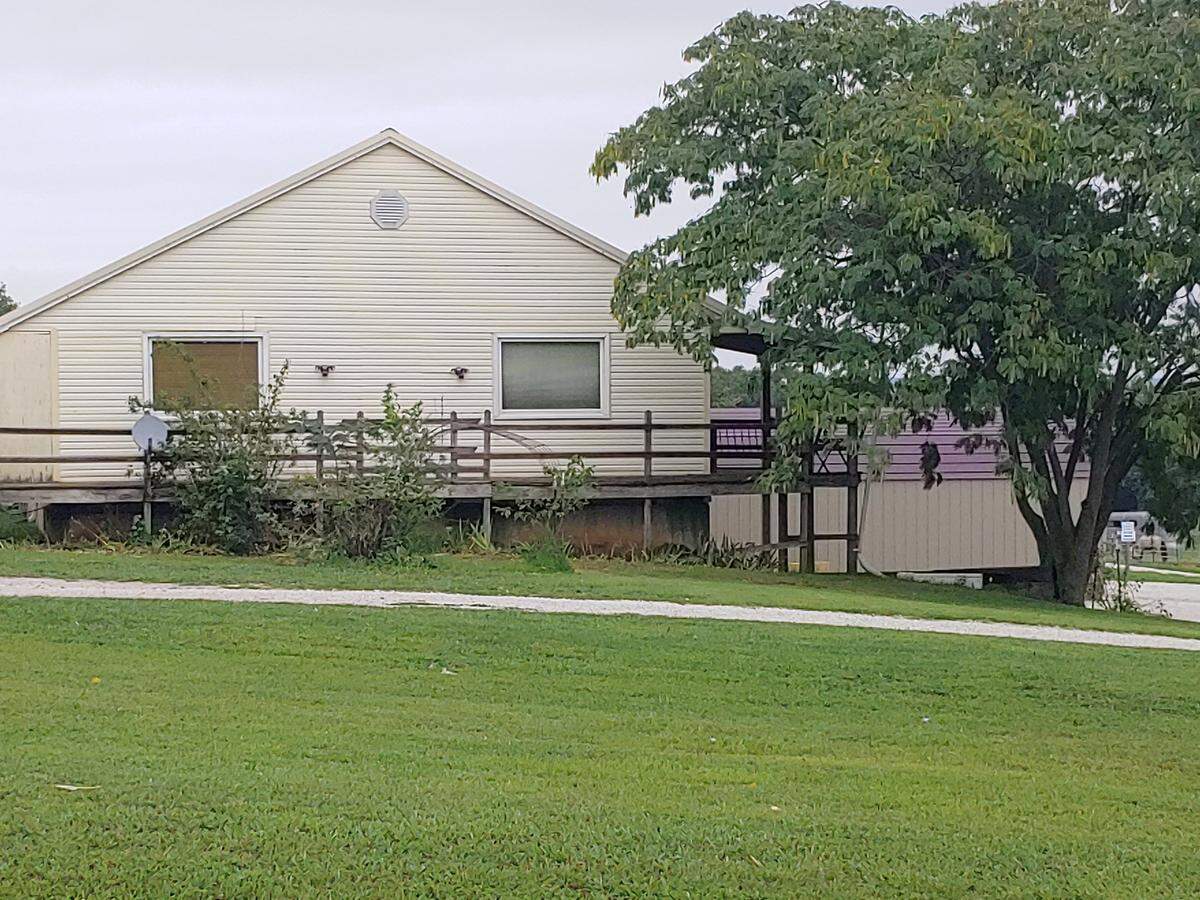
The ranch is located less than seven miles from Humansville on Highway N in Cedar County. Next to the main buildings, a Trump 2020 flag waves alongside American flags and a nearby white warning sign:
“SMILE YOU ARE ON CAMERA,” it reads.
Below are the “Campus Rules:” No weapons, except authorized persons. No smoking. No cursing. No alcohol and no drugs.
The last rule: “You must speak English America’s language.”
The Circle of Hope Girls’ Ranch opened its doors to three girls on July 1, 2006, according to the school’s website. Since then, the reform school has expanded to more than 20 girls.
“The girls come from all walks of life, some have been in gangs, drugs, alcohol, boys, etc,” the website says. “Some have been physically violent with their families and some have been abused. Most of them have been adopted, or come from broken homes and do not know how to deal with the past.
“Circle of Hope’s goal is to help young ladies who were destroying their lives through poor choices and behaviors, change their future. ... We use the BIBLE to teach them that they are to obey their Parents and the authority over them.”
The Circle of Hope website has two sections containing testimonials from parents and former students, many praising the Householders for turning their daughters’ lives around.
“We are so grateful to Circle of Hope and God for giving us our daughter back,” wrote parents identified only as “I” and “G.”
“I honestly do not know what would have happened to her if not for this wonderful ranch and caring people! Our daughter loves and cherishes the Householders as well as we do for the love and care that they show and have shown. I recommend Circle of Hope for anyone that is at the end of their rope with their daughter.”
Circle of Hope has a strong connection to independent fundamental Baptist churches, which teach followers to separate themselves from worldly influence. Some of the former residents said their parents attended IFB churches and their pastors recommended that they send them to the Missouri school.
The school isn’t registered with the Missouri Department of Elementary and Secondary Education.
“We don’t have purview over non-public schools,” said an education department spokeswoman. “We don’t regulate private schools in any way.”
In correspondence with parents, Boyd Householder makes it clear that he is in charge.
“I need to address a few items, the first being the reason your daughter has been placed at Circle of Hope,” he wrote in an Oct. 19, 2007, letter. “She was misbehaving and disrespectful and you felt that you had no other choice. You wanted her life to change and her behavior to change. I cannot understand why I receive so many phone calls questioning my decisions and rules, when what you did at home did not seem to work.”
He told them he realized the letter seemed harsh, “but as the contract states, I have a Non-Interference Policy.”
“It is my job to get her to change her life, if you do not allow me to do this then you are wasting my time, your time and money and your daughter’s time ... I will NOT argue with another parent about how I do things at Circle of Hope, if you do not agree with me you have a choice deal with it or take your daughter back.”
A daughter speaks up
Amanda Householder was 15 when her parents opened Circle of Hope. Before that, the family lived in nearby Stockton, where her father worked at Agape Boarding School, a Christian home for troubled boys.
She said “Brother House,” as Boyd Householder was called, required girls to wear different shirt colors to distinguish their rank, which he determined based on their behavior and attitude.
“When I was there, when you came in, you were an orange shirt, and then you worked your way up,” said Amanda, now 29.
There were few adult staff, Amanda said: “They used the older teenagers. So the teens were literally running that place.”
Each day, Amanda said, the girls performed manual labor.
“They would go out and clean the horse pens,” she said. “Rarely would we get to ride the horses or anything like that. They would just do farm work. Digging holes for posts, moving brush from one place to another.“
The school curriculum they used, Amanda said, was Christian-based and required students to work at their own pace.
“You basically teach yourself,” she said. “Getting school taken away from you was a punishment. And my dad would use that a lot.”
On Sundays and Wednesday nights, she said, everyone was required to attend Berean Baptist Church in Springfield, an independent fundamental Baptist church about an hour’s drive from the school. The church’s pastor, Jeff Ables, sits on the Circle of Hope board of directors, according to its most recent tax form.
A few months after the school opened, Amanda, still 15, ran away with two of the residents. The trio ended up in New Mexico. After learning of the girls’ location, Boyd Householder and Amanda’s grandmother flew out and brought her home. When they got back, Amanda said, “he threw me up against the wall and told me I will stay there until he says.”
“The Wall” was one of Brother House’s favorite forms of punishment, Amanda said.
“I don’t remember a time when somebody wasn’t on the wall,” she said. “The only thing you can do is look straight ahead with your nose touching the wall or look down reading a Bible. You don’t get to sit down. You’re not allowed to eat, and you can’t use the restroom until they let you.”
After that, Amanda said, she looked forward to the day she turned 18 so she could leave.
She didn’t have to wait that long. Her parents kicked her out at 17, she said, after she was reported for trying to console a young girl who was crying because she was afraid her mother was going to hell for wearing pants.
Amanda went to live with her grandparents in Florida, but left after a month because her grandfather died. She soon found herself in a bad relationship and then a marriage that didn’t work out. She eventually moved to California, where she now lives with her sons, ages 5 and 8.
Stories of abuse emerge
In 2010, Amanda said, some of the girls from Circle of Hope started coming forward with stories of physical and emotional abuse. At first, she said, she wasn’t supportive.
“And then I had my own kids, and a lot of stuff just started coming back and I was like, ‘Oh, wow, this was really wrong.’ So in 2015, I reached out to a lot of them, and we started working together.”
Amanda said her therapist called to report the concerns about Circle of Hope to the state in 2015 but never heard back. She called the child abuse and neglect hotline herself in 2016, she said, but didn’t get a return call. In 2018, she said, a woman whose sister had been sent to the Circle of Hope contacted a Missouri Highway Patrol officer.
“And he did a huge investigation,” she said.
When the investigation appeared to go nowhere, Amanda said, “We kind of got discouraged. A lot of girls backed away. They stopped talking about it, which is totally understandable.”
Then in March, Joseph Askins, a friend of Boyd and Stephanie Householder, contacted her. He’d just gone to see them, he said, and was so upset at the way Boyd Householder had treated the girls that he secretly took video on his cellphone in which Householder could be heard telling some of the girls to assault another.
“It shook me up so much,” Amanda said. She showed it to the former residents she’d been communicating with.
“I told them, ‘I can’t be silent about this. If you guys want to join me, you can join me.’ So the majority of them joined. And we have been going public since.”
Amanda posted the video on Facebook, and it got about 3,000 views. Then she put it on TikTok. It went viral, and a Cedar County Sheriff’s deputy reached out to her soon after.
Amanda said though she and the former Circle of Hope residents are excited about the current investigation, “they’ve probably had an investigation at least once every year for the past five years.”
She said the Missouri Department of Social Services investigated her parents as far back as 2007, the year after Circle of Hope opened.
“My parents told me, ‘When CPS (child protective services) comes out, you take the girls outside and you get them to work.’ Looking back, I realize it was to hide the girls from the CPS agents so the girls couldn’t talk to them.”
‘They took my soul away’
Teresa Tucker was at the end of her rope.
“My daughter was 16,” said the single mom from Texas. “She was doing drugs, she was running away.”
On Dec. 4, 2014, the troubled teen bolted again. Police took her to a drug rehab center, but they wouldn’t keep her. Desperate, Teresa called her pastor. He made some calls, and a missionary in Missouri recommended Circle of Hope Girls’ Ranch. So two days later, the pastor and his wife drove Tucker’s daughter, Ashley, to southwest Missouri. It was just for a visit, they told her, to check the place out.
Boyd and Stephanie Householder met them at the door.
“They said, ‘We’re going to counsel this girl, we’re going to get her all the help that she needs, we’re going to turn her into a completely different person,’” Ashley told The Star. “And my preacher and his wife, they were all for it, because I was going down this horrible path.”
Then they left her there.
The first 30 days, Ashley said, she wasn’t allowed to speak to her mom. Nor could she participate in school. It was almost impossible to make friends, she said, because girls weren’t allowed to talk to each other.
She said punishment for things like failing to say “yes, sir” or being “disrespectful” was common and often severe. One girl, she said, was put in a neck brace because she wouldn’t stop looking from side to side.
“They put it on her really tight,” she said. “She could barely breathe. And so she wouldn’t take it off, they handcuffed her to the table for the rest of the night. She cried and cried and cried.”
The worst punishment Ashley said she received was when she was told she wasn’t properly cleaning a wall. After ordering her to do a series of pushups, then accusing her of being disobedient and rebellious for doing them “wrong,” Householder “grabbed me and threw me to the floor,” she said, “and I ended up being restrained.”
Ashley said Householder shoved his knee into the back of her head and called for several staff members to hold down her arms and legs, pushing on her pressure points while someone else twisted her ankles.
“They did it as hard as they possibly could,” she said. “I was screaming because it hurt. And Stephanie and Boyd were laughing at me.”
After an hour, Ashley said, Householder demanded more pushups, but she was so exhausted that she couldn’t get up. So they got back on top of her, she said, and restrained her again.
Later, she said, she was summoned to Householder’s office. When she walked in, she was stripped of her orange shirt and given a black shirt — signifying the lowest ranking, she said. Then Householder shouted something to his dog in German.
“And it bit my leg and hung on and would not let me go,” she said. “I was terrified that if I fell down, this dog was going to eat me alive. And I’m screaming, ‘Get it off, get it off!’
“They just sent me back to bed. They said, ‘Duchess doesn’t like rebellious girls.’”
Ashley said she showered, but the blood from the bite continued to run down her leg. When she went to bed, she asked to go to the restroom so she could use her four allotted squares of toilet paper to wipe it up.
After that day, Ashley said, “I was terrified. ... they were starving me and I saw everything they were doing to the girls and I was just like, ‘I have to play the game.’”
Teresa Tucker said she called Stephanie Householder every day to check on Ashley.
“They would tell me she didn’t want to do her school work, she was being bad, she got restrained. I said, ‘What do you mean, restrained?’ She said, ‘Oh, we just hold her down.’ She told me that they were in school every day and they were in counseling every day.”
But the second time she was allowed a phone call with Ashley, her daughter shouted that she was starving and had lost a lot of weight. Then the call was cut off. Teresa said she called back but when Ashley tried to talk, the phone went dead again.
“I called back and told them I would be down there to pick her up on Saturday,” she said. On Feb. 14, 2015, Teresa Tucker drove to Missouri with a neighbor to retrieve her daughter.
“When we walked in the door, she was crying,” she said. “She was really skinny.”
Teresa Tucker said the Householders made Ashley sign a form before leaving.
“It says, ‘I acknowledge that I have not been physically, sexually, emotionally or mentally abused by Stephanie Householder and Boyd Householder,’” she said. “They said, ‘If you don’t sign this, you can’t leave.’ My next-door neighbor told Ashley, ‘Do what they want; let’s get the hell out of here.’”
When they got home, Teresa Tucker said, she called the Humansville police.
“They told me there’s nothing they could do,” she said. “They tried to put it off because I live in Texas. Then I called CPS. CPS said they went out and investigated and there was nothing they could do because nobody would talk.
“It just blew my mind. I kept being told they weren’t doing anything about it because they’re a religious entity and they fall under a different government law.”
Earlier this year, Ashley started seeing the videos and posts on social media by former Circle of Hope residents. Teresa Tucker had eventually given up calling authorities, but decided to try again. She said she got the same story from the Missouri Department of Social Services.
But a Cedar County Sheriff’s investigator listened, she said, and recently interviewed Ashley.
“He talked to me and asked me what happened, and I just started crying,” said Ashley, now 22. “You could tell he cared.”
Still, she said, it opened up old wounds.
“I’ve never got to heal from all this,” she said. “It feels good to be out of there, but nobody ever gets away from the trauma.
“I had just kind of got my life together. Now, I can’t eat, I can’t sleep, I have nightmares that they’re coming after me. My anxiety is back, my depression is back, my PTSD is back.”
That day she was restrained, she says, still haunts her.
“Before that, I was bad, but I had a soul,” she said. “That day, they took my soul away.”
A secret video
Joseph Askins couldn’t believe what he’d just been told.
The Pennsylvania trucker had known Boyd and Stephanie Householder since he was 14 and a resident of the Agape Boarding School in Stockton when “Brother House” was on staff. After getting out in 2004, Askins had stayed in touch with the couple over the years.
In February, Askins sent a message to Stephanie to see how things were going. She said Boyd was dying.
In early March, he rented a car and drove 17 hours to Missouri. But when Boyd Householder came out to greet him, Askins was surprised.
“He looked fine.”
Askins stayed at a motel in Humansville that night, then returned to the ranch the next morning. Brother House sat down in the dining room with the girls, he said, and read “write-ups” — notes written by the older girls, or “higher ups,” about the rules the younger girls had broken overnight.
“He hands out the discipline,” Askins said, “and I started to see how he really acted toward these girls.”
Householder would humiliate the girls, Askins said, by letting everyone know why they’d been sent there.
“One girl had sex for an iPhone in high school. He’d say, ‘This is why you’re here, because you did this at home.’ Or ‘Stay away from that girl, because I know you’re a lesbian.’ It was a constant belittling, a berating.”
That night, he said, the girls were goofing off in the dorm.
“He gave them all about an hour-and-a-half-long workout, watching them on the security cameras,” he said of Householder. “There was this one girl in particular that I noticed he really had it out for.”
The other girls knew that, Askins said, so they tried to get in Householder’s good graces by being extra mean to her.
“She got punched in the face by one of the girls when I was there,” he said. “This girl had been having to work out all day long. She’d been doing pushups with a jacket on and it’s like 70 degrees, so she’s sweating even more, outside in horse s---, no gloves. So she was thirsty. And they kept telling her, ‘No water, no water, no water.’ So during this dorm-wide workout, she came up to the higher-ups and said, ‘Can I please have some water before I go to bed?’ And they said no.”
In the living room that night, Askins said, some of the residents were talking about the girl, whom he estimated to be 13 or 14. And Householder gave them instructions, Askins said: “If she gets out of hand, he said, ‘Knock her out.’”
Stunned at what he was witnessing, Atkins secretly recorded the conversation on his phone.
The next morning, he said, the “higher-ups’‘ reported that after the girls had gone to bed, one gave the thirsty girl some water. Householder ordered the girl who provided the drink to do pushups. But the punishment for the other girl, Askins said, was appalling.
“He said, ‘Go find me the biggest glass that you have and fill it up with water.’ They found this big container and he made her drink it in front of everybody. This girl’s 100 pounds — not even.
“He said, ‘I’m gonna make it so you’re never thirsty again.’ She said, ‘Sir, I can’t do any more. I’m gonna puke.’ He said, ‘Good.’
“He made her drink three of those. Then he made her go outside and run around the field three times. She came back inside, and he said, ‘I just want to make sure that you’re not thirsty anymore.’ And he made her drink some more. One of the higher-ups said, 10 pushups now. When she was doing the pushups, she threw up on the floor. And then he took her by the back of the head and rubbed her face in it like a dog.
“She was crying the whole time. She was basically saying, ‘I can’t breathe. My stomach’s too full.’”
A couple of hours later when everyone was outside doing chores, Askins said, he saw Householder grab the girl’s jaw.
“And he says, ‘Look at me in the eyes.’ And he slapped her across the face and he said, ‘You will call me sir. Do you understand me?’ It wasn’t just a love tap. It was a clunk. Then he made her get down in pushup position, and she was just bawling.”
Askins left for Pennsylvania the next morning — sickened, he said, by what he saw.
“As soon as I left, I called the state police. They said, ‘Is it an exigent circumstance?’ And I said, ‘It is. This girl could have died. And the squalor that these girls are living in, and the things that these girls are going through…’”
The Highway Patrol told him to call the Missouri Department of Social Services, he said, and he was put in touch with a worker familiar with Circle of Hope.
“She said, ‘I have personally taken a vested interest in Circle of Hope.’ But she told me, ‘No matter what we do, we can’t put our thumb on this guy. We can’t touch him, due to the laws in Missouri, due to his reach.’
“She paid an emergency visit that night to Circle of Hope. And she called me and she said, ‘I can’t even talk to the girls, because legally, he’s their guardian and he’s saying you can’t talk to any of my girls.’”
The DSS worker told Askins to call the Cedar County Sheriff.
“And that detective on duty called me back on a Saturday from his home number,” he said. “The deputy told me, ‘We don’t want this place up and running. We hear all kinds of stuff about it.’”
Askins contacted Amanda Householder soon after that and sent her the video. Since then, Askins said, he’s received two calls from Cedar County Sheriff’s detectives telling him the prosecutor now has the case and asking if he’d be willing to come back to testify.
“I want it shut down,” said Askins, who has a 13-year-old son and a 5-year-old daughter. “It’s OK to have a private school. It’s OK to teach them about Christ and whatever your agenda is. But you guys need to be certified to run these schools. They need to be inspected. And there has to be an accountability system for when there is an abuse allegation going on.”
Boyd Householder sent a letter to parents on March 14, telling them about Askins’ visit and saying DSS workers “arrived at 5:00 with abuse allegations” on the day he left.
“The next day we were informed that he had taken a video in our house, and had cut and doctored it to make it look like we were trying to incite 26 girls to attack 1 girl,” he wrote. “It is clear that it is doctored and we now know that he was trying to ‘get dirt on us,’ although we are not sure of his reasons.”
A time to heal
The Facebook page, named “Circle of Hope Recovery,” went up last month. It’s Brian Stoddard’s way of reaching out to parents and their daughters who suffered at the Cedar County reform school like they believe Emily did.
He hopes former students and their parents reach out to him and he can use his training and resources as a pastor to help them heal and get the guidance they need.
Another goal is to serve as a warning, something he and his wife didn’t have when “we did our homework” after their daughter’s counselor recommended Circle of Hope in late 2017. They didn’t know then that the school wasn’t licensed by the state or that so many girls said they had suffered emotional and physical abuse at the school.
“God forbid if they are open again,” Brian said. “... Two years ago, if there was another parent who had written these things, I would have paid attention to that.”
Michelle Stoddard said she looks back now and feels “so stupid.” And she doesn’t want that to happen to others.
“We have to let people know about it. There are places that aren’t safe. Are other kids trapped in these hellholes?”
Boyd Householder asked the Stoddards to sign forms similar to the one Ashley signed. He wanted Brian to say they were removing their daughter because of her poor behavior and for Emily to sign a form saying she was never abused at the ranch.
“When I refused to sign them, I heard him tell his wife, ‘You need to call the attorney then,’” Brian Stoddard said.
In late July, the family drove away from the Circle of Hope for the last time. Emily’s parents told her they were headed to the sheriff’s office, that authorities needed to know what was happening at the ranch.
The teenager was able to describe what life was like at the reform school. So much of what investigators had been told was from years ago. What Emily detailed was from present day, and it corroborated what girls had said before, the Stoddards said.
A worker with the Children’s Division called the Stoddards last month, before authorities went to the Circle of Hope and removed two dozen girls living there.
“You need to go get your daughter,” the worker told Michelle. “We’re moving the girls.”
The family had been home for more than a week, something the state worker hadn’t been told.
When they got back to Washington, Emily’s parents called the numbers on the paper hidden in their daughter’s shoe when she left the boarding school. Two of the three parents were concerned for their daughters and had wondered if something bad was going on at the ranch.
The third parent wasn’t concerned, the Stoddards said.
Watching her parents get involved and try to spread the word about the damage done by the school, as well as trying to help girls in their recovery, makes Emily happy. She sees it making a difference.
“Look at other girls who tried to do the same thing,” Emily said. “A lot of those girls were rebels without a cause. They didn’t have parents like I do to help them.”
This story was originally published September 6, 2020 at 5:00 AM.