
Kansas ends mail-in ballot grace period. Why have other states followed?
Once a bipartisan safeguard against postal delays and slow mail processing times, Kansas’ three-day mail ballot grace period is now gone — axed by lawmakers, challenged in court, and mirrored in a growing number of Republican-led states.
Following the 2020 election, former President Trump promoted false claims of widespread voter fraud, targeting states that allowed ballots postmarked by Election Day to be counted after polls closed, many under temporary pandemic-era policies. Trump and his allies seized on mail delays and extended deadlines to cast doubt on the legitimacy of the results.
A law passed nearly unanimously by the Kansas Legislature in 2017 granted a three-day grace period for legally postmarked mail-in ballots to be counted after Election Day, responding to concerns that U.S. Postal Service delays were causing some ballots, especially from rural areas, to arrive late and go uncounted.
Since the 2020 election, however, some Kansas lawmakers have leaned into unfounded voter fraud claims to justify changes to election law and signal to constituents that they’re taking action, said Chloe Chaffin, fellowship manager at Loud Light.
“Because of the big lie, all of a sudden, state legislators that want to show their constituents that they’re responsive and taking action, they will likely use it as an easy scapegoat essentially just to chip away at legal votes.” Chaffin said.
According to the Secretary of State’s office, 2,110 properly postmarked ballots that were counted in 2024 would have been thrown out under the new law eliminating the grace period.
In the past year, North Carolina eliminated its grace period prior to the 2024 primary election, unanimously adopted in 2009. Utah followed in 2025 by repealing its decade-old policy established during its shift to vote-by-mail.
The swing state of Pennsylvania, where the state Supreme Court permitted a three-day grace period, became a key target of those allegations. Nevada, which maintained its long-standing policy of counting timely postmarked ballots after Election Day, also faced scrutiny from Republican allies. Both battleground states — and the presidency — were called for Joe Biden on Nov. 7, 2020, four days after voting ended, further fueling conspiracy claims.
On May 5, three advocacy groups, including Loud Light, filed a lawsuit in Douglas County District Court challenging Senate Bill 4, which ended Kansas’ three-day grace period for mail ballots. The suit, naming the Douglas County clerk and secretary of State, argues the law is unconstitutional and disproportionately harms voters affected by mail delays, including rural, elderly, disabled, and out-of-state residents.
“Proponents of voter suppression bills, such as [Senate Bill] 4, love to say that they just want ‘Election Day to be Election Day,’ which is rhetorically simple, but a deceptive mantra. Elections have never been finished on Election Day,” Chaffin added.
Grace period enacted eight years ago
David Haley (D-Kansas City), who has served in the Senate since 2001, recalled lawmakers establishing the three-day mail ballot grace period, and voiced frustration that it was now being dismantled.
“We voted to allow that extension knowing that the Postal Service needs more time to count every legally cast vote postmarked by the same deadline,” Haley said on the Senate floor in February. “We want to see every legally cast vote counted in our democracy”
According to the Secretary of State’s Office, over 120,000 Kansans cast their ballots by mail in the 2024 election. That number was even higher four years earlier in 2020, when nearly 460,000 voters voted in advance by mail amid the COVID-19 pandemic.
After three attempts in two years to eliminate the grace period, the Legislature overrode Gov. Laura Kelly’s veto of Senate Bill 4 in March. The law takes effect Jan. 1, 2026.
Despite bipartisan support when the grace period was introduced, Kelly said the Legislature’s move to eliminate it would undermine access to the ballot, particularly in rural Kansas.
“Not only will removing the three-day grace period for mail ballots disenfranchise thousands of Kansas voters, but it also shows a lack of understanding of our elections in Kansas,” Kelly said in her March 24 veto statement. “This bill is an attack on rural Kansans who want to participate in the electoral process guaranteed by our Constitution.”
Sen. Mike Thompson (R-Shawnee), who introduced SB 4, said the three-day grace period was originally adopted to address concerns about counting military ballots. But during SB 4 debate, he argued that rationale no longer applies, since military ballots don’t receive a grace period, only mail-in ballots do.
Military ballots are sent earlier and fall under federal protections through the Uniformed and Overseas Citizens Absentee Voting Act.
“The military ballots get 45 days to be received, and they have no grace period. They have to be received by 7 p.m. on Election Day, like everyone else. If you vote in person, or on Election Day, or you vote in person advance, or you drop off your ballot in a drop box, you all have the same requirement — that has to be received by 7:00 p.m.,” Thompson said during the debate. “The only exception we give are for those with those mail-in ballots, and that creates a situation where we continue to receive ballots for up to three days after the election has closed.”
USPS delays fuel debate over repeal
A 2024 audit by the U.S. Postal Service’s inspector general found widespread delays at the Kansas City processing center, including nearly 100,000 pieces of delayed mail over three days.
Kansas law requires counties to begin mailing advance ballots 20 days before an election and prohibits voters from requesting a mail-in ballot less than seven days before Election Day. The Postal Service recommends voters mail their completed ballots at least one week in advance to ensure timely delivery. In 2024, ballots postmarked by 7 p.m. on Election Day could still be counted if they arrived within the three-day grace period.
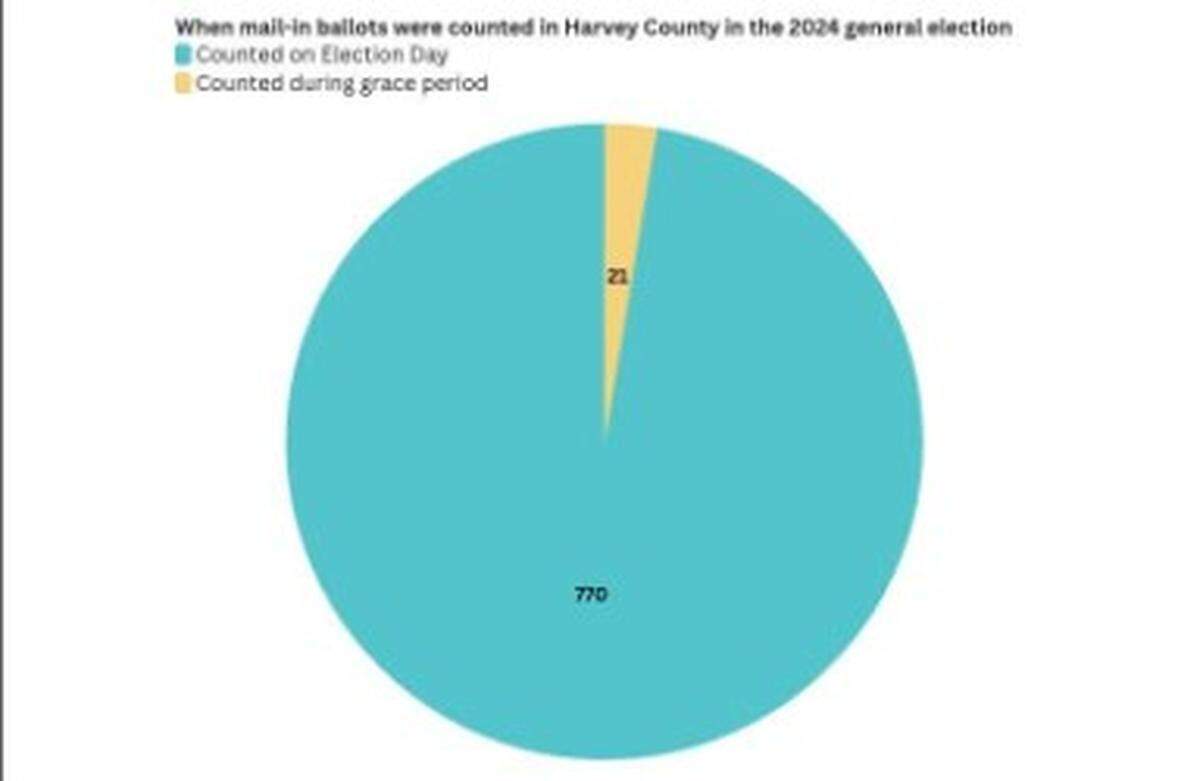
Harvey County Clerk Rick Piepho, elected in 2014, has overseen elections in the county seat of Newton for a decade and said even ballots mailed a week before an election have sometimes arrived too late to count. He cited an instance where two ballots from the same household —mailed the same day — arrived days apart.
“We’ve had stories of two people in the same household. We mail them both on the 20 days before the election. One of them gets it right away within a couple days, and the other one might be a week or more before it ever shows up,” Piepho said. “Even if you mailed it from Newton to Newton, that mail doesn’t stay in Newton. It goes to Wichita or Kansas City or some other sorting center.”
Harvey County, which sits north of Sedgwick County, has a population of 34,000.
Cille King, advocacy chair for the League of Women Voters of Kansas, says the fight over the mail ballot deadline isn’t new. She recalled standing behind the original 2017 proposal that created the three-day grace period — and still sees it as necessary. King testified against Senate Bill 4 in January, calling it a voter suppression bill.
“Our league testified for the bill to expand to the three-day grace period back in 2017. And we just feel like it’s important to be able to get a ballot mailed in. And we know the mail is slow and it’s not getting any faster. It’s getting slower,” King said. “We’ve supported the three-day grace period since its beginning.”
Like Piepho, King — who lives in Lawrence — emphasized how unpredictable ballot return times can be, even within city limits.
“Some of my mail comes in 11 days,” King said. “Coming or going from Lawrence to my place in Lawrence, it’s taken 11 days sometimes.”
More than 65 million Americans — about 43% of voters — cast their ballots by mail in 2020, the most in U.S. history, mostly driven by concerns over the pandemic. In 2024, that number fell to about 42 million.
Chris Krebs, a Trump appointee and the director of the Cybersecurity and Infrastructure Security Agency, was responsible for protecting the nation’s election systems in 2020. After the election, Krebs said that the 2020 contest was “the most secure in American history,” citing the use of paper ballots and post-election audits as key safeguards. Trump later fired Krebs.
Leading up to Election Day in 2020, Republican leaders falsely cast mail-in voting as vulnerable to fraud, sparking partisan backlash against a system long viewed as secure, Chaffin emphasized.
From 2018 through 2024, Kansas elections revealed no evidence of voter fraud, according to multiple court rulings and local investigations, mirroring national trends in both the 2020 and 2024 general elections, where no credible fraud claims emerged in any state
On March 25, the same day both chambers overrode Kelly’s veto of Senate Bill 4, President Trump issued an executive order, “Preserving and Protecting the Integrity of American Elections.’’ It mandates that all mail-in ballots must be received by Election Day to be counted.
Longer nights anticipated
Kelly cited concerns that the legislation would create confusion for election administrators, particularly at the local level.
“Implementing this will create confusion among county election officials, who will have to update policies and procedures on handling of mail ballots in a higher turnout election year.” Kelly added in her statement.
Ford County Clerk Debbie Cox, whose office oversees Dodge City, said the main change under the grace period elimination would be a minor shift in staffing. She noted that in the 2020 and 2024 presidential elections, no more than 10 mail-in ballots arrived during the grace period.
The only thing I may have to add [are] more board workers for the counting board on election night,” Cox said via email. “We are a small county when it comes to mailing out ballots. So, we don’t have that many that go out. Most all get back to us on election day whether they take them to the polls or in the drop box. That 10 [ballots] or less is the total that comes back in that three-day grace period.”
Tyler Kirby is a University of Kansas senior from Overland Park, studying journalism and political science.