
Kansas debates daylight saving time as local support for change builds

Kansas lawmakers are once again weighing whether to eliminate the biannual ritual of changing clocks — a debate that has percolated in Topeka for more than five years.
Senate Bill 1, introduced at the start of the 2025 legislative session, would exempt Kansas from observing daylight saving time and place the state permanently on standard time. The bill passed the Senate in February, 33–7, but didn’t advance in the House before adjournment. Lawmakers say they will revisit the bill.
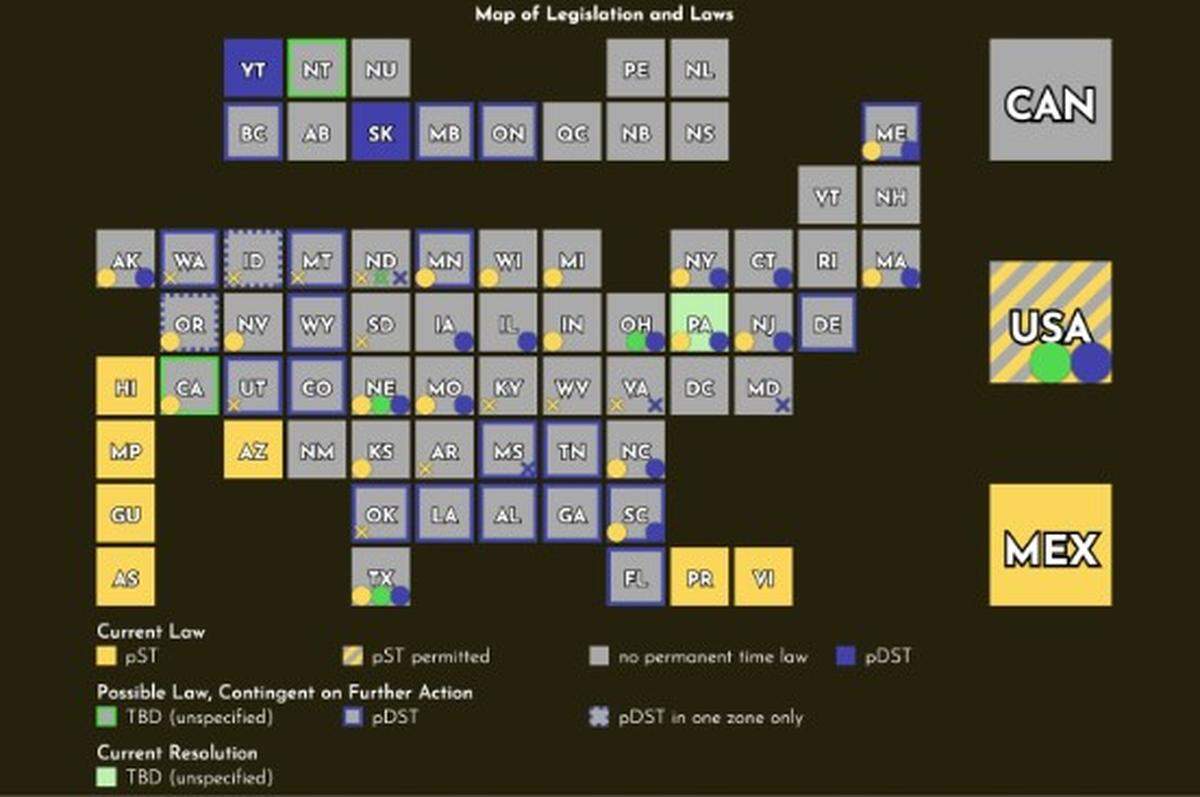
Kansas is not alone in revisiting its clock practices. According to national tracking, 20 states have enacted legislation or resolutions supporting a switch to permanent daylight-saving time, contingent on federal approval. Meanwhile, a smaller group of states — like Arizona and Hawaii — already observe permanent standard time. Most states, including Kansas, currently have no permanent time law in place.
As shown in a 2025 map of U.S. state actions, efforts vary: some states have passed laws ready to pull the legislative trigger if Congress allows permanent DST, while others have pending resolutions to study the issue further. Still, under federal law, no state can independently adopt permanent daylight- saving time without congressional approval.
Though some states have proposed staying on daylight-saving time year-round, federal law — specifically the Uniform Time Act of 1966 — prohibits states from making that change without congressional approval. Under current law, states are only allowed to stay permanently on standard time. States cannot independently adopt permanent daylight-saving time unless Congress passes a bill allowing it
Daylight saving time
Among the Kansans pulling for the shift is Brigid Gwidt, a senior on the University of Kansas women’s swim team. With practices starting as early as 6 a.m., she says the time change is more than an inconvenience — it disrupts everything from training to academics.
“We already have tight schedules, and losing an hour really messes with our sleep and recovery,” said Gwidt. “It takes days to adjust, and by the time you do, you’re behind on classwork or not performing well in the pool… A lot of us are up before the sun most of the year anyway. Keeping the clocks consistent would give us one less thing to deal with.”
Gwidt said some teammates get headaches or feel run-down after the switch, especially in the spring when clocks move forward in March and sleep schedules shrink overnight. The clocks then shift back again in November, creating a second disruption.
“Everyone thinks it’s just one hour, but for athletes balancing school and training, it throws off the whole routine,” she added. “I don’t know a single person on the team who looks forward to it.”

Jennifer Ankenbauer, who owns Kansas Crown Beer, Wine and Spirits in Lawrence, has a different angle — but similar concerns. Her store, like many others, depends on evening traffic, which can drop off sharply when it gets dark early.
“It’s simple — when it’s dark by 5:15, people don’t go out as much after work,” Ankenbauer said. “That affects restaurants, bars, and small shops like mine. Daylight means foot traffic.”
Still, the store owner said she supports the idea of staying on one time permanently — even if it’s standard time.
“I’d prefer daylight saving time year-round if we could get it,” she said. “But consistency is key. Staff schedules, deliveries, even customer habits — all of that gets disrupted when we change the clocks. It’s a headache for planning inventory and staffing,” she added. “And with how competitive retail is right now, losing even a few hours of busy time matters.”
Kansas law
Sen. Kenny Titus (R-Manhattan), who introduced SB 1, has said the goal isn’t to settle the daylight-vs-standard debate, but to end the disruptions that come with switching twice a year. The bill mirrors legislation introduced in more than 30 other states, many of which have passed resolutions urging Congress to allow permanent daylight-saving time.
A 2023 Gallup poll found that 55% of Americans support eliminating the twice-yearly clock change and sticking to one time year-round, while only 31% prefer keeping the current system.
“It’s not just a minor annoyance,” Titus said at the Committee on Federal and State Affairs Senate hearing on Jan. 23. “It affects health, safety, and productivity. We’ve studied this long enough — it’s time to act.”
Studies have shown that transitions in and out of daylight-saving time are associated with increased car accidents, workplace injuries, and spikes in heart attacks. Meanwhile, school officials and parents have expressed concern over kids commuting in the dark or struggling to adjust their sleep.
Though the bill stalled in the House this session, legislators are 6xpected to reintroduce it or continue studying the issue in a joint committee during the interim.
If it passes next year and is signed into law, the change would take effect in November 2026.
Until then, Kansans like Gwidt and Ankenbauer say they will continue adjusting their alarms and routines twice a year — hoping this is the last time.
“We don’t need perfect,” Ankenbauer said. “We just need consistent.”
Holden Rodgers is a University of Kansas senior from Arlington, Texas, studying journalism.