What went wrong in DC plane crash? KC pilot explains flying in dark, collision detection
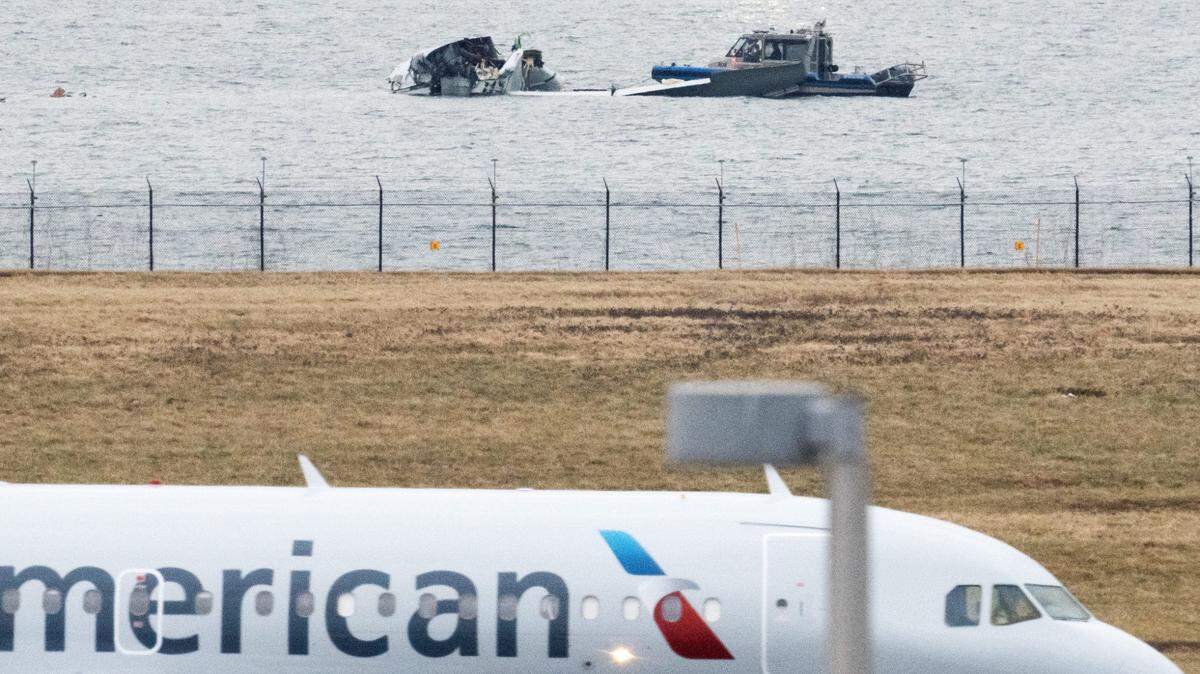
The National Transportation Safety Board is investigating the cause of the mid-air plane crash over Washington, D.C.’s Potomac River, which killed 67 people Jan. 29. A Kansas City aviation expert shares some of the factors that might have contributed.
James Rainen is an assistant chief flight instructor at ATD Pilot Training at Charles Wheeler airport.
What stood out to Rainen was that the military’s Black Hawk helicopter was at the altitude of American Airlines flight 5342 from Wichita. The military helicopter was approximately 325 feet above surface level at the time of the crash, in an area where helicopters are only supposed to fly up to 200 feet, according to the Associated Press.
He shared general information about how pilots prevent collisions, land planes and fly at night.
How do planes avoid each other in the sky?
Rainen said the best way for pilots to avoid collision is to be above or below another aircraft.
Commercial airplanes are required to have the traffic alert and collision avoidance system, called TCAS, which alerts pilots of other aircraft nearby and gives pilots urgent instructions to avoid collisions. However, TCAS is disabled at lower altitudes like near airports, because planes have to pass by each other in close proximity, because of the high traffic, as reported by outlets including CNN.
If the plane had been a higher altitude, Rainen described what it would be like for TCAS to alert him that another aircraft got too close to his small plane.
“There’s going to be a tile or an image that comes up on our display, and it’s going to go ‘alert’ in our headset. We’re going to hear ‘traffic, traffic!’ and again I would look at the display. It’s going to turn yellow and there’s a big image on there that says, ‘alert,’” Rainen says.
To monitor where other objects are located in the sky, pilots also use a device called an Automatic Dependent Surveillance–Broadcast, or ADS-B. The system, required in certain airspaces, uses GPS to tell where vehicles are in 3D space. A screen with an arrow shows where other planes are located and heading, and a number shows how high they are in relation to their plane.
USA Today reported that the military helicopter might not have had ADS-B, which would have made the Black Hawk less visible to the airliner.
How do pilots land a plane?
Rainen said professional pilots, like the ones involved in the collision, are consistent in their landing patterns.
“Picture a little kid sliding down a slide at a playground,” he said.
“They’re flying that same glide path or that slide, shall we say, time and time and time again, repeatable, no matter what airplane is doing it,” Rainen said.
He said that the tire marks on MCI runways are at the same spot, because airliner pilots are so consistent at landing at a 3 degree angle.
Pilots are assisted by colored lights on the runway that show if they are too high or low on the landing. They also communicate with the ground crews and other planes in the airspace.
How do pilots navigate in the dark?
When flying planes at night, pilots rely on instruments to determine how high they are flying and how fast they are moving.
Pilots are encouraged to turn on their landing lights when below 10,000 feet and within 10 miles of an airport, according to the FAA. These lights, on both wings and the tail, help pilots locate other planes.
Rainen mentioned that most mid-air collisions happen on bright sunny days, so the recent Washington D.C. crash is an outlier.
There are a number of optical illusions that pilots have to account for when flying at night, according to the Federal Aviation Administration’s airplane flying handbook.
The handbook recommends pilots experiencing spatial disorientation rely on their instruments over visual information and transfer control to another pilot, since two people rarely experience these illusions at the same time.
Runways are hard to spot from the air at night, especially in urban airports with many lights. The FAA says to look for a rotating beacon before a runway becomes visible.
People see better in their peripheral vision at night, leaving the center of the vision as a black hole. Some can also confuse the lights of a city with stars or vice versa, leading to something called a false horizon. Pilots can also think a stationary light is moving in the dark due to the phenomenon of autokinesis.