Kansas law will restrict access to adult websites. What does this mean for residents?

A Kansas law that will go into effect Thursday will ask online adult websites to verify the ages of each user who goes to their website within the state.
The Kansas Legislature passed Senate Bill 394 in April and it will go into effect in late June. The bill was approved when Kansas Gov. Laura Kelly let it become law without signing it.
Kansas follows more than a dozen other states like Idaho, Indiana, Kentucky, Texas and Utah, which all require adult websites to verify visitors are adults, despite privacy concerns and the broadness of the law.
In response, a few websites will opt to restrict access to visitors in these states.
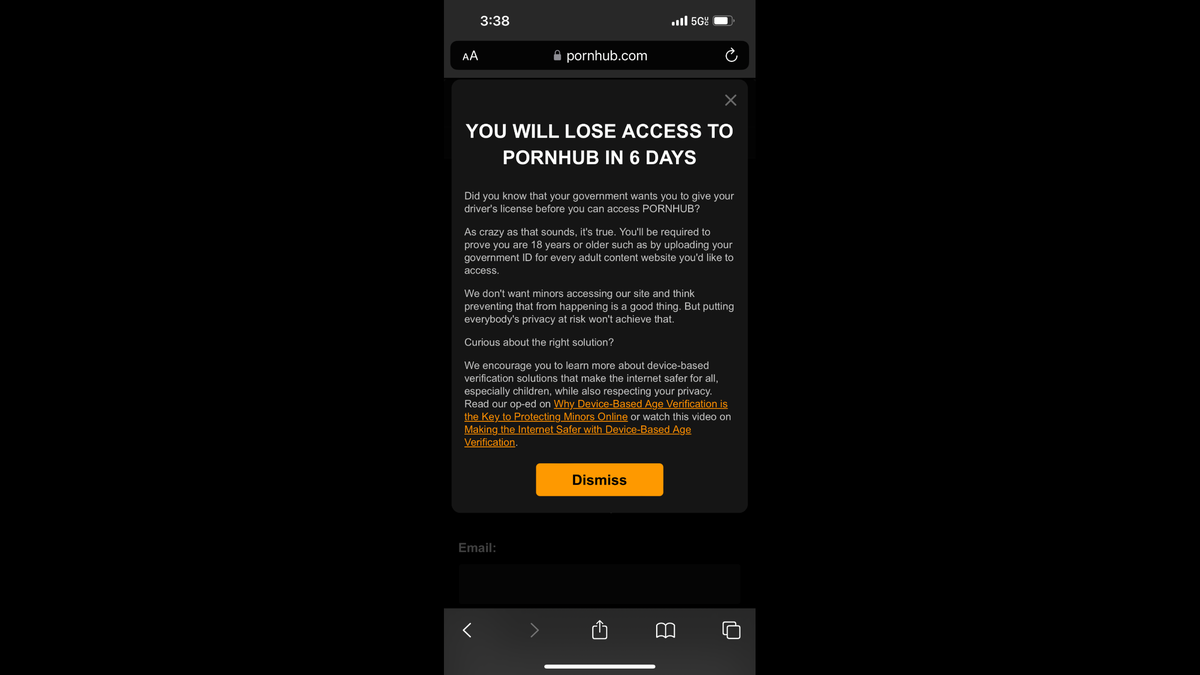
A message that appears to users visiting adult website Pornhub says residents in the state will lose access to the website June 27.
“Did you know that your government wants you to give your driver’s license before you can access Pornhub? As crazy as that sounds, it’s true. You’ll be required to prove you are 18 years or older such as by uploading your government ID for every adult content website you’d like to access.”
What websites will be defined as having content that is “harmful to minors”? How will the privacy of visitors be protected? Does it violate users’ free speech? Here’s what to know.
What websites are affected by the law?
Age verification would be required for websites where 25% or more of the content viewed by users each month is sexually explicit, according to the bill.
The bill says they will verify the ages of users through a “commercially available database that is regularly used by businesses or governmental entities for the purpose of age and identity verification,” or “any other commercially reasonable method of age and identity verification.”
Why is Pornhub cutting off Kansas?
Aylo, the media company that owns Pornhub and other adult websites, said it complied with the law passed in Louisiana in 2023 and as a result, traffic to Pornhub in the state dropped approximately 80%.
Aylo has cut off access to its websites in seven states: Arkansas, Montana, Mississippi, North Carolina, Texas, Utah and Virginia. It plans to do the same in Kansas over concerns with privacy around the new laws.
“Until a real solution is offered, we have made the difficult decision to completely disable access to our website in (these states),” the company said in a statement.
What is defined as ‘harmful to minors’?
The bill uses the phrase “harmful to minors,” which is also used in Kansas statute 21-6402. The statute prevents anyone who owns a business from promoting material that can harm minors.
The statute has legal definitions of what is considered harmful, which include “acts of masturbation, homosexuality, sexual intercourse or physical contact with a person’s clothed or unclothed genitals or pubic area or buttocks or with a human female’s breast.”
The new Kansas law makes it a violation if a website containing content that is “harmful to minors” fails to verify that a Kansas visitor is 18. The attorney general then could go to court seeking a fine of up to $10,000 for each violation.
Parents also could sue for damages of at least $50,000, according to the bill.
Are there any concerns about privacy with the bill?
While the bill says that websites or third parties that receive a user’s personal information when they verify the age can’t use it for any other purposes, some say that can be difficult to enforce.
Rep. Brandon Woodard, a Lenexa Democrat, told the Associated Press in April that opponents don’t understand “how technology works.” He said people could bypass an age-verification requirement by accessing pornography through the dark web or unregulated social media sites.
Aylo said that after Louisana passed its bill last year, people looked for other ways to access adult content and non-compliant sites or found other methods of evading the law.
“They just migrated to darker corners of the internet that don’t ask users to verify age, that don’t follow the law, that don’t take user safety seriously and that often don’t even moderate content,” Aylo said. “In practice, the laws have just made the internet more dangerous for adults and children.”
The company says states should use other methods to restrict minors’ access to adult content.
“We publicly supported age verification of users for years, but we believe that any law to this effect must preserve user safety and privacy, and must effectively protect children from accessing content intended for adults,” Aylo said.
Rep. Ken Collins, a Mulberry Republican, told the Associated Press that he feared the information used to verify a person’s age could fall into the hands of entities who could use it for fraudulent purposes.
Can there be issues with how the bill is interpreted?
Critics of the bill said it’s important to protect minors from age-restricted content and websites, but they shared concerns with how the bill would be interpreted.
Rep. John Carmichael, a Wichita Democrat who is an attorney, said he voted against the measure for many reasons. Most importantly, because the legislation is written so vaguely the standard for censorship is often subjective.
It’s uncertain what effects the bill could have on freedom of speech, he said in April.
“Because a statute defining what is harmful to minors is so subject to interpretation, I don’t think you’re ever going to find someone who can say with certainty what is allowed and what is forbidden,” Carmichael said. “You’ll find that one judge who says it’s allowed, another who says it’s forbidden and that it’s a crime, and another who would call it English literature.”
The law using the phrase “homosexuality” could also mean that the state can “require age verification to access LGBTQ content,” attorney Alejandra Caraballo said on Threads.
“Kansas residents may soon need their state IDs” to access material that simply “depicts LGBTQ people,” Caraballo said.
Brittany Jones, a lobbyist for the conservative Kansas Family Voice and a lawyer, said in April concerns about the bill censoring LGBTQ+ content are unrealistic.
“We all know what we’re talking about in this bill,” Jones said. “Everyone should be able to agree that children should not have access to sexual content. And if you read the bill, that’s all it says. They’re trying to make it into something that it’s not and has not been done in any other state it’s passed in.”
Rep. Rui Xu, a Westwood Democrat, asked lawmakers on the House floor whether the bill could censor a website listing the “top 10 most gay-friendly cities.”
He said this bill is just one in a series of bills written vaguely where Republican lawmakers did not fully consider the vast, unintended consequences that may follow.
“It’s broad and unclear what homosexuality means there,” Xu told The Star in April. “This would have been fairly uncontroversial legislation if we were to amend these outdated laws on the books. But no mind has been given to that.”
The Star’s Jenna Barackman contributed to this report