‘I am totally scared’: Black students dread return to Kansas State after racist tweet
Michaela Ross, a Kansas State University sophomore, went to her internship boss at Exxon Mobile last week and told him, “I’m scared to go back to school.”
She wanted him to know why she couldn’t concentrate on work. She was preoccupied checking in with schoolmates after a K-State student’s racially insensitive tweets about George Floyd offended students of color — and drew support from national white supremacist groups.
“I’m not scared to speak out. I’m scared of the unknown,” said Ross, a mechanical engineering student from Blue Springs. “I feel like the K-State environment is hostile and not welcoming to Black students. And our administration has not taken actionable measures against racist incidents that have happened there, and this is not the first one.”
Many students on social media and in conversations with The Star have expressed concern about returning to the campus for the fall semester, despite statements university officials have made about their willingness to address the problem.
In an unscientific student poll on Twitter, 124 of the approximately 700 Black students on the Manhattan campus responded to the question, “Do you feel safe on campus?” About 80% said no, they don’t.
Some incoming freshmen questioned their school choice given the many confessions about racism on campus that students tweeted under the hashtag #BlackAtKState. Others warned prospective students to choose a different school.
“I think the tensions are very high, and I don’t think that it is safe at all,” said Amaya Molinar, 19, who is from Wichita and studying biological systems engineering. “I definitely feel nervous. I have been called the N-word on campus. I feel like things like that will be more common in the fall given what has happened this summer, and I am totally scared.
“And the university knows that we are concerned because they have offered us counseling services. But we don’t want counseling. Instead of teaching us how to live with racism on campus they should focus their efforts on eliminating it.”
K-State’s list of actions
K-State has been in the headlines for more than a week since Jaden McNeil, a junior in political science and head of K-State’s controversial America First Students chapter, tweeted about Floyd, the 46-year-old Black man killed in May under the knee of a white police officer in Minneapolis, sparking protests across the country.
McNeil’s tweet — “Congratulations to George Floyd on being drug free for an entire month!” — drew immediate reaction. Many supported his right to free speech, but most denounced the tweet. K-State students, alumni and others called for him to be expelled. And some K-State athletes said they refused to be involved in any athletic activities on campus until McNeil was gone.
On Wednesday, K-State President Richard Myers announced the university would not expel McNeil, implying that to do so may violate McNeil’s First Amendment rights. “While these messages are disrespectful and abhorrent, we cannot violate the law,” Myers said.
Myers’ comments came with a list of actions the university would take instead, including improving the process for receiving complaints of discrimination, developing a social media policy for students, training for staff, scholarships for minority students, and recruiting and retaining more students and faculty of color.
K-State football players, who had initially said they would not play for the Wildcats until McNeil was gone from campus, last week announced that they are pleased with the way K-State leaders have reacted and that they will show up at voluntary workouts scheduled to resume July 13.
The athletic department announced it would institute its own policies to combat racism, including launching a fund to support diversity initiatives; mandatory diversity and inclusion training for student-athletes, coaches and staff; and promoting the Black Lives Matter movement at all home games.
But some non-athletes said they were not satisfied, saying the president’s plan sounds like promises they’ve heard before.
“We have been discussing need-based scholarships since before I was a freshman and that was 2016,” one student said on Twitter
“When I read the statement, it just seemed like it wasn’t doing anything,” said Sarah, a K-State junior who was too afraid of repercussions from groups that support McNeil to give her last name. She recalled her freshman year, walking to her dorm from work when a carload of white K-State students yelled at her, “You don’t belong here,” as they drove past. “I was scared. It was dark. I thought they were going to turn around and come back. I remember calling my mother that night in tears.“
Sarah, who is from Virginia, will do her fall semester online but expects to eventually return to campus.
“I thought about transferring because of all of this,” she said. “But I came to K-State because of the veterinarian medicine program. It’s too hard to start over. It is easier to stay than to transfer.”
Besides, she said, she wants to stay and push for change. “But it feels like we are fighting a battle we should not have to fight. When minority students who want to come to K-State ask what it is like on campus, I want to be able to tell them that it’s safe, that they care about us.”
When students tweeted last week that they have considered leaving K-State, university officials attempted to assure students their safety is a priority.
”We encourage any student who feels threatened to contact the Office of Student Life,” said Jeff Morris, university spokesman. “We have a wide array of resources to help them. We have been working closely with many of our students and student athletes who have been affected by recent events.”
On Monday, Charles Taber, K-State’s provost and executive vice president, added his own statement: “We hear and take seriously the concerns and ideas shared over the last several weeks by our students regarding how Kansas State University can do more and better in creating a more welcoming and inclusive campus, especially for our students of color.
“The university is moving forward with action steps announced last week and has built a webpage to publicly track progress. University leaders responsible for overseeing action step progress are currently being identified. … Student voices, along with our faculty and staff, will be critical in moving forward with these steps and ones that may be added as this important work evolves.”
Students’ list of demands
Students say they don’t believe the university can protect them, and they are worried. The university has been holding unity rallies every year since 2017, when a noose was found hanging from a tree on campus. The rallies aren’t enough, the students say.
A $6.3 million multicultural center is set to open next to the K-State student union this fall. The center was among the asks made by students of color to university officials in 2017. Last year, the student newspaper, The Collegian, published a letter from a K-State student denouncing the center as “state-sponsored segregation,” although the center has been promoted as open to students of all races and ethnicities.
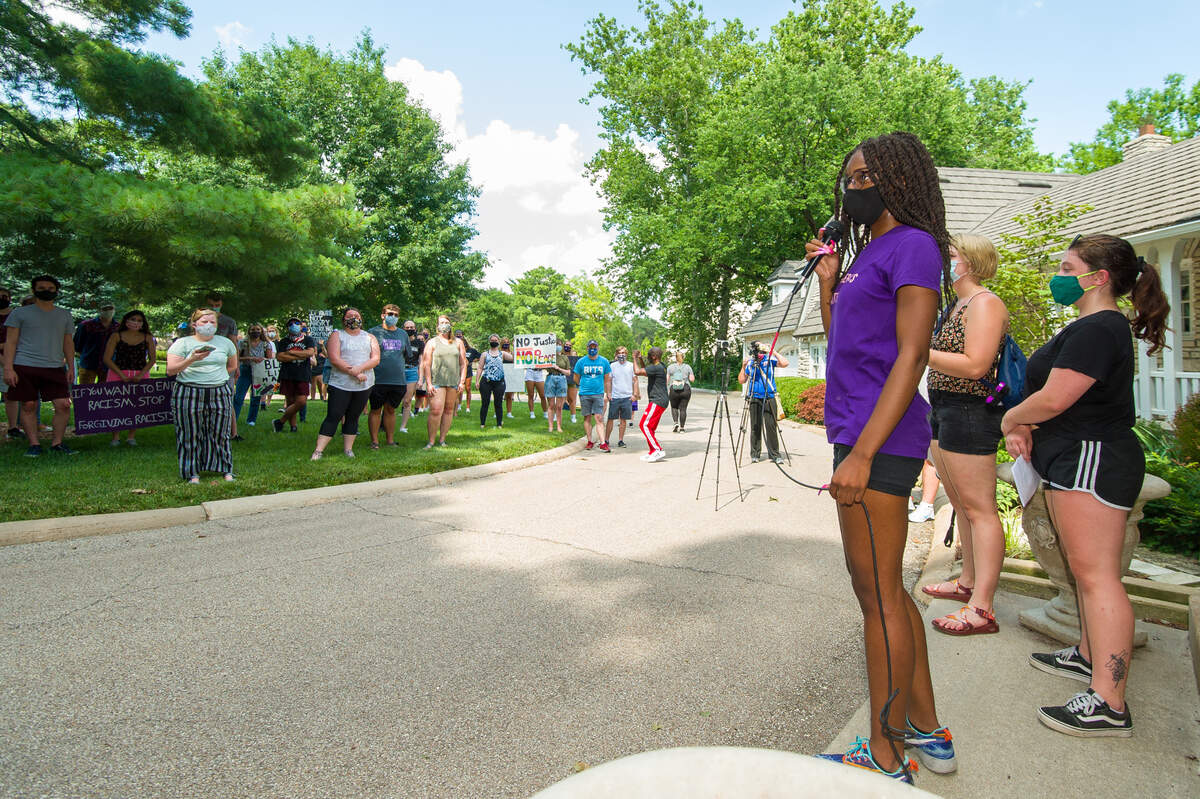
On July 4, students protested and marched for Black lives in Manhattan and announced a list of demands. They want all K-State students to be required to take courses on American ethnicities and on intercultural competency. They say the student code of ethics should provide for disciplinary action against students involved in racist behavior. They want the university to address “longstanding” problems with campus and Riley County police and their “racist treatment of Black students.”
Molinar of Wichita said she doesn’t want to sound hopeless. “But I have thought about leaving K-State. And even considered it. But at the end of the day I am at K-State because I am an engineering student, it’s a good school for that and I’m there to get my degree.”
Ayana Belk, a graduate of Kansas City’s Lincoln College Preparatory Academy, said she feels trapped at K-State because she’s a junior majoring in landscape architecture. “With that major, it’s not easy to just go somewhere else,” the 20-year-old said.
“I did let them know that I didn’t want to come back to K-State and that I did want to transfer,” Belk said. “But I’m going back because my program does very well coming out of K-State.”
Still, Belk said she is making plans this summer with friends for how they will stay safe on the campus. She plans to take as many classes as she can remotely. They will stay away from large groups, “because they might get violent. Students can carry guns on campus. And I feel like since nothing happened to Jaden that students are very emboldened. I think a lot of students are going to feel unsafe. My plan is to stay around people I trust.”
As for Michaela Ross, she knows her internship in Houston will soon end and she’ll be returning to K-State, “hoping for bold changes. Specifically for a zero-tolerance policy on racist remarks, racist acts, racism of any kind.”
Ross, who is biracial, said she has no expectation that the university will eliminate racism on campus. “There will always be fiery arrows of racism, and I’m not afraid of those arrows as long as we are not being sent into battle without protection. What we need is a shield and that shield would be a policy.”
“I want to stay and fight,” she said. “But if the university is not willing to give us a shield. I will go. I will consider finding a shield elsewhere.”
This story was originally published July 6, 2020 at 3:12 PM.