Andrew Bailey wins Republican race for Missouri attorney general, defeating challenger
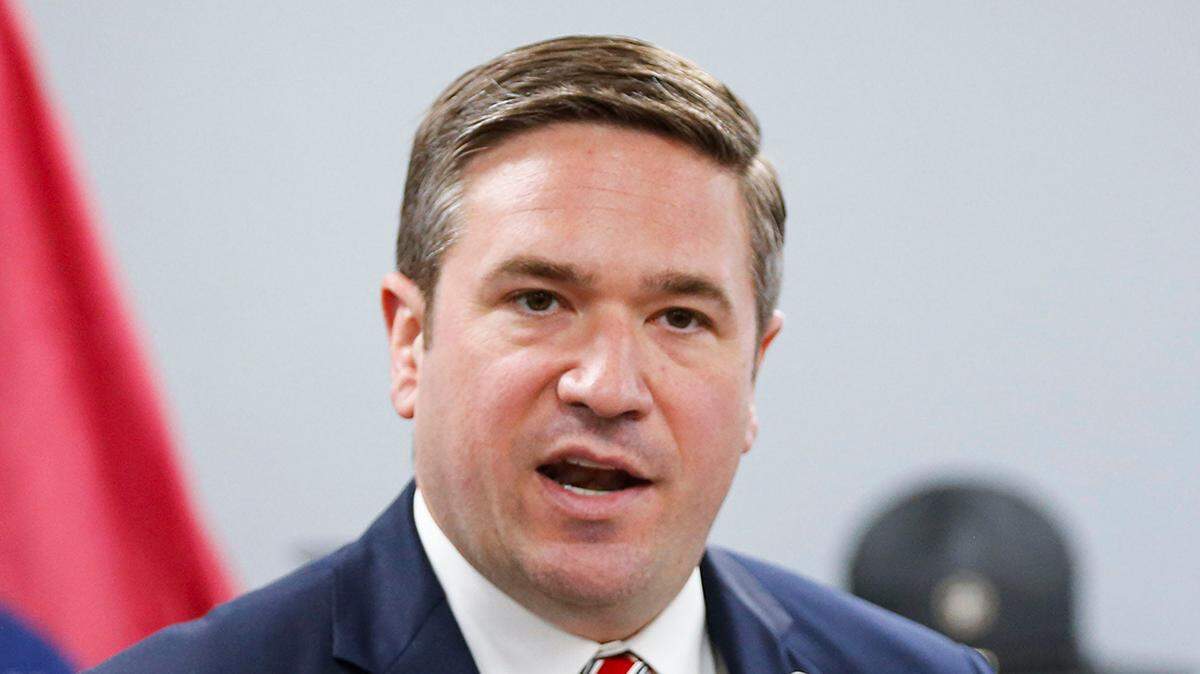
Missouri Attorney General Andrew Bailey won the Republican primary for the office on Tuesday, fending off an aggressive challenger in a nasty battle that pitted two candidates with virtually identical politics against each other.
Bailey, a former lawyer for Gov. Mike Parson, who appointed him to the office less than two years ago, stands on the edge of winning a full, four-year term. Over the course of a bitter campaign, Bailey and his opponent, Will Scharf, went to ever-further lengths to demonstrate their support for former President Donald Trump as the GOP presidential nominee is criminally prosecuted.
Scharf conceded the race at a watch party in St. Louis. Bailey had more than 60% of the vote to Scharf’s 37.5%, with approximately 14% of votes counted, according to the Associated Press.
Bailey will face Democrat Elad Gross in the November general election. Gross, a civil rights attorney from St. Louis, ran unopposed in the Democratic primary. Democrats last won the Missouri Attorney General’s Office in 2012.
“This victory is for the hardworking Missourians who have fought tirelessly alongside me over the past 18 months. Your dedication and passion have been the driving force behind this incredible triumph. Together, we WILL keep Missouri strong, safe, and free,” Bailey said in a statement.
Bailey and Scharf, who serves as a member of Trump’s legal team, shared extremely similar positions on policy. The tone of their campaigns were also remarkably similar, with both men casting themselves as delivering law and order against conservatism’s perceived opponents – liberals, migrants and transgender residents.
At the same time, Bailey and Scharf – and the political action committees supporting them – painted each other as ineffectual and soft on crime. Bailey was cast as coddling criminals, while Scharf was attacked over his upbringing by affluent parents in New York.
As of late July, Scharf’s campaign had taken in the most cash – 1.7 million to Bailey’s 1.2 million, according to reports filed with the Missouri Ethics Commission. But those figures don’t count the additional millions raised and spent by PACs supporting both candidates.
“You’ve got two candidates with virtually zero policy difference between them and virtually zero stylistic difference between them and you’ve got one who’s got the benefit of incumbency – albeit appointed incumbency – and one who’s got the benefit of a massive war chest,” said John Hancock, a former chair of the Missouri Republican Party. “So it’s fascinating to look at, at that level.”
The Republican contest underscored the ways in which state attorney general offices across the country have been transformed over the past two decades into instruments to battle the federal government and wage political and cultural battles. Traditional functions – such as consumer protection, anti-fraud work and defending criminal convictions in appeals courts – still happen but are frequently no longer front and center.
For his part, Gross promises to lean into the core components of the positions.
“We need a major change in that office. We need somebody who knows how to be the attorney general of Missouri,” Gross said at a candidate forum this summer.
Scharf’s loss marked a stunning setback for the first-time candidate, who had hoped to break into electoral politics by taking down a sitting attorney general. Scharf heavily promoted that he was a member of Trump’s legal team.
“Tonight we came up short,” Scharf said in a statement. “We always knew that challenging an incumbent and the Jefferson City establishment would be difficult, and despite the tremendous grassroots energy around our campaign Andrew Bailey has certainly earned a full term in office. He has my unqualified support in the general election, and I hope that he will do Missouri proud in the coming years.
Scharf worked on the U.S. Supreme Court case that resulted in a landmark decision in July that former presidents enjoy presumptive immunity from criminal prosecution for official acts taken in office. But Trump didn’t fully repay the loyalty in return. The former president endorsed both Scharf and Bailey last week – a split decision that was widely seen in Missouri Republican circles as benefiting Bailey at Scharf’s expense.
Already in office, Bailey proposed few new initiatives or ideas if elected to a full term. Rather, he appeared to mostly promise a continuation of the way he’s currently using the office as a vehicle to sue the federal government and influence the behavior of local officials through lawsuits and threatening letters.
Bailey sued Washington University over its transgender center at St. Louis Children’s Hospital. Last year, he attempted to use a consumer protection law to restrict gender-affirming care for both adults and kids. A judge temporarily blocked the restrictions, but Bailey withdrew the rule before a final ruling in the case.
As recently as Friday, Bailey said his office had launched an investigation into a fitness center in St. Louis County over allegations the business was allowing “a biological male to use women and girls’ private spaces,” his office said.
Bailey also filed numerous lawsuits against the Biden administration and was especially aggressive in opposing efforts by President Joe BIden to forgive student loan debt. The U.S. Supreme Court last year blocked a major debt cancellation plan, citing harm to Missouri.
The attorney general, who took office in January 2023 after Eric Schmitt resigned after winning election to the U.S. Senate, has also sought to block the release of wrongfully convicted prisoners. Last month, Bailey obtained a court decision temporarily delaying the release of Christopher Dunn, who was wrongly convicted of murder in the 90s; Dunn was released a week later.
Bailey also attempted to reverse the conviction of Eric DeValkenaere, a former Kansas City police detective who shot and killed a Black man in 2019 and was convicted of manslaughter. Jackson County Prosecutor Jean Peters Baker previously called his actions “extremely distressing” and “disappointing.”
Earlier this year, the Missouri Supreme Court denied Bailey’s application to review DeValkenaere’s case.
The Star’s Kacen Bayless contributed reporting
This story was originally published August 6, 2024 at 8:41 PM.