Is Johnson County tough enough on fentanyl? Opponent says Howe should charge more cases
As Johnson County sees a surging number of fentanyl-related deaths — nearly triple the number of homicides over the last several years — how to address the crisis has become a major point of debate in the district attorney’s primary race.
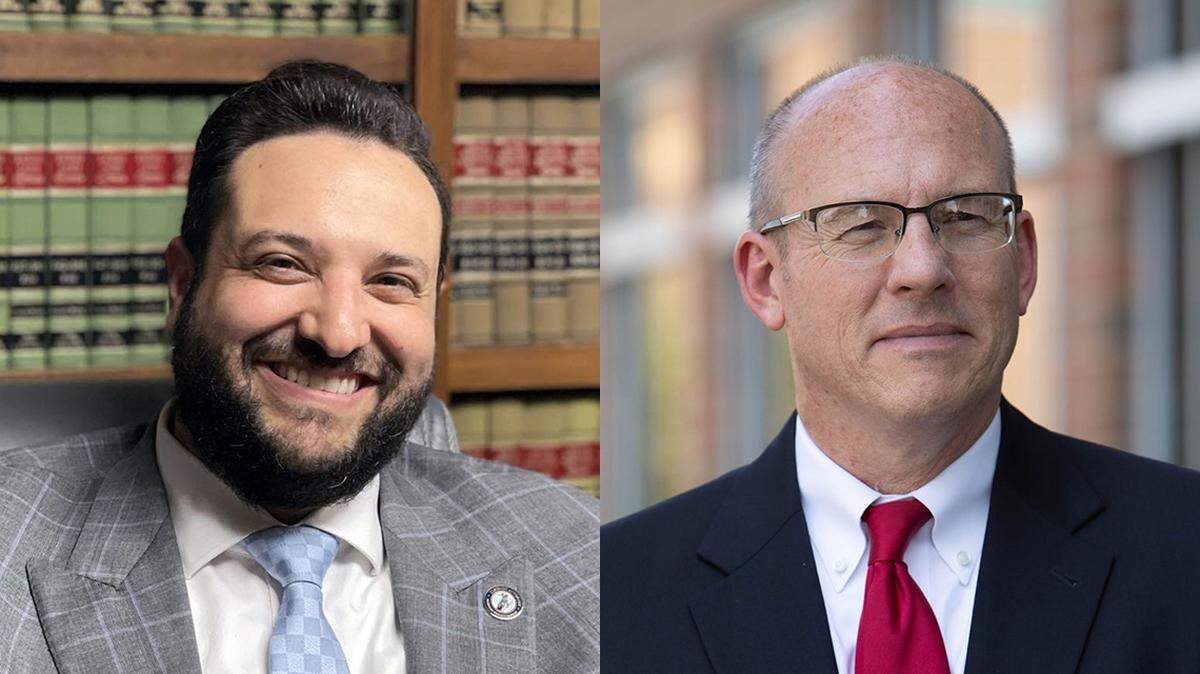
Johnson County District Attorney Steve Howe, facing his first Republican primary challenge since taking office 16 years ago, argues his office is a leader in the state on prosecuting fentanyl distribution and fatal overdose cases. But his opponent, David Greenwald, who was recently promoted to deputy district attorney in Douglas County, says a more aggressive approach is needed.
Greenwald argues that Johnson County should be seeing more charges in such cases, as the county, officials say, has recorded 170 deaths related to the synthetic opioid in the past four years.
“I charge those because in my mind, they’re homicides,” said Greenwald, who has led the Douglas County DA’s drug unit for the past few years. “If my option is to do nothing, or my option is to do something — and maybe we need to plead it out and it’s not a 40-year prison sentence, but it’s something — that’s justice.”
Douglas County has taken a hard stance on fentanyl. And Johnson County has been ahead of others in the Kansas City metro in prosecuting fentanyl-related cases. Howe, who is seeking his fifth term, argued his office has prioritized bringing the uniquely challenging cases to court.
“There have been four jury trials in the state of Kansas on fentanyl overdose cases. We’ve tried three of them. We have a trial going on right now,” Howe said. “I’m proud of the work we do. We don’t shy away from those difficult cases. And I think our reputation and our history indicates that.”
Greenwald, 37, is an Overland Park native who previously worked in the Wyandotte County District Attorney’s Office, and from 2019 to 2021 worked in the Johnson County DA’s Office specializing in traffic crash cases and fatalities. He joined Douglas County as a senior assistant district attorney in 2021.
Howe began his career as a prosecutor in 1988. He worked his way up the ranks in the Johnson County District Attorney’s Office before he was among eight attorneys who were fired amid sweeping administrative changes shortly after former district attorney Phill Kline took over the office in 2007. Howe ran in 2008 and defeated Kline in the Republican primary before winning the general election against Democrat Rick Guinn.
Howe on Aug. 6 now faces the most competition for his seat since he was first elected. In addition to his Republican primary challenge, two Democrats hope to advance to the November election: Vanessa Riebli, who spent 21 years in the Johnson County DA’s Office, and Zach Thomas, a criminal defense attorney who sought to unseat Howe in 2020, but lost with 48% of the vote.
Early voting has started in Johnson County, allowing registered voters to cast ballots in person until Aug. 5, except on Sundays. On Aug. 6, polls will be open from 7 a.m. to 7 p.m.
Fentanyl front and center
The Republican primary race has largely been focused on how the district attorney should address the rise in fentanyl-related deaths in Johnson County, as the metro has been ravaged by the highly addictive, extremely potent drug.
An investigation by The Star last year showed there were 149 fentanyl-related deaths in Johnson County from 2018 through 2022, which was close to triple the number of homicides during that time. And that number has continued to soar.
The Star found only a small fraction of those overdose death cases have made it on the prosecutor’s desk for possible charges.
Law enforcement officials say the cases are among their most difficult to investigate, requiring police to track down one deadly pill, when it was bought and who sold it. Howe said Johnson County police departments have referred 17 cases to his office in the past five years. His office has charged eight so far.
“And we had not only the three that went to trial, but another person plead. So we are resolving those cases and they are getting time in the penitentiary, significant time,” Howe said.
Earlier this month, for example, Howe’s office announced that Diego Alessandro Gomez-Rodriguez was sentenced to more than 8 years for two counts of distribution of fentanyl, in a case where investigators found more than 1,600 pills.
In May, the Johnson County DA’s office announced Cameron B. Bryant, of Grandview, was sentenced to more than 11 years for the 2021 fentanyl death of Olivia Piotrowski, a Shawnee Mission East senior. He had pleaded guilty to distribution of a controlled substance causing death.
That same month, a different high profile case went the other way. A Johnson County jury found Aaron Hansberry not guilty of distribution of a controlled substance causing death. Hansberry was charged in connection to the death of 16-year-old Cooper Davis, of Shawnee, who took a pill that his family said he didn’t know contained fentanyl. His case garnered national attention.
A federal law was named in honor of the teen, the Cooper Davis Act, which requires communication service providers, including apps like Snapchat, to work more closely with federal authorities who need data to fight illegal drug sales.
After the decision, Cooper’s family said in a statement to KSHB, “We hope that this experience will help equip the DA’s office with tools to be successful in future cases that can bring justice to other families.”
Howe feels his office has been a leader in the state in going after such cases, which he said is proven by taking more cases to trial than any other county in Kansas. He said he’s also shown leadership on the issue by testifying in front of the state Legislature to push for harsher penalties for fentanyl-related crimes and to make publicly available naloxone, often known by its brand name Narcan, which can reverse the effects of an overdose.
But Greenwald argues that more should be done.
He said in Douglas County, he has charged 15 defendants in 20 fatal overdose cases, in a county where he says the Lawrence Police Department has been proactive in investigating fatal overdoses. The Star’s report last year showed his office had yet to take a case to trial, and instead secured guilty pleas with prison sentences.
“I take a very aggressive stance on charging because it’s a homicide,” Greenwald said. “These aren’t cases where you delay charging because maybe one day you’ll find new evidence and it’ll get better.”
His current office is led by Douglas County District Attorney Suzanne Valdez, whose brother died from fentanyl, which the family learned was likely found in a pain pill, she previously told The Star.
Both Howe and Greenwald agree that fentanyl-related cases are especially tricky, with a major hurdle being when multiple drugs, not just fentanyl, are found in a victim’s system.
“My opponent wants to say, ‘You should do more cases.’ The problem with that is of the 170 overdose cases we’ve had over the last four years, 108 of those had multiple drugs on board,” Howe said. “And our medical examiner has made it clear, if there are multiple drugs on board, she cannot definitively say the cause of death was fentanyl. That eliminates a big percentage of those cases.
“If my medical examiner can’t say the cause of death is this pill that killed you, that kind of nullifies our ability to go forward with that case,” he said.
Greenwald argued, “I think that there’s ways you can get creative. And if you have to let the defense call the Johnson County coroner as a defense expert, so be it.
“If a coroner wants to say we can’t definitively say it was fentanyl that killed them, maybe it was asthma or whatever other complication, I will put that to a jury every single time. We know that person took something. We all know how lethal it is. You decide what killed them,” Greenwald said.
‘Multi-faceted approach’
Greenwald also criticizes Howe for being slower to embrace the implementation of a drug court, which was launched in Johnson County last year for defendants charged with lower level crimes such as drug possession to receive supervision and substance abuse treatment as an alternative to incarceration.
He said Johnson County was behind many other municipalities in launching the program, as well as a similar behavioral health court, which also began last year for defendants in need of mental health care. Johnson County judges were instrumental in starting the specialized treatment courts and securing funding for them.
Johnson County already had a veterans treatment court, which was started in 2016.
Greenwald has pointed to a debate during the last election in 2020, where Thomas — running against Howe for the first time — advocated for the start of a substance abuse treatment court.
Howe said during the debate, hosted by Kansas City PBS: “There’s a jurisdiction that has a drug court, it’s called Jackson County. Has that reduced crime, reduced violence? No. Drug courts aren’t some magic elixir that’s going to solve all the world’s ails. Should we dedicate resources to help those struggling with substance abuse? Absolutely.”
Howe now says the treatment courts are playing a role in his office’s “multi-faceted approach” to handling drug cases.
But Greenwald criticizes Howe for not pushing for the programs sooner, saying that he is a “huge believer in them.”
“One of the aspects of fighting the drug epidemic is getting people sober,” Greenwald said. “It’s about combating the addiction. Getting people sober reduces the property crime rate, the violent crime rate, drug crime rate. It reduces the burden on the public health system. Reduces the burden on social services. And so standing in opposition to that has been a detriment to helping save people’s lives, but also reduce the overall crime rate here.”
Howe said that he believes treatment court programs are “one component of the solution,” but stands by the idea that they “are not going to solve the problem alone.” He said other substance abuse programs that existed in Johnson County before the treatment courts are also making a difference.
“Yes, it can be helpful. But in drug court we’re only handling 20 to 30 cases at a time. We have hundreds of drug cases,” Howe said. “But it can be a component of it. And when the courts finally had the resources, and we got district court judges wanting to implement that, I said, ‘Sure, I’ll be involved in that process.’ It can be helpful in some high-risk cases. I went to the training for it myself.”
Howe said, “Just because I’ve been a prosecutor for some time doesn’t mean I’m not willing to look at different ways to go about doing our work.”
But Greenwald argues it’s one example of the office needing a fresh perspective.
“I have relevant experience in the courtroom on modern trial techniques, seeing what the next thing is to continually improve and expand our skills,” Greenwald said. “… That’s experience from being an active prosecutor now, and not a figurehead. What I bring to the table is somebody who is actively involved in a number of different types of cases, with a broad knowledge on multiple types of cases.”
Howe countered that he has remained closely involved in his office’s high profile cases, and argued that his experience leading the large district attorney’s office can’t be matched.
“I was a supervisor for nearly a decade before I became district attorney. This is the largest DA’s office in the state. We have 42 lawyers, 128 employees, a $15 million budget, in the biggest county in the state,” Howe said. “To me, experience, which (Greenwald) doesn’t have, as well as just leadership experience is critically, critically important.”
This story was originally published July 26, 2024 at 6:00 AM.