National conservative PAC backed 7 Johnson County school candidates. Almost all won
Update: As vote count continues, one Olathe school board seat flips to moderate candidate. The race, and another in Blue Valley, is too close to call. Story here.
A New York-based political action committee, aimed at abolishing critical race theory, campaigned on behalf of seven Johnson County school board candidates. In Tuesday’s election, five of them were in the lead.
After months of tense debates over COVID-19 policies and diversity initiatives, Johnson County saw a groundswell of newcomers running for local school boards. Conservative candidates campaigned on “parent choice,” opposing mask mandates and wanting a stronger say in what curriculum is taught in class.
And national hot-button issues, such as the teaching of critical race theory — even though it is not taught in Kansas K-12 schools, according to the Kansas state school board — drew PAC endorsements, donations and support from new sources, such as energized parent Facebook groups.
The 1776 Project PAC has been targeting local school board races with the goal of “abolishing critical race theory,” or CRT, a college and law school-level framework for evaluating the impact of racism on key institutions. There is no evidence that it is being taught in Kansas K-12 schools.
Two races remain too close to call.
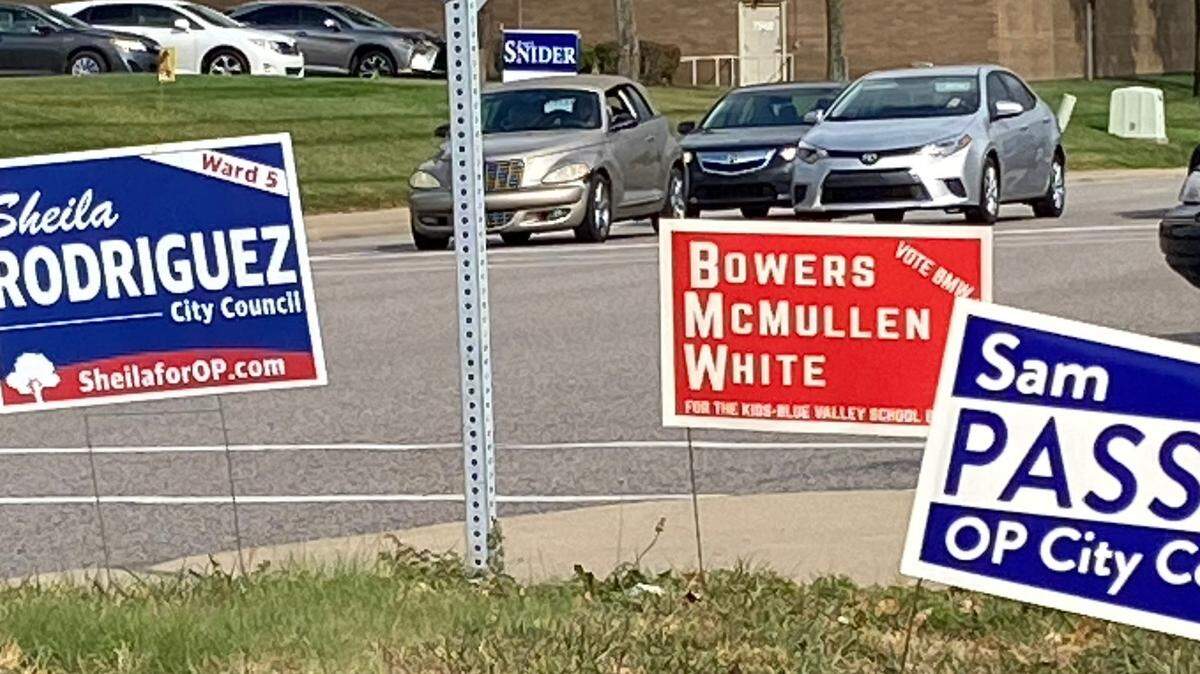
In Blue Valley, the PAC endorsed Jim McMullen, Christine White and Kaety Bowers. Only White, a pediatrician, lost her race on Tuesday, but she had already dropped out and had said she would not serve if elected. But McMullen’s race is not yet decided, with him leading by 165 votes on Tuesday.
In Olathe, it endorsed newcomers Jennifer Gilmore, Brian Connell and Robert Kuhn. All three appeared to win their races, although Gilmore’s contest was extremely close and not yet called. On Tuesday, Gilmore had 50% of the vote, ahead of Julie Steele, with 49.9%. The candidates were separated by only 32 votes.
In a statement, Steele said that she “recognizes that this race is entirely too close to call and she looks forward to participating in the democratic process of ensuring that every vote is counted, including those that are still in ballot boxes and the mail, as well as any provisional ballots that have been cast and have not yet been processed.”
Kansas law allows mail ballots postmarked on Election Day to be counted through Friday, which could change the results of closer races. Final results will be certified after the canvass next week.
And in Shawnee Mission, the PAC endorsed Brian Neilson, but he lost to at-large incumbent Heather Ousley, the board president.
In a tweet, the PAC claimed it “supported 58 candidates in 29 school districts.” It raised $437,881 this year, according to Federal Election Commission filings.
Locally, it launched a text messaging campaign, urging Johnson County residents to vote for the conservative candidates.
There has not yet been evidence of the PAC donating to individual local candidates’ campaigns. School board candidates have until Dec. 2 to submit campaign finance reports.
The Kansas Board of Education in July issued a statement calling CRT an “advanced and complex concept” that is often misunderstood and not a part of the state’s education standards. Scholars who study it say it is not a specific curriculum or ideology but a lens for examining how institutional racism and inequality impact criminal justice, law, health care, housing and other institutions.
CRT has now become a catch-all term for schools’ teachings on race, diversity and equity and the target of parents and conservative politicians who say the concept itself perpetuates racism and division.
BEHIND THE STORY
MOREThe Bigger Picture: Critical Race Theory
Until recently, critical race theory was a body of advanced study discussed primarily in law schools beginning in the 1970s.
Developed by a group of Black legal scholars led by Harvard’s Derrick Bell and Kimberle Crenshaw, critical race theory is a response to what they perceived as the failure of the 1960s civil rights movement to bring about the kind of structural change it promised. CRT examines how racism and white supremacy remain embedded in essential institutions such as education, criminal justice, real estate and finance.
Nothing approaching the complexity of critical race theory is taught in most public elementary or secondary schools. Over the last couple of years, however, a network of conservative think tanks, activists and wealthy donors have seized on CRT and depicted it as an attempt by liberal educators to indoctrinate schoolchildren in an ideology of hatred for the U.S.
CRT has evolved into an umbrella term to denounce any attempt by schools to introduce more context to the uglier chapters of American history, such as slavery, Jim Crow and the treatment of Indigenous people. This distortion has spawned dozens of bills in state legislatures to eliminate an essentially nonexistent threat.
Some of the candidates who won on Tuesday said that while their districts might not be teaching critical race theory, they worry it has seeped into diversity and equity programs. Others said districts need to be more transparent when it comes to diversity work.
Others argue that diversity, equity and inclusion initiatives are unrelated to CRT, and important in schools in order to ensure all students feel welcome and safe — especially as Johnson County’s demographics continue to shift. Some moderate candidates in this race emphasized the need to hire a more diverse staff, so that administrators and teachers better represent the student population.
The 1776 Project PAC is the first national political action committee to target local, nonpartisan school boards, according to Axios. Ryan Girdusky, a political consultant, conservative writer and supporter for former president Donald Trump, is behind the PAC.
According to its website, the PAC claims that supporters of critical race theory hold views that are, “incredibly hostile to white people, Western civilization, classical liberalism, the enlightenment, the founding of America, and capitalism.”
Concern over the concept has been a major conservative talking point in recent months. Kansas Attorney General Derek Schmidt pledged this summer to reject any teaching of critical race theory in schools if he’s elected governor. Several Kansas lawmakers have indicated plans to introduce legislation banning what they view as critical race theory from Kansas classrooms.
And last week, in testimony to a committee evaluating mental health in Kansas, Rep. Kristey Williams, an Augusta Republican, urged the panel to consider whether critical race theory was leading young white students to have mental health issues and feel shame unnecessarily.
This story was originally published November 3, 2021 at 12:16 PM.