Johnson County Republican known to ‘infuriate everyone’ is invisible for this campaign
Usually a sleepy race, the Kansas Board of Education election has woken up this year, as districts look to the state for guidance on the COVID-19 pandemic.
Some observers believe the board is getting more attention than it has in decades. But it is almost hard to tell with one candidate in Johnson County, Republican Benjamin Hodge, who has failed to show up to campaign, debate or explain his platform, in person or online.
Even some fellow Republicans worry he would take a similar approach if elected — pointing to his record of missing dozens of votes while serving as a state representative in 2007 and 2008.
And Stephanie Sharp, a former Republican state representative who sat next to Hodge while serving in the Capitol, argued that when he did show up, it was often to be disruptive.
“He was certainly a more conservative Republican, but he found ways to infuriate everyone. He was sort of an equal opportunity agitator,” said Sharp, who is now a political consultant. “I don’t think Ben has an interest in K-12 education. He has an interest in being disruptive. There are very few people like that in politics, who are truly disruptive to be disruptive. But he is like that.”
Hodge, a serial candidate for public office over the years, did not return multiple emails and calls requesting an interview.
His opponent, Democrat Melanie Haas, is a technology executive and entrepreneur who has never run for office but is actively campaigning for the open school board seat. District 2 includes the Shawnee Mission, Blue Valley, De Soto and Olathe school districts, as well as the Turner district in Wyandotte County.
The seat was left vacant by Steve Roberts, who is stepping down after an unsuccessful GOP primary campaign for U.S. Senate.
A Shawnee Mission parent, Haas has been the only candidate to attend debates and forums or respond to interview requests. And she hasn’t been afraid to take jabs at Hodge for his invisible campaign.
“He has left a lot of people with open-ended questions. And I’m very concerned because a lot of people in Johnson County might typically vote straight Republican on the ballot, and I think that’s what Ben Hodge is banking on,” Haas said. “So I’ve let voters know that I’m concerned they will vote for him, then he won’t show up for them. He didn’t show up for them when he was in the House. And he won’t show up for them in this position.”
A stark division
The state school board election has been one to watch as voters grapple with whether to send their children back to classrooms. And new awareness of the board’s role came after it rejected Gov. Laura Kelly’s order delaying the start of school until after Labor Day in a 5-5 vote, two weeks before the primary.
The board’s tie vote — which ultimately left it up to districts to decide when to start the school year — was among the most controversial and high-profile decisions it has made in recent years. And it was a first for the panel, as a new state law requires the governor to seek the board’s permission before closing schools.
Five of the board’s 10 seats are up for election this year, but just two, including the Johnson County seat, are contested. Republican incumbent Kathy Busch, who represents Wichita, is facing Democratic challenger Betty Arnold. Three other board members — Deena Horst, Ann Mah and Jim McNiece — are running unopposed.
Mark Tallman, with the Kansas Association of School Boards, said the state board of education hasn’t received this level of attention since the debates over teaching evolution two decades ago. While Republicans have usually held the majority on the board, which oversees the Kansas State Department of Education, Tallman said there has traditionally been a division among moderates, Democrats and conservatives.
“There have typically been real splits between the more moderate — what I would call supporters of traditional public education — and those who are more skeptical and conservative, and in some ways more willing to challenge the status quo,” he said.
The board, with Republicans holding an 8-2 majority, has been more “united” in recent years, Tallman said. The tie vote this summer showed a rare and stark division. Opponents of Kelly’s order argued that decisions should be left up to local districts. Supporters countered that the virus is affecting the entire state and does not respect city or county borders.
Three of the four board members running for re-election supported Kelly’s order. They included Mah, who represents Topeka and parts of northeast Kansas; McNiece, who represents parts of south-central Kansas, and Busch. Horst was the only one up for reelection who voted no.
Overall, the state board of education is generally tasked with adopting regulations and setting accreditation standards. But as the country reconciles with the impacts of COVID-19 on the public education system, leaders will likely continue to wrestle with the near-sacrosanct value of local control versus state mandates.
The state board approved reopening and safety guidelines for districts before the school year began. And it carved out a vision for districts to offer more individualized learning plans for students, as some learn online and some learn in person, or a mixture of the two, often at their own pace.
But state leaders also will have to determine how much authority the state school board should have in these areas, Tallman said. It’s a decision that could have lasting impacts.
“None of the work the state board has done has been telling local school boards what to do. They have only given guidance to districts,” Tallman said. “If you want a more statewide response, that could be seen as a bad thing. If you like what your own district decided, that could be a good thing.”
“But there are some real questions around who has the authority to order schools to close or open. Or what alternatives can be provided. These are all questions we’ve never confronted before.”
.jpg "BeFunky-collage (1).jpg")
New representative for Johnson County
Roberts, who held the District 2 seat since 2013, voted against Kelly’s order delaying the start of school.
Tallman said Roberts was a frequent dissenter, often voting differently than the rest of the board. And he wonders if Hodge would be a similar outlier.
“I’ve heard nothing about his race for state board. But I remember when he was in the Legislature. He was quite conservative and kind of an iconoclast,” Tallman said. “I anticipate he would bring a more critical eye and be skeptical of institutions. What that would mean for the board, I don’t know.”
It is difficult to know where Hodge stands on public education policy issues, since he has not been actively campaigning, in person or online. His campaign website has not been updated since his unsuccessful 2016 run for Johnson County Board of Commissioners.
But Haas made it clear, in an interview, that she would have voted differently than Roberts and would have approved Kelly’s order.
“I still believe the school districts needed those extra weeks to get ready. And teachers were very afraid to go back so soon,” she said. “I didn’t feel like that decision was about education. It became more about the politicization of each individual’s perspective on the governor. And that was really frustrating to me.”
Haas has two daughters in the Shawnee Mission district, and said she got more involved in politics after watching the local school board make policy decisions. An entrepreneur, Haas previously ran her own small business and continues to do technical consulting in the Kansas City area.
Her tech background is what furthered her interest in public education, she said, after the Shawnee Mission district launched an initiative to equip every student with a laptop or iPad. Especially now with many students learning online during the pandemic, she believes her expertise will come in handy, whether the state board is discussing broadband access or recommending software for virtual classes.
“I believe the state board needs to have someone that is understanding of the technology component of every policy decision we make,” Haas said. “In the past, when they made a decision, that component wasn’t there. And now kids are learning online all day long. We need a focus on technology, and then go beyond that and understand that just because a child has a device, does not mean they have a clear individualized learning plan.”
Haas argues that her opponent does not have the same passion that she does for the job.
In addition to serving one year as a state representative, Hodge was a Johnson County Community College Board of Trustees member, from 2005 to 2009. And he has unsuccessfully ran for office many times over the years.
According to his website, Hodge has a bachelor’s degree in journalism from Kansas State University and a master’s degree in business administration from the University of Missouri-Kansas City. He has written for some right-leaning and conservative publications.
His campaign website describes him as an “economic conservative” and though it makes no mention of his current bid for a state school board seat, it states, “Let’s put children and parents first in education.”
In the past, he has posted on social media and written about education, often pushing for school choice, or for funding to go toward charter schools or students’ tuition at private schools. In a 2011 column in The Monitor, he wrote that, “It’s time to change K-12 education. It’s time to move to school choice — either tax deductions for private education or school vouchers.”
On Facebook in 2018, he argued that private schools were quickly growing because it is “increasingly difficult to find public school leaders who use reason and logic to make decisions.”
Johnson County Republican Party Chairman Fabian Shepard said that while the party is supporting Hodge on its website, he has yet to speak with him during the campaign.
“I’m communicating with all of our other candidates as regularly as I can,” he said. “I don’t have as much information from Ben Hodge as I do from other people. I am not concerned, personally, because I’m not part of his campaign.”
“I would tell you this. I haven’t communicated with the president of the United States and he’s a Republican. So I’m not going to talk with every candidate. But this county party is hopeful for all of our Republican candidates.”
Hodge won the endorsement of Kansans for Life, a political action committee pushing for anti-abortion policies, according to its website. Haas has received endorsements from the Kansas National Education Association, Stand Up Blue Valley, Education First Shawnee Mission and the political action committee of the Mainstream Coalition.
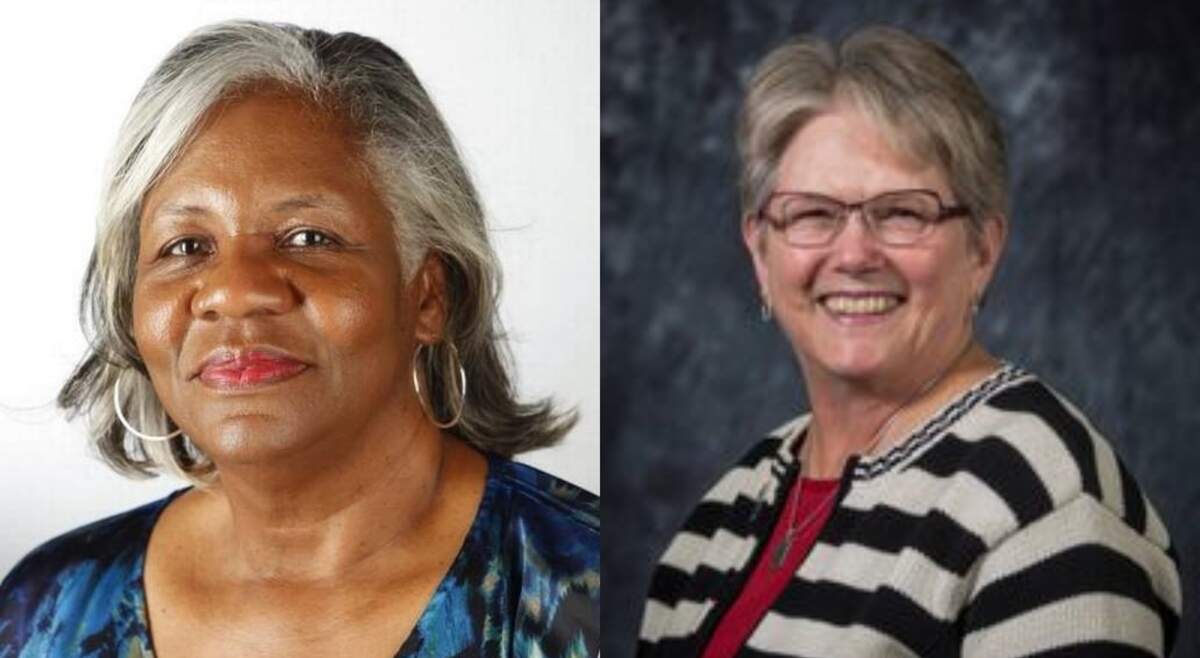
Race in Wichita
Unlike in the Johnson County race, both opponents for the District 8 seat in the Wichita area have extensive backgrounds in public education.
Busch is completing her second term on the state board of education and currently serves as chair. For years, Busch, a Republican, worked as a teacher and building administrator in Kansas, including as assistant superintendent of middle schools for the Wichita school district.
She was among those who voted to delay the start of school, wanting to give teachers and districts more time to plan for the fall semester.
Her Democratic opponent, Arnold, served for 10 years on the Wichita school board. She said she was motivated to run for the state board after realizing the toll the COVID-19 pandemic was taking on the public school system.
“The way that things were being addressed caused me a little bit of concern. I felt like we weren’t really providing, as a state, the solutions or guidance that districts need to navigate this,” Arnold said. “This is an opportunity to re-imagine and redesign the delivery system for education. For years, we have seen very little changes or progress in the way we educate students.”
Arnold also would have delayed the start of school until after Labor Day. But she argued that the state education department and school board should have given districts even more guidance and time to prepare for the school year.
“What have we truly done to ensure the safety of everyone? And what have we gained so far? We’ve gained an exhausted group of educators. We’ve gained teachers who are getting this virus more. We’ve gained students who are exposed,” she said. “What can you pinpoint and show that this has been successful?”
Busch counters that leaders pulled off a herculean task in a short amount of time to ensure that districts had clear recommendations to follow when opening classrooms. And she said that the state’s guidance has been continually updated and discussed by the board.
“In November, we will look at other things we can do to try to help during this tough time. In Johnson County, for example, a lot of folks are still remote, so we need to reevaluate how we can support districts and teachers and address their needs,” she said.
She also touted other steps the board has taken during the pandemic, including earlier this month, agreeing to extend the accreditation cycle for school districts to offer them more time. And Busch argued that since she joined the board, she has helped the state redesign its school system and move toward a new approach of evaluating success for high school graduates.
Under the redesign program, districts create an individual plan of study for all middle and high school students. The road maps would help students align career interests with coursework and plan for two years beyond high school graduation.
Both candidates offer similar views on the future of public education in the state, including a focus on providing each student with a personalized plan for how to reach their career goals after graduation. And both argue that teachers should be given more support during the pandemic.
“They are two different people from two different parties, but there aren’t big issues separating them,” Tallman said.
He argued that having two contested seats this election cycle is not likely to drastically change the direction of the board. But he expects the coronavirus, and the state’s response to controlling it in schools, will keep the spotlight on the board for months or years to come.
“We know that when schools were not open, there were a lot of frustrated parents, understandably. But we also know the board is hearing from a lot of concerned parents and staff that did not want to open too fast,” Tallman said. “So with these races, it will be interesting to see where the public is at on these issues and who they support.”
This story was originally published October 29, 2020 at 12:12 PM.