
Despite pledge, dangerous buildings still stand in Kansas City
Wearing a hard hat and safety vest, Kansas City Mayor Sly James grabbed the controls of the idling yellow excavator and smashed a dilapidated house at 44th and Brooklyn into a pile of dust and splinters.
That photo op from two Septembers ago kicked off what James promised would be an aggressive campaign to erase the backlog on the city’s demolition list.
“Over the next 24 months, the council and I want to see those thousand dangerous buildings gone,” James said.
It was welcome news for inner-city residents, frustrated that the city had left some houses for years after they’d been condemned.
But now with that 24-month deadline fast approaching, city officials concede they are only halfway to meeting their goal.
“We set a high goal for ourselves with regard to our demolition program and, while we didn’t reach it,” James said Thursday, “we have certainly made an impact in our neighborhoods.”
Clearly, razing 500 decaying buildings is a lot of blight removal in two years — James points out that the city previously had been averaging a little more than 100 demolitions annually. But thanks to the rise in the number of abandoned houses because of foreclosures, the city’s demolition effort hasn’t been able to keep pace.
The demo list has now grown to 1,340 structures. And with each house demolition costing the taxpayers nearly $10,000 on average, the city will never catch up at this rate given the current $1.6 million that is set aside annually for that purpose.
“There’s no way,” said Dalena Taylor, head of the city’s demolitions program, “unless we received $8 to $10 million, could we tear down every blighted building in the city.”
City officials say three factors made it impossible to tear down 1,000 boarded-up buildings the last two years.
First, fewer tax dollars than expected came in to fund the program. Then the pace slowed when some neighborhoods objected to tearing down houses they felt were salvageable. And finally, a good thing: Some houses got a reprieve when the threat of imminent demolition prompted some property owners to take steps toward fixing up properties they’d neglected for years.
“When it started, we were just going to knock them all down,” said City Manager Troy Schulte. But since then, Schulte said, the city’s demolition effort has taken on “a more nuanced approach.”
That said, he agrees the job is going to take an infusion of tax dollars if the city is ever to catch up.
“We’re going to keep at it,” he said.
As the population of Kansas City’s urban core dwindled in recent decades, the number of abandoned houses and commercial buildings grew accordingly.
The thousands of vacant lots bear witness to the city’s successful efforts to remove the resulting blight. But since the early 1990s at least, City Hall has had trouble keeping up with the number of damaged or neglected buildings that need to be torn down.
As always, a lack of money got the blame.
Like the city’s snow removal budget that was so often shortchanged, too little was set aside for tearing down neighborhood eyesores. But although emergency funds could always be found to clear the streets in snowy winters, buildings on the demo list were allowed to pile up and rot.
Then in 2012, James and his council colleagues vowed to change that as they embarked on a renewed effort to reverse the exodus from the inner city through blight removal.
Their plan was to spend whatever it took to cross off most if not all the addresses on the demolition list as quickly as possibly.
“To everybody it was a no-brainer,” said Councilwoman Cindy Circo. “We get these complaints all the time from people who say, ‘You just let these buildings stay standing.’”
Ridding neighborhoods of blight would stabilize neighbors’ property values, curb crime and deter illegal dumping, all while opening the way for new investment.
But city leaders’ good intention soon ran into stubborn reality.
Problem No. 1: “The money is not coming in at the rate they thought it would,” Circo said.
The month before James climbed on that excavator, voters had just passed a new half-cent sales tax for parks and streets. One side benefit of that was increased revenue from the corresponding use tax that businesses pay on large purchases from out-of-state vendors.
The tax was expected to raise an additional $3 million a year, at least a third of which was earmarked for demolitions that first year.
“This is just the first step,” Schulte said at the time, promising to adequately fund the demolition program for the next three to five years.
That first extra million gave the program a boost in early 2013.
But when other priorities such as adequately funding pensions arose and the new revenue stream didn’t bring in as much money as expected, the city’s commitment to fully funding the demolition program suffered.
“When this was being announced, the budget was in better shape,” said John Wood, director of neighborhood and housing services.
Also slowing the pace of demolitions was growing resistance to what more than one neighborhood leader saw as the city’s “indiscriminate tear-down policy.”
Schulte said plans to demolish a few dozen East Side houses were put on hold for a year when residents near the new East Patrol police station asked for time to find ways to save them.
Elsewhere, neighborhood groups insisted on setting their own priorities for which houses should be torn down and which saved for possible rehabbing.
In Manheim Park, for instance, that meant that only about half of the two dozen houses on the list were demolished, said neighborhood association leader Seft Hunter.
Three or four more still need to be taken down, said Hunter, president of the Historic Manheim Park Association. But the hope is that others can be fixed up as people are attracted to an area that is revitalized because of the redevelopment around the former Bancroft School. The neighborhood is east of Troost and south of 39th Street.
“We’re at the place where we don’t have a lot of properties we want taken down,” he said.
The city plans to raze 120 buildings this year. Where possible, the property owner will be billed for the cost. But all too often, the owners have died, can’t be found or the houses now technically belong to the taxpayers.
Given its limited funds for demolition, the city has tried to be more strategic. Rather than tearing down the worst properties on the list, wherever they may be in the city, specific neighborhoods are designated to achieve maximum impact.
This year, it’s Marlborough’s turn.
“It’s about time,” said Brenda Thomas, president of the Marlborough Neighborhood Coalition. She’s not sure how many houses will be torn down in the targeted area south of 79th Street and east of Troost Avenue, but each one will be a blessing.
“You have people who’ve lived here 25 years and have a nice home and have taken care of it,” she said, “and right across the street is some absolute crap.”
Clemmie Richardson knows the feeling.
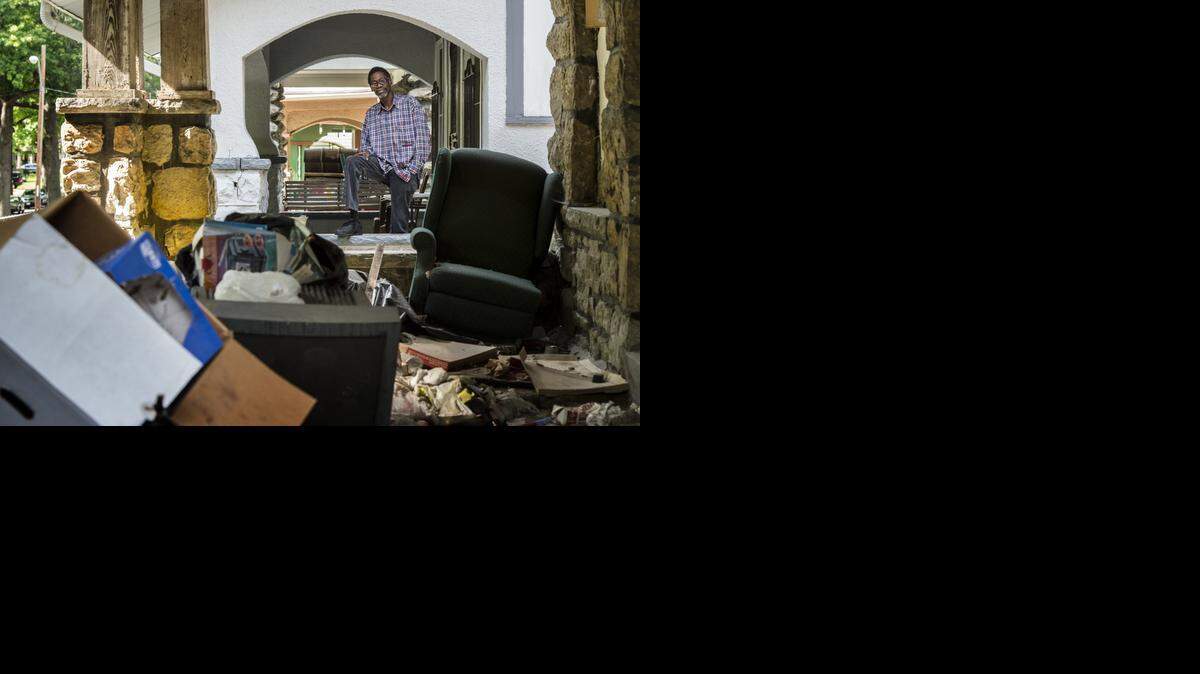
For a quarter century, he’s taken care of his bungalow, and right next door is a boarded-up house that’s been vacant since a 2007 fire gutted it. Branches are piled at the curb, while a half-dozen bags of garbage, an old TV and a broken-down chair clutter the front porch.
“It’s horrible,” Richardson said. “It makes my house look bad.”
Unfortunately for Richardson, that charred wreck is in the 4200 block of South Benton Avenue, five miles north of this year’s target area. Which means that, unless it’s in danger of imminent collapse — and that’s not likely — there is almost no chance the city will be tearing it down anytime soon, demo chief Taylor said.
However, there is one slim bit of hope for Richardson and others like him. That wreck on South Benton is owned by the Land Bank of Kansas City.
Although the Land Bank has almost no money in its budget for demolitions this year, Schulte has proposed that the year-old city agency borrow $1.2 million to start tearing down buildings that can’t be salvaged.
Of the 1,000-plus vacant houses owned by the Land Bank, about 140 fit the bill, said executive director Ted Anderson.
“We’ve got plenty of structures,” he said, “with gang graffiti on them, with failing roofs that need to come down.”
To reach Mike Hendricks, call 816-234-4738 or send email to mhendricks@kcstar.com.
This story was originally published July 24, 2014 at 11:29 PM.