
UMKC snuffing out smoking on campus
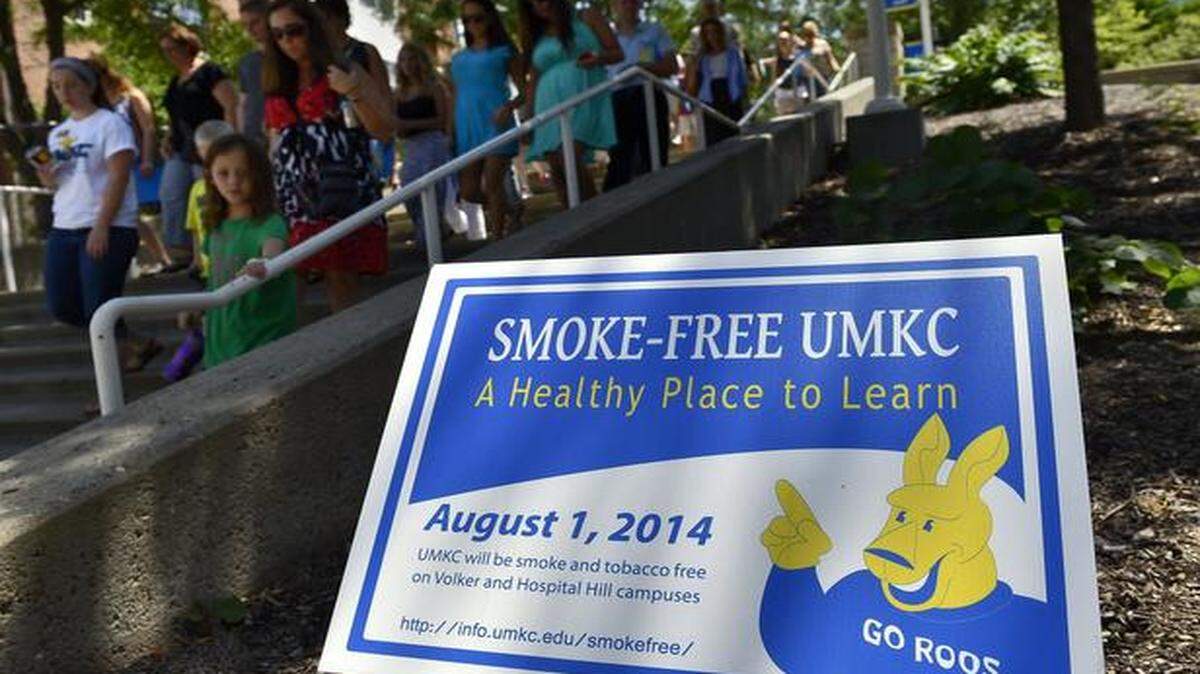
For five years, Chris Fasl, a University of Missouri-Kansas City graduate student, spent a few minutes each day standing outside some campus hall, puffing on a cigarette.
He quit last month after being a smoker for 15 of his 33 years.
Just in time. Starting Aug. 1, UMKC is going completely smoke-free.
No smoking on university-owned or leased property. Not indoors, not outdoors, not even on the sidewalks on any of the UMKC campuses.
Plan on escaping to your car for a quick smoke break? Better roll those windows up tight, because any smoke drifting out of a vehicle on campus is a violation.
Clearing the air, UMKC officials call it.
“Is that just for a semester, or forever?” business student Yang Qing, a freshman from China, asked as he walked across campus blowing smoke rings above his head.
Forever, they say.
Qing, 20, sighed. “I guess I will be OK. I will have to smoke in my (off-campus) apartment.”
The university imposed a basic smoking ban in all campus facilities last summer. This year, with the support of student government, it’s expanding that policy.
University officials said the new policy was prompted by the growing use of e-cigarettes inside campus buildings, a campus commitment to promoting health and fitness, and complaints about smokers congregating outside building entrances.
“There literally were places where people had to walk through a haze of smoke to get into a building,” said Robert Simmons, associate vice chancellor at UMKC.
According to a university survey, 14 percent of students and 7.9 percent of faculty smoke. A majority of students, faculty and staff said they wanted a smoke- and tobacco-free campus, Simmons said.
UMKC is not alone in moving to eliminate the use of all tobacco products on campus. Such efforts got a lift when the U.S. Department of Health and Human Services created the Tobacco-Free College Campus Initiative in 2012.
Americans for Nonsmokers’ Rights said in a report this month that at least 1,372 U.S. colleges and universities have adopted a 100 percent smoke-free policy across their entire campuses, including residences.
That report said that 938 schools are 100 percent tobacco-free — with a prohibition against chewing tobacco and hookah use, too. And 176 of those schools, including the University of Missouri in Columbia, the University of Central Missouri and soon UMKC, also prohibit e-cigarettes.
“We expect this number to continue to climb rapidly as a result of the growing social norm supporting smoke-free environments, and support from within the academic community for such policies for campus health and well-being,” said Cynthia Hallett, executive director of Americans for Nonsmokers’ Rights, an anti-smoking advocacy group.
Colleges and universities, she said, are “catching up with the smoke-free trend.”
The University of Kansas, Kansas State University and Rockhurst University prohibit smoking near building entrances. Avila University’s policy prohibits smoking indoors and at outdoor facilities, except garages.
For schools going tobacco-free, the tricky part is how those policies are presented and enforced, said Ty Patterson, who launched one of the nation’s first smoke- and tobacco-free campus campaigns more than a decade ago at Ozarks Technical Community College in Springfield.
Now director of the National Center for Tobacco Policy, Patterson said he is working with the University of Kansas to help administrators there move to a smoke- and tobacco-free campus.
One key, he said, is to start preparing the campus community a year ahead of the policy change. Also, don’t focus entirely on the health consequences of tobacco use, but remind smokers that refraining on campus is a matter of courtesy.
Tobacco users know the health risks and may resent authority figures telling them what they can and cannot do, Patterson said. But most people don’t want to be considered rude.
On its UMKC Smoke-Free website, the university makes it clear its policy does not require smokers to quit. But the site directs smokers to resources that help with cravings and with quitting if they choose.
No penalties for violating the policy are listed. “We are calling this a good citizen policy,” Simmons said.
That means UMKC expects people to adhere to the policy because it’s the rule. Besides, Simmons said, the university can’t afford to hire more campus police officers to chase down smokers.
Some see that as a problem.
“You can’t just ... expect it to just go on autopilot,” said Fasl, who wears a half-pack-a-day smoking cessation patch to help him stay the course. He quit after a family member was diagnosed with a smoking-related illness.
His friends still smoke, he said, and “they are pretty cynical about whether the university effort will succeed. People might say, ‘I’m going to light up and smoke until I get a ticket.’”
But university administrators aren’t worried.
“Evidence shows that these good citizen policies are successful,” Simmons said. “That’s not to say there won’t be some grumpy people.”
To reach Mará Rose Williams, call 816-234-4419 or send email to mdwilliams@kcstar.com.