
Kansas lawmakers negotiate deal to close the state’s budget gap
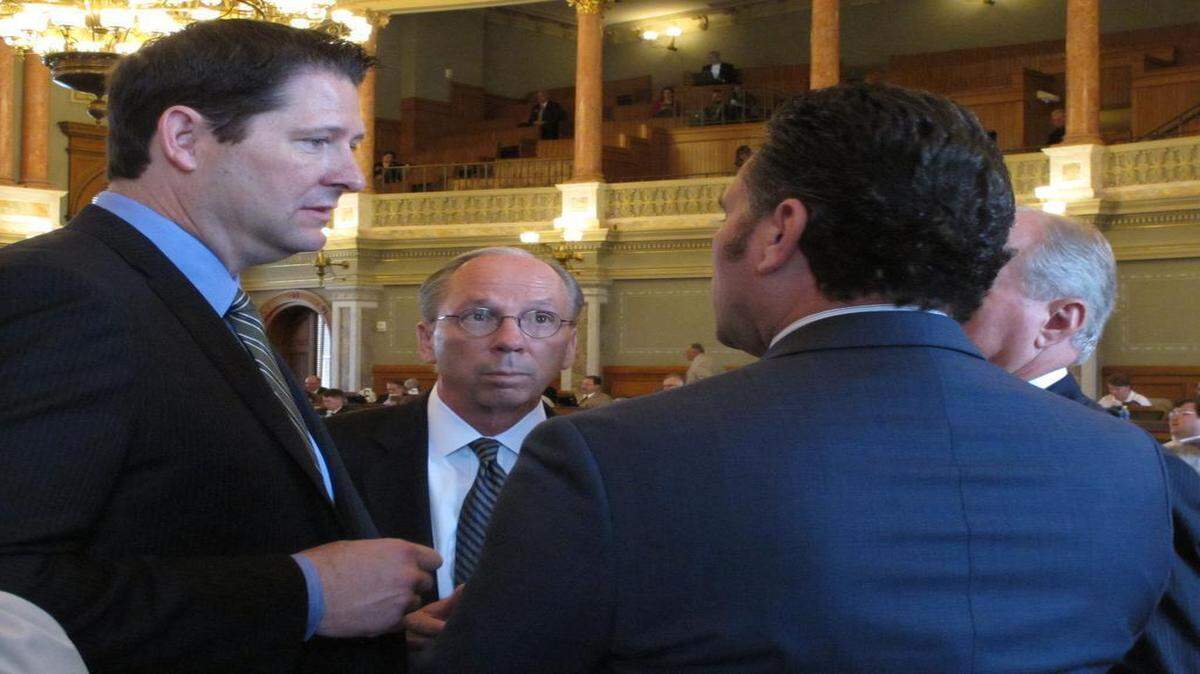
House and Senate negotiators struck a deal Saturday to address the state’s $290 million budget shortfall, but the plan would hand off additional budget-cutting work to Gov. Sam Brownback.
The bill would delay a $99 million payment to the state’s pension fund until fiscal year 2018, and it would shield K-12 public schools from spending reductions.
The House had expected to debate the budget bill late Saturday night, but plans changed near midnight to put off debate until Sunday afternoon.
House Majority Leader Gene Vickrey, a Louisburg Republican, said that the Senate had decided to adjourn and so it made sense for the House to do the same.
Lawmakers were hoping to complete the budget work and adjourn the 2016 session this weekend. Compared to the protracted turmoil of the 2015 session, that would be quite an achievement.
Last year’s session ended in June after 114 days, the longest in Kansas history, and was marked by bitter debates over tax policy in the GOP-dominated Legislature.
The 2016 session was in its 72nd day on Saturday.
Senate President Susan Wagle, a Wichita Republican, acknowledged that the Saturday-into-Sunday debate could drag on.
“It may take several budgets before we get there,” she said.
Late Saturday evening, Eileen Hawley, Brownback’s spokeswoman, said the governor had reviewed the bill and “believes it is something he can sign.”
To address the $290 million shortfall, Brownback said earlier he would take $185 million from the state highway fund, delaying 25 new road projects, and cut spending to state universities by about $17 million.
It was unclear the amount of additional cutting that will be needed. Those cuts will be up to the governor, but the plan includes a provision that prohibits spending reductions to K-12 public schools.
“We’ve been very consistent when we passed the block grant that we want stable and secure funding for our schools in unsecure times,” said Rep. Ron Ryckman Jr., an Olathe Republican and House Appropriations Committee chairman.
Mark Tallman with the Kansas Association of School Boards said the K-12 provision was a good sign.
“I think it will give districts some comfort,” he said.
To make up the delayed pension payment, the state would designate any revenue that comes in above the state’s revenue estimates for that purpose. It also could use funds from the state’s tobacco settlement, but only that part of the payment above the amount appropriated to early childhood programs.
Delaying a payment to the pension program, the Kansas Public Employees Retirement System, does not affect current retirees’ benefits, budget officials said. But critics have warned that delayed and missed payments could harm the financial health of the system.
“It’s incredibly irresponsible,” said Rebecca Proctor, executive director of the Kansas Organization of State Employees. “Putting it off just means you’re going to owe more later.”
Proctor also objected to lawmakers leaving additional cuts up to the governor.
“I understand it’s an election year, but I think it’s really important that legislators do the job they were elected to do,” she said.
The Brownback administration said it has significantly increased the state’s payments to the retirement system. The average annual general fund contribution from 2012 to 2015 during Brownback’s administration was $388 million. It was $181 million a year from 2001 to 2010, officials said.
Rep. Kathy Wolfe Moore, a Kansas City, Kan., Democrat who is on the Appropriations Committee, said she opposed the KPERS payment delay.
“I can’t believe we are holding on to this terrible tax plan on the one hand and doing this to KPERS on the other,” she said, a reference to the 2012 income tax cuts many blame for the state’s repeated budget shortfalls.
The pension payment delay was one of three options Brownback recommended to the Legislature for filling the $290 million budget hole. The others were selling future payments from the tobacco settlement for a one-time infusion of $158 million and an across-the-board spending cut of 3 to 5 percent, including to K-12 public schools.
On Monday, Standard & Poor’s Rating Services warned it could downgrade Kansas’ AA bond rating in the next 90 days if the state fails to better align ongoing revenues and spending. One-time budget fixes, such as the KPERS payment delay, don’t solve the “structural imbalance” of the state budget, an S&P analyst said.
The Legislature’s adjournment means it won’t be around when the state Supreme Court makes a crucial ruling in the Gannon v. Kansas school funding case.
The court in February ordered the Legislature to equalize state aid between wealthier and poorer school districts by June 30. If it didn’t, the court said, schools would not open for the 2016-2017 school year.
Lawmakers approved an equalization plan in March, and the court is reviewing whether it complies with the order. Oral arguments are scheduled for May 10. If the court rejects the plan, lawmakers would have to decide whether to return to the Capitol and try again.
Lawmakers are taking final action on bills as they work to complete the session. Here are a few of the bills approved by the Legislature in recent days and sent to the governor:
▪ HB 2462 reduces penalties for first- and second-time marijuana possession as a way to reduce the prison population.
First-time possession would result in no more than six months in jail, down from a year, and up to $1,000 in fines. A second conviction would be reduced from a low-level felony to a misdemeanor with up to a year in jail and $2,500 in fines.
▪ SB 22 would classify video and audio from police body cameras and dashboard cameras as criminal investigation documents exempt from mandatory disclosure under the Kansas Open Records Act.
Those involved in an incident captured on police cameras would be allowed access to video and audio records. Agencies could charge a fee.
▪ HB 2088 moves up a limitation on the power of cities and counties to levy property taxes to January 2017. A law previously was set to take effect January 2018.
Cities and counties would not be allowed to spend an increase in property tax revenues above the rate of inflation without first getting voter approval. Without that approval, local officials would have to reduce levies.
▪ HB 2369 bans young people under age 18 from using tanning beds at tanning salons. Salons would be subject to a $250 fine for each violation.
Bryan Lowry of The Wichita Eagle contributed to this report.
Edward M. Eveld: 816-234-4442, @EEveld
This story was originally published April 30, 2016 at 1:13 PM.