
A century ago, World War I loomed and Kansas City argued about … streetcars
While Europe edged toward the catastrophe of World War I in June 1914, the overriding public issue in Kansas City was streetcars.
Yes, we were arguing about streetcars 100 years ago, as we are now.
The difference was that then we already had some 260 miles of rail. The controversy was about whether to grant a 30-year franchise to operate the system to an Eastern company.
Trivial, compared with the consequences of an assassination June 28, 1914, in Sarajevo that triggered the “war to end all wars.” One month later, on July 28, the cascade of war declarations began.
“It was tremendously destructive in terms of loss of life,” said Nathan Wood, an associate professor of history at the University of Kansas. “There were new technological capabilities, and very quickly it descended into a stalemate on the Western Front. The soldiers dug deep trenches, and there was very little movement.
“There were planes and tanks. Machine guns were widely used. Razor wire. Poisonous gases. All these new technological ways of killing people. It really was truly horrific.”
World War I shaped the 20th century. It was the opening act of World War II, and it left legacies that remain with us in the 21st century. Artificial boundaries drawn in the Middle East — Iraq in particular — helped sow the seeds of the current turmoil there.
The United States stayed out of the fray for three years before joining the Allies. More than 4 million American men and women served in uniform during World War I. The nation had about 375,000 casualties, including 116,516 deaths — almost twice as many deaths as in Vietnam.
Of those, 441 were from Kansas City, including a Red Cross nurse and the first American officer to be killed in the conflict.
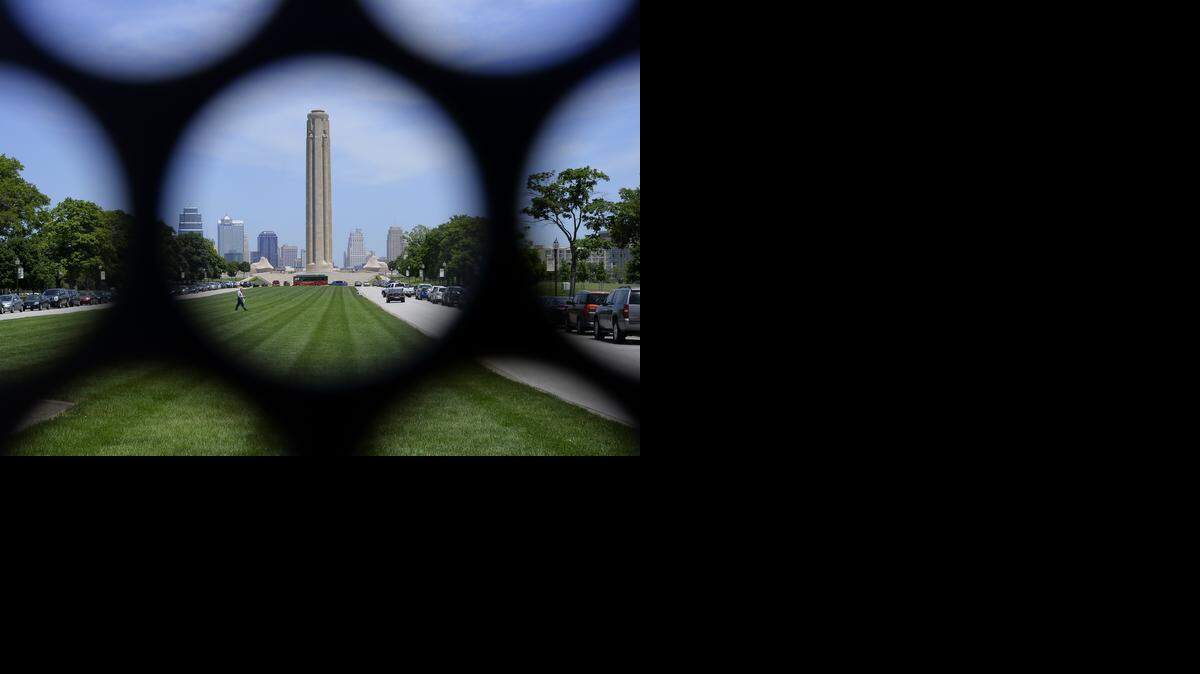
The local commemoration of the war’s centennial begins at sunset Sunday when a lone bugler will play taps at Liberty Memorial.
Streetcars aside, Kansas City was aware of worldly affairs in 1914. There was a revolution going on in Mexico and a mediation conference going on at Niagara Falls. The papers reported the passage of an Irish Home Rule bill in the British Parliament. And the fact that ladies’ bare ankles had been seen in Paris made the front page.
A drunken Kansas man was arrested for breaking into Buckingham Palace just to prove, he said, that it could be done. He scaled a wall, forced open a basement window and got within a few feet of Queen Mary’s private apartments.
This breach of security was jolting at a time when the women’s suffrage movement had begun to produce militants in Britain. In Kansas, women already had the vote. In Missouri, that summer petitioners gathered the 25,000 signatures they needed to get the measure on the November ballot, where it failed.
Still, the general feeling here was that Kansas City, at a national crossroads with its river and rail connections, was primed for prosperity.
The city’s population had grown by more than half from 1900 to 1910 to nearly 250,000 and was on the way to more than 320,000 by 1920.
The Muehlebach Hotel was going up at 12th Street and Baltimore Avenue. Union Station, the third-largest train depot in the country, was nearing completion.
And Kansas City had just snagged one of the new regional Federal Reserve Banks, gathering 355 votes over 191 for Omaha and 132 for Denver. A local banker called it “one of the greatest boons that could possibly come to Kansas City.”
On top of that, the Kansas wheat crop was projected to produce a whopping 179 million bushels.
“The outlook is for an enormous output of wealth from the farms,” The Star declared. “It means active business for everybody in the last six months of 1914.”
Three years later, in June 1917, American men were registering for the draft.
President Woodrow Wilson, who ran for re-election in 1916 on the slogan “He kept us out of war,” by spring had asked Congress for a declaration after Germany resumed unrestricted submarine warfare and had tried to goad Mexico into war against the U.S.
On Sept. 5, the first 41 soldiers from the Kansas City area shipped out from Union Station, headed to Camp Funston at Fort Riley, Kan.
Among them was Charles Stevenson of Olathe, who was eager to serve. He joined the 314th Engineers of the 89th Division led by Maj. Gen. Leonard Wood, whose name is now attached to an Army base in Missouri. A year later Stevenson was digging trenches and repairing bridges on the Western Front, “work just as essential as carrying up ammunition,” he wrote home.
“Air raids are common and almost every evening we see four or five planes battling each other with machine gune (sic) fire and with Allied and German anti-aircraft guns popping at them from the earth,” Stevenson wrote of the St. Mihiel offensive in France in September 1918. “It gets mighty hot at times I’ll tell you.”
His letters are part of the collection of the National World War I Museum at Liberty Memorial.
Lt. William Fitzsimons of Kansas City became the first American officer to be killed in the war. A graduate of the KU School of Medicine, he had gone over early and was tending the wounded in France in September 1917 when a German shell landed on his hospital tent. Former President Theodore Roosevelt wrote an editorial about him in The Star. There is a memorial to Fitzsimons at 12th Street and the Paseo.
Another Kansas Citian, Maj. Murray Davis, was killed Sept. 29, 1918, at the Battle of the Argonne Forest. His last words were, “Take care of my men.” There is a pocket park named for him at 40th and Main streets.
A young man from Grandview with poor eyesight named Harry Truman became commander of an artillery regiment in the 35th Infantry in France. He trained and served with a nephew of Kansas City political boss Tom Pendergast, forming a relationship with that family that would set him on a path to the White House.
Ernest Hemingway, briefly a reporter at The Star, became an ambulance driver in Italy and later made his way to literary fame.
John L. Barkley of Blairstown, Mo., near Warrensburg, became known for something else. The self-described small man with a stammer didn’t think the Army would take him. But it did and used the 23-year-old to gather intelligence on the battlefields of France. He would receive the Medal of Honor, the highest one, for his actions near Cunel on Oct. 7, 1918.
While stationed at an observation post, and on his own initiative, Pfc. Barkley repaired a captured German machine gun and mounted it inside a disabled French tank. When a German battalion marched right past Barkley, he opened fire, killing and wounding a large number of the enemy. Barkley survived, and U.S. forces were able to advance.
In his memoir, a manuscript of which is in the Liberty Memorial collection, Barkley wrote: “I wanted to live to see mother and Missouri again, apart from that I didn’t care.”
Sgt. Stevenson was sleeping with other soldiers in a hayloft just more than a month later when he learned of the Armistice. He heard a barrage and discovered the French were in the street firing their light artillery straight up in celebration.
By Thanksgiving, his unit was billeted in civilian homes in Belgium, enjoying warm goat’s milk and bacon after a wartime diet of hardtack and coffee.
“The folks erected hurriedly some arches and got some signs up — ‘Welcome to our liberators’ and such,” Stevenson wrote home. “They tried to make our flag; they got the red and white stripes all right but mussed up on our little blue and white corner of stars — but the spirit was there so we didn’t mind it if it did look queer.”
Barkley came home from the war without his stutter. He said a shell that exploded nearby had scared it out of him. In 1939 he was ready for another fight.
“Germany at that time was raising a ruckus,” said his daughter, Joan Barkley Wells of Kansas City. “He said if requested, he would serve in some capacity in the Army.”
To reach Matt Campbell, call 816-234-4902 or send email to mcampbell@kcstar.com. Follow on Twitter @MattCampbellKC.
Eight things that WWI left us
Total, mechanized, industrialized war, with tanks, air power, machine guns and chemical weapons.
The “American Century.” The United States shed its isolation and became a creditor nation. The world financial center shifted from London to New York.
World War II. German resentment at its punishment gave rise to fascism and Hitler.
The beginning of the end of the age of empires. The Ottoman Empire collapsed along with the Austro-Hungarian.
The modern map of the Middle East. The victors in World War I carved up the Ottoman Empire with boundaries that often ignored cultural differences.
The rise of communism. The Russian Revolution occurred during World War I.
Women’s empowerment. They entered the work force and stayed there. The right to vote was inevitable.
The wide popularity of the wrist watch, or trench watch. Pocket watches had been standard for men but were not practical in modern warfare.
This story was originally published June 21, 2014 at 12:24 AM with the headline "A century ago, World War I loomed and Kansas City argued about … streetcars."