
Putting KC’s Grand Boulevard on a slimming diet — and adding bikes
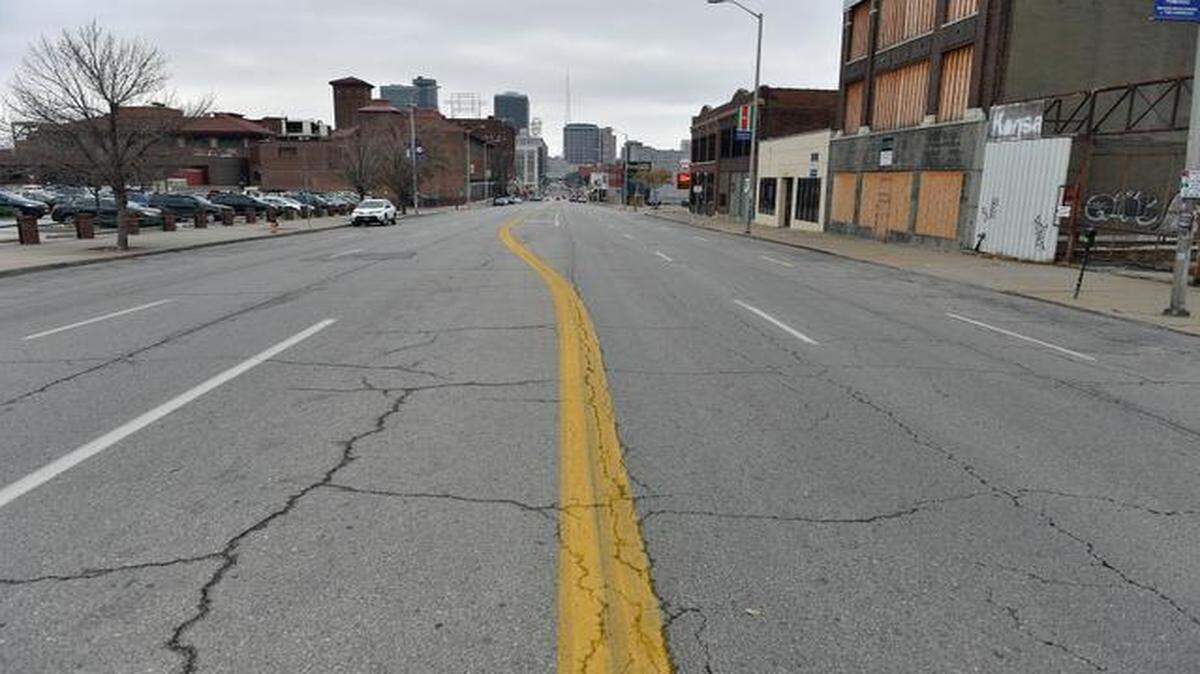
At seven lanes across at its widest, Grand Boulevard is Kansas City’s fattest downtown thoroughfare.
Now it’s about to go on a “road diet” that could become a model for other broad city streets that operate under capacity.
Road diet is urban-planner speak for squeezing motor vehicle traffic into fewer lanes, dedicating more asphalt to bicyclists and pedestrians.
In the case of Grand, which stretches 2 miles from the River Market to Crown Center, city planners are proposing a drastic slimming sometime next year.
No new construction would be required. All it would take is a relatively inexpensive paint job to reduce the number of traffic lanes from five to three — one going each way, north and south, with a shared turn lane between them.
Except at bus stops and intersections, on-street parking would remain on both sides south of Truman Road, with bikes lanes added between the parked cars and the traffic lanes.
For safety, a 2- to 3-foot, zebra-striped buffer would add some distance between each bike lane and the cars, buses and trucks rolling by.
You might think this would lead to rush-hour gridlock. But city planners say Grand has way more capacity than the amount of traffic it carries. Only where traffic turns to get on Interstate 70 does it bunch up.
Many other streets in and beyond downtown also have more capacity than traffic. Which means Grand might not be the only wide street to see traffic lane markings altered in the years ahead.
A committee headed by City Councilman Russ Johnson will consider a resolution next week ordering a citywide road-diet analysis. Its goal: to see how many undivided four-lane streets could be converted to three lanes.
“Compared to most other major American cities,” Johnson said, “Kansas City is the least congested.”
Putting other roads on diets might help city leaders make good on their commitments in the BikeKC plan to add many more miles of bike lanes.
That might also improve traffic safety by slowing traffic to posted speed limits.
“With these wide streets, you basically get a drag-racing effect,” said Eric Bunch, co-founder of the advocacy group BikeWalkKC. “You just drive fast from red light to red light.”
That doesn’t mean that expansive streets like Gillham Road and Armour Boulevard will necessarily be cinching their belts in the same way that Grand will be next year, assuming that plan isn’t scuttled for some reason.
That’s not likely. Objections to the conversion have been few, according to the city’s Public Works Department, which has been meeting with downtown business groups and residents. The transportation committee is expected to give its final approval in February.
Changes on other streets would be most likely if the road-diet analysis shows that losing traffic lanes could be done without creating traffic nightmares.
Grand’s heyday
Like many downtown streets, Grand was designed to handle lots more traffic than it sees today. While downtown remains a major employment center, that’s less so than during its heyday.
It’s been decades, likewise, since downtown was a retail hub. One by one, the department stores that once drew thousands of customers closed or moved to the suburbs.
The upshot is that, even with the influx of new residents and entertainment options downtown, there’s overcapacity.
“The streets used to be crowded,” said John Laney, a former city development director and past chairman of the Downtown Council. “We have way less traffic than the streets were designed for.”
In acknowledgment of that, the city has converted some one-way streets downtown to two-way. Street lights have been replaced with stop signs at some intersections, and diagonal parking was added on some streets in the Crossroads.
Elsewhere, Kansas City has been building new three-lane streets in areas where four lanes would have been the norm a decade ago. So far, that’s worked out, Johnson says.
Grand would be the first major, undivided arterial in the city converted to three lanes.
Local advocates of “complete streets,” which are designed for multiple modes of transportation — not just cars, trucks and buses — are enthused about the project, funded with a $724,000 federal grant.
“I think the road diet is a huge first step,” said Thomas Morefield, a planner at a local architectural firm who lives downtown and has been pushing for such a change.
In 2012, he helped organize a one-day demonstration of how a three-lane Grand Boulevard might operate during a busy First Friday celebration in the Crossroads Arts District.
With the city’s blessing, the Better Block KC group constricted traffic between 17th and 16th streets by adding temporary curbs made out of coiled burlap, setting off bike lanes and lining the sidewalks with donated landscaping.
There was no traffic jam, Morefield says. Buses made it through fine, and pedestrians found it easier to cross the street on temporary crosswalks.
“It blows my mind that there are not even crosswalks on that street now,” he said.
Morefield and others would prefer that the city locate the bike lanes between the sidewalks and the parked cars for greater safety. But as he explains in some detail on a website urbanangle.net, that would cost far more money than the city has available for road dieting.
Lack of funds held back the city’s 2012 Grand Boulevard Streetscape Plan, a $30 million-plus dream of turning Grand into a tree-lined, linear park, also with three traffic lanes.
“That’s why I like this,” said Jared Campbell, a City Council candidate, who attended an open house on the plan this week. “It’s simple, and you can change if you don’t like it.”
All it takes is more paint. And as money become available, some of the amenities from that more expensive plan can be added.
Early on, there was some concern about how buses will manage. Grand is now the main north-south corridor through downtown for The Jo and the Kansas City Area Transportation Authority. And two more routes will be shifted to Grand from Main Street as a result of the streetcar line being built there.
To ease the squeeze on buses, plans call for increasing the lane widths on Grand from the current 10 feet to 12 feet.
Previously, ATA officials voiced safety concerns about buses crossing the bike lanes. But with proper bus stop locations and reducing the number of stops, as planned, buses and bikes ought to be able to co-exist on the new Grand, says Dick Jarrold, the ATA’s vice president of regional planning and development.
To reach Mike Hendricks, call 816-234-4738, or send email to mhendricks@kcstar.com.
This story was originally published November 27, 2014 at 4:25 PM.