
Sen. Jerry Moran of Kansas savors his role in GOP election victory
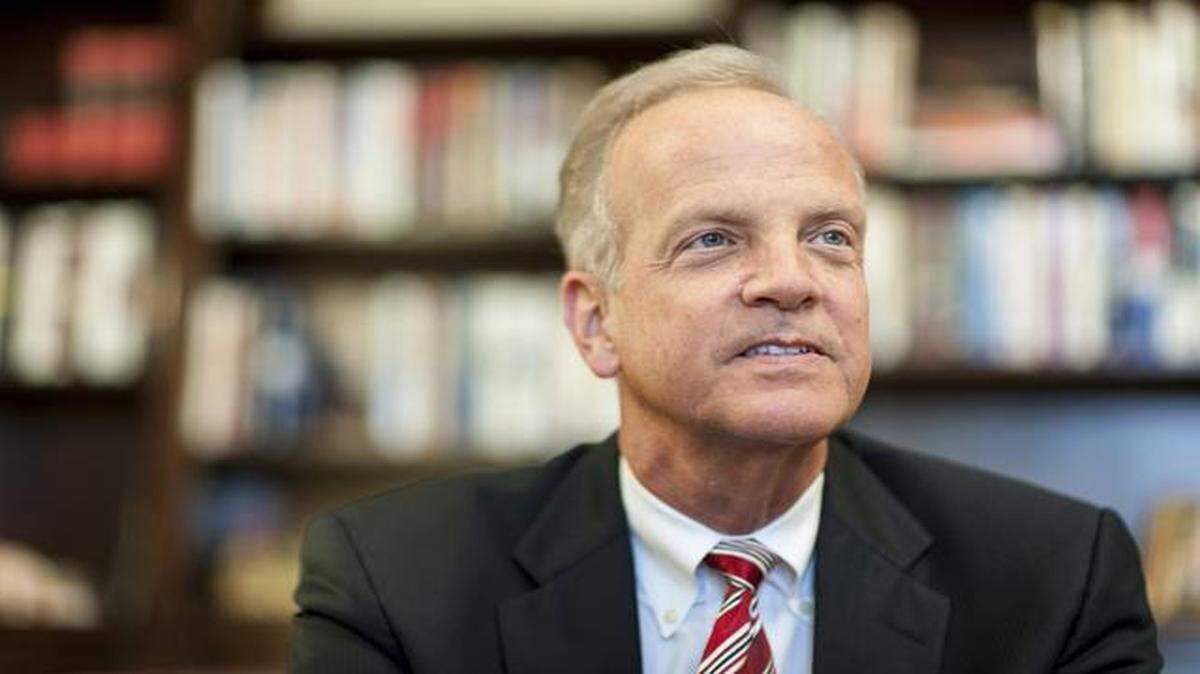
Sen. Jerry Moran of Kansas took the stage shortly before midnight Tuesday at a jubilant Election Night bash for the Republican Party in Washington’s Union Station.
Republicans had just picked up a sixth Senate seat with the victory of Joni Ernst in Iowa, making it official: The Grand Old Party had seized control of the U.S. Senate.
Now, with the spotlight squarely on Moran, he took a moment to savor the Republican rout he’d helped engineer as chairman of the National Republican Senatorial Committee. As Moran thanked his staff and colleagues, television screens in the ballroom flashed the news that Republicans had picked up a seventh seat in North Carolina. The giddy crowd exploded in cheers.
Within hours, the full extent of the GOP’s victory would become clear. Republicans held at least 53 seats in the 100-seat Senate, with a shot to grab another in a runoff in Louisiana in December.
For Moran, the overwhelming feeling was relief — and vindication.
“I’m anxious for this phase of my political life to come to an end,” he said in an interview Friday.
The 60-year-old lawmaker from Plainville says he’s more than ready to move on to legislating as a member of the majority party. It will be the first time he’s had a chance to do so since being elected to the Senate in 2010.
The results on Election Night were even better than the 51 seats Moran hoped for when his colleagues elected him as campaign committee chairman two years ago.
Assuming such a high-profile, high-pressure position was an uncharacteristic gamble for the first-term senator. He has a reputation for averting risk, not embracing it.
“Most people looking at my time in politics would not think this was a job that I would be willing to do or would pursue,” Moran acknowledged Friday.
His reward, he said, is a Senate that will let him advance the agenda Kansans elected him to pursue in Washington. He also could get a more tangible thank-you from Republican leadership in the form of a committee chairmanship, although those roles likely won’t be decided until January.
Republicans succeeded this year because they learned from past failures, Moran said.
In 2010 and 2012, the party missed opportunities to win competitive Senate races because poorly vetted or inexperienced candidates won primaries but couldn’t attract enough votes to win in the general election.
This time around, Moran said, the National Republican Senatorial Committee concentrated on recruiting electable candidates.
“We tried to get all aspects of our party — from tea party to the Chamber of Commerce — to sit in a room and decide on a candidate they could all agree on,” Moran said. “Sometimes we were more successful than others. … Even if this candidate may not be our first choice, can we agree that they are worthy of support?”
After settling on a candidate, the committee put recruits through “boot camp” training sessions to make sure they were well-versed in party policy, campaign tactics and media skills.
“We’ve learned that candidates matter, and a candidate has the ability to not only damage themselves but also Republican candidates across the country,” Moran said. “That did not happen in this election.”
Moran’s committee not only had to help the party gain Senate seats, it also had to help defend vulnerable incumbent senators, including in his home state of Kansas.
A major concern for Moran had been to ensure fellow Kansan Sen. Pat Roberts won a tough re-election campaign against independent challenger Greg Orman, a wealthy businessman from Olathe.
Moran said a big key to Roberts’ victory was convincing tea party activists and other anti-establishment conservatives in Kansas that a vote for Roberts was a vote against President Barack Obama and a Senate run by Democratic Majority Leader Harry Reid.
“A component of Sen. Roberts’ success was a realization that if you want to protest how bad things are in Washington, D.C. — which most Kansans think is true — the protest vote is to re-elect Sen. Roberts, not to vote for somebody else,” Moran said. “Had Sen. Roberts not been re-elected, it would have furthered the president’s agenda and continued the leadership of Harry Reid.”
Despite the accolades and national media attention, Moran said he’s eager for this phase of his political life to come to an end. He said he has no plans to take on another leadership position in the Republican Party, although he wouldn’t rule out that possibility in the future.
“I did not seek this job as NRSC chair to put myself on any kind of ladder to climb into the Republican leadership of the Senate,” he said. “I like my independence. The more that you are part of the leadership, the less flexibility you sometimes have in the positions you take. I want to make sure my focus is on Kansas, not trying to ingratiate myself to Washington.”
Whether Moran’s stint in the party leadership in Washington ultimately helps or hurts him in the eyes of Kansas voters has yet to be seen. He is up for re-election in 2016.
To reach Lindsay Wise, call 202-383-6007 or send email to lwise@mcclatchydc.com. Twitter: @lindsaywise.
This story was originally published November 7, 2014 at 6:14 PM with the headline "Sen. Jerry Moran of Kansas savors his role in GOP election victory."