
Insiders predict how the Kansas governor election will chart the direction of the state
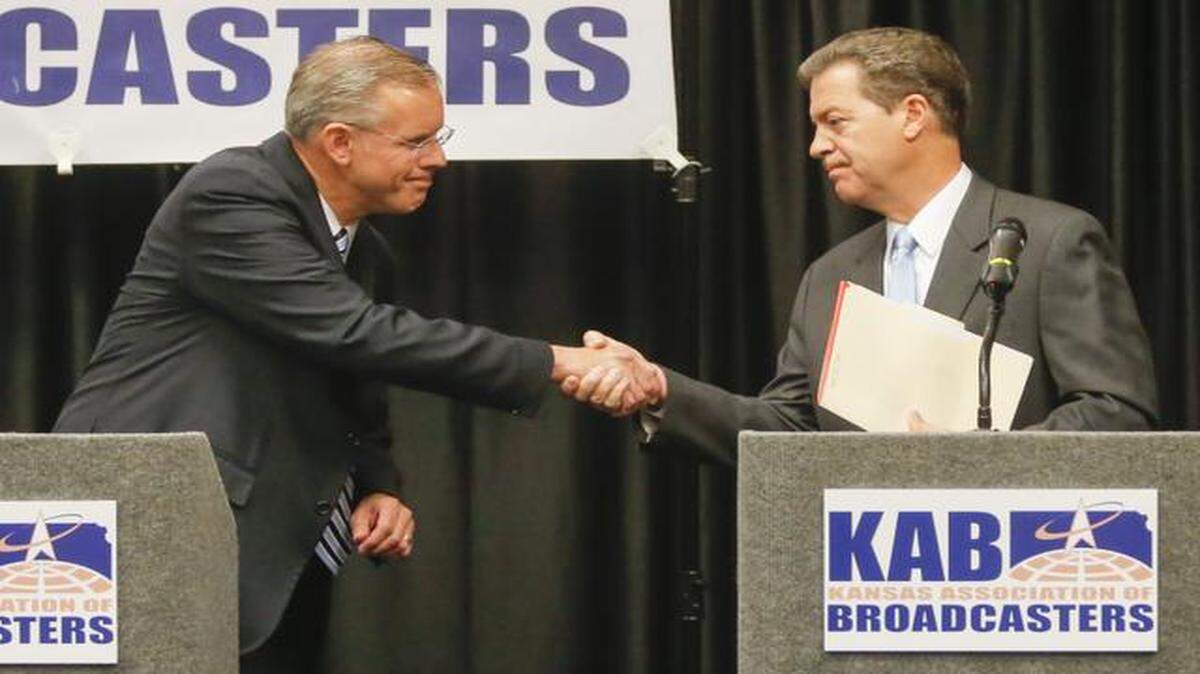
Back and forth the Kansas governor’s race goes.
Democratic challenger Paul Davis accuses Republican Gov. Sam Brownback of using Kansas for a tax-cutting experiment that risks bankruptcy.
Brownback paints Davis as a far-out lefty who will raise taxes and appoint liberal judges soft on violent criminals.
On Tuesday, one of them will emerge the winner. The result will matter.
Will the state continue to cut taxes? Or will future cuts be put on hold?
What will the judiciary look like? Or funding for schools?
The Star rounded up political insiders to predict how the election will chart the direction of the state.
Panel members were picked for their insight on Kansas politics and for their range of outlooks. Their answers have been edited for brevity and clarity.
The experts:
▪ Kansas Rep. Richard Carlson, a St. Marys Republican, is leaving the Legislature after 10 years. As chairman of the House tax committee, he successfully guided the passage of bills cutting income taxes.
▪ Dennis McKinney of Greensburg, a Democrat, served in the Kansas Legislature from 1993 to 2008. He preceded Davis as the House minority leader. He served as state treasurer from 2009 to 2010.
▪ Senate Vice President Jeff King, an Independence Republican, is a lawyer who has been in the Legislature since 2007, first as a House member, then as a senator beginning in 2011.
▪ John Carlin, a Democrat, served as the state’s 40th governor from 1979 to 1987.
▪ Stephanie Sharp, a former Johnson County legislator, served three terms in the Kansas House. She is now a Republican political consultant.
▪ Bob Vancrum, a lawyer and former longtime Republican legislator from Johnson County, served from 1981 to 1996 in the Kansas House and Senate. He also has worked 14 years as a legislative lobbyist.
What will happen to tax policy if Brownback is re-elected?
Carlson: Kansas will continue the path of low taxes on productive income to grow the private sector and create jobs with additional emphasis on budget efficiencies, while adequately funding the state’s essential services.
McKinney: The effort to further repeal income taxes will continue. (The question is whether) the changes cause wealth in Kansas to grow fast enough to generate tax revenues that will prevent drastic cuts to schools and public safety.
Carlin: The governor will see re-election as confirmation that his tax policy has the support of the people of Kansas and that the income tax over time will be abolished.
Sharp: If things go bad the next few months and revenues don’t improve, the governor will have to (cut) the current year budget to make ends meet by June 30, 2015. I expect a special session with the House unwilling to cut services and the Senate unwilling to reduce tax cuts.
Vancrum: Brownback and the economists advising him believe the state would actually collect more revenue with little or no state income tax by spurring growth in jobs and new businesses. … He will stay the course and let automatic decreases in rates continue.
If Davis wins?
McKinney: The focus will return to slowing the shift to property taxes. He would likely halt further reductions in the individual income tax.
King: Income taxes would rise. Davis would likely continue the two actions of former governor Kathleen Sebelius that substantially raised local property taxes: shrinking the local property tax base and removing state property tax relief for local governments.
Carlin: Davis will work with the Legislature to stop the remaining tax cuts that were passed and signed by Brownback.
Sharp: Governors do not operate in a vacuum. Republicans will retain a veto-proof majority in the Senate and a near veto-proof majority in the House.
Vancrum: Davis has called for a freeze on further income tax rate cuts to continue through 2017. It also seems his call for increased funding for K-12 and higher education would require an income tax increase. The question is how he can do that if Republicans retain huge majorities in both the House and Senate.
What will happen to school funding if Brownback is re-elected?
Carlson: Brownback will continue to add moderate state funding to (education) with additional targeted funding for specific areas, such as tech schools and making job-ready high school graduates.
McKinney: Regardless of which candidate is elected, the Legislature will be reluctant to solve a budget crisis with further cuts to education. If state revenues don’t begin to increase after income tax cuts, however, school funding cuts will be unavoidable.
Carlin: Based on what Brownback has done with tax cuts and what he is committed to, he will have no choice but to continue to severely cut state aid to education.
Sharp: Topeka will rely increasingly on local funding. Without the will to cut services in the House or reverse tax cuts in the Senate, allowing more local control will bring more money to classrooms without increasing the state’s responsibility.
If Davis is elected?
Carlson: Davis will attempt to increase school funding without regard to targeted funding or efficiencies.
Carlin: He, at best, can stop the digging and lay the groundwork for steps that will restore responsible funding for public education.
Vancrum: Davis will push to insert more money into public education and is quite likely to embrace whatever order the Supreme Court determines to be adequate education funding.
What will happen to the selection of judges if Brownback is re-elected?
Carlson: Brownback will continue the selection of conservative judges, with strict constitutional-based decisions.
McKinney: It is possible the governor will support a constitutional amendment giving him the ability to appoint judges to the state Supreme Court with consent of the Senate.
King: Brownback would lead a compromise where we have three to five people picked by a nominating commission that is not controlled by lawyers. The governor would select one nominee, and the Kansas Senate would hold confirmation hearings for that nominee.
Carlin: The governor will push to change the Kansas Constitution to allow governors to make direct appointments of whoever they see fit to serve on the Kansas Supreme Court.
If Davis is elected?
Carlson: A continuation of appointing liberal, so-called progressive, judges.
McKinney: Davis supports the current system of picking Supreme Court judges through a screening panel of lawyers and nonlawyers that recommends three candidates to the governor to choose from.
Carlin: Davis will oppose any change to the state constitution allowing direct (gubernatorial) appointments of members to the Supreme Court.
Vancrum: Davis did not and will not support changing the current system using a nonpartisan Supreme Court nominating committee to screen candidates and send their top three choices to the governor. He likely would back another plan to increase the size of that group with more nonlawyer members.
What will happen to the state’s renewable energy standards for utility companies if Brownback is re-elected?
Carlson: Most likely no major changes.
McKinney: Recent efforts to repeal it were not successful in the Legislature because quite a number of entrepreneurs, mostly Republican, are responding to the opportunities to diversify our energy sources.
Sharp: Nothing. Opponents brought the issue to a vote six times in an effort to bully legislators to change. This only emboldened support to maintain renewable energy standards.
Vancrum: Not clear. Although some House Republicans back a lower renewable energy standard, there are enough who could join with Democrats to block the change unless elections this year change the equation.
If Davis wins?
Carlson: Most likely will continue the same policies with the possible additional use of state- or federal-backed loans to renewable energy companies.
Carlin: Davis has been and will continue to be a strong supporter of the existing state’s renewable energy standards.
Vancrum: Davis would not support — in fact would likely veto — any reduction in renewable energy standards. I believe a veto override would likely fail in the House.
To reach Brad Cooper, call 816-234-7724 or send email to bcooper@kcstar.com.
This story was originally published October 28, 2014 at 7:30 PM.