
Kris Kobach’s proposed voter registration time limit damages rights, speakers say
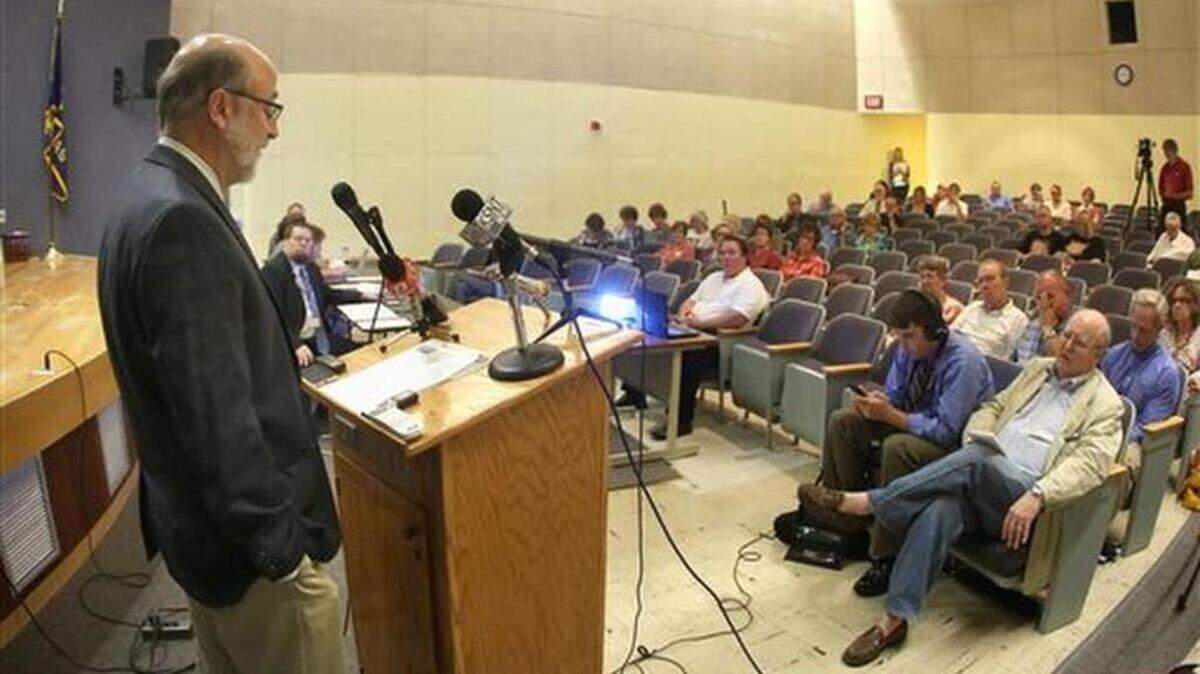
Voting advocates and others Wednesday spoke out against a new rule proposed by Kansas Secretary of State Kris Kobach to toss out incomplete voter registrations after 90 days.
The rule is unnecessary and would discourage many from even trying to participate in the voting process, they said. One speaker charged that the rule change was politically motivated.
But a county election commissioner said the 90-day limit made sense as a matter of efficiency.
Kobach didn’t attend the hearing, which was run by state elections director Bryan Caskey.
Caskey said there are about 36,000 incomplete registrations on file and about 32,000 of those are missing proof-of-citizenship documents. He said Kobach would consider all public and written testimony before making his decision.
In 2011, the Kansas Legislature passed the Safe and Fair Elections Act, which included a photo ID requirement for voting and proof-of-citizenship rules for voter registration.
The proof-of-citizenship portion took effect in January 2013. It requires those registering to vote to provide such documents as a birth certificate or passport, which Kobach and others say is needed to ensure that only U.S. citizens vote.
Marge Ahrens, co-president of the League of Women Voters of Kansas, said that producing proof-of-citizenship documents is a challenge to many because of the cost and time, particularly to older residents.
State and local officials don’t assist people in getting documents to complete their registrations, she said, and it would be a hardship if their applications were discarded.
“This requires them all to begin again,” she said.
Doug Bonney, legal director of the American Civil Liberties Union of Kansas, said 90 days isn’t enough time.
“There is no valid reason to limit this,” he said, except that the backlog of incomplete registrations is “huge and embarrassing” for Kobach.
Bonney also said it appears Kobach would “exceed his authority” if he implemented the rule. Asked after the hearing about possible ACLU legal action on that point, he said, “We’re looking into it.”
Kobach has said the rule change is within his administrative authority and has been cleared legally. He can implement it or consider changes after reviewing testimony from the hearing.
Michael Smith, an Emporia State University political scientist, presented data from a review of incomplete registrations that about 16 percent were actually completed over an eight-month period.
That’s about three times longer than the proposal would allow, he said.
Andrew Howell, Shawnee County election commissioner, defended the time limit as an efficient way to handle the incomplete applications. He said there were “significant costs” in repeatedly trying to contact applicants about the missing documents.
“A deadline makes it easier for us to do our job,” he said, noting that some people call back to ask that they not be contacted again about registering.
Several at the hearing said they spoke for the disadvantaged. The Rev. Ben Scott of the Topeka branch of the NAACP said Kansas’ election rules are a deterrent to voting for those with less means.
“If they’re denied for any reason, they will not go back again,” Scott said. “I don’t see anything in the regulation that talks about how to improve voter registration.”
Sonja Willms of Capital City-Topeka National Organization for Women said the voting rules are a hindrance to the underprivileged because they lack transportation and the money needed to obtain and deliver the documents. They also are more likely to vote Democratic than Republican, she said.
“I do think there’s a political motive behind this,” Willms said. “I think it’s to block mostly Democrats from voting.”
Kobach has said his purpose in proposing the 90-day rule is to keep costs down for county election officials. Georgia and Arizona also have proof-of-citizenship laws and they have shorter time limits, he said.
Ann Mah, representing Senate Minority Leader Anthony Hensley, a Topeka Democrat, at the hearing, said the proof-of-citizenship rule simply isn’t working.
“We have created the most unfair, unsafe elections in the nation in order to fix a problem that doesn’t exist,” she said.
To reach Edward M. Eveld, call 816-234-4442 or send email to eeveld@kcstar.com. Twitter: @eeveld.
This story was originally published September 2, 2015 at 11:06 AM.