Kansas City audited The Star’s coverage for bias. Mayor denies ordering it
AI-generated summary reviewed by our newsroom.
- Assistant city manager compiled a 2024 review alleging Star bias.
- Lucas denies ordering it, saying it was voluntarily provided.
- Experts raised concerns the review could chill press freedom.
Kansas City Mayor Quinton Lucas’ administration conducted an audit of The Star’s coverage for perceived bias against city government in 2024, according to the former city staffer who performed the review and a tranche of internal emails.
But Lucas, in a pair of statements to The Star, vehemently denied ordering the audit. Based on Lucas’ recollection, the review was “voluntarily suggested and provided to us,” he said.
The extraordinary review of a media outlet’s coverage, revealed in emails obtained by The Star, is unheard of in Kansas City politics, according to one former mayor. It’s sparked concern from First Amendment advocates, who question the city’s use of government resources to audit an independent media organization.
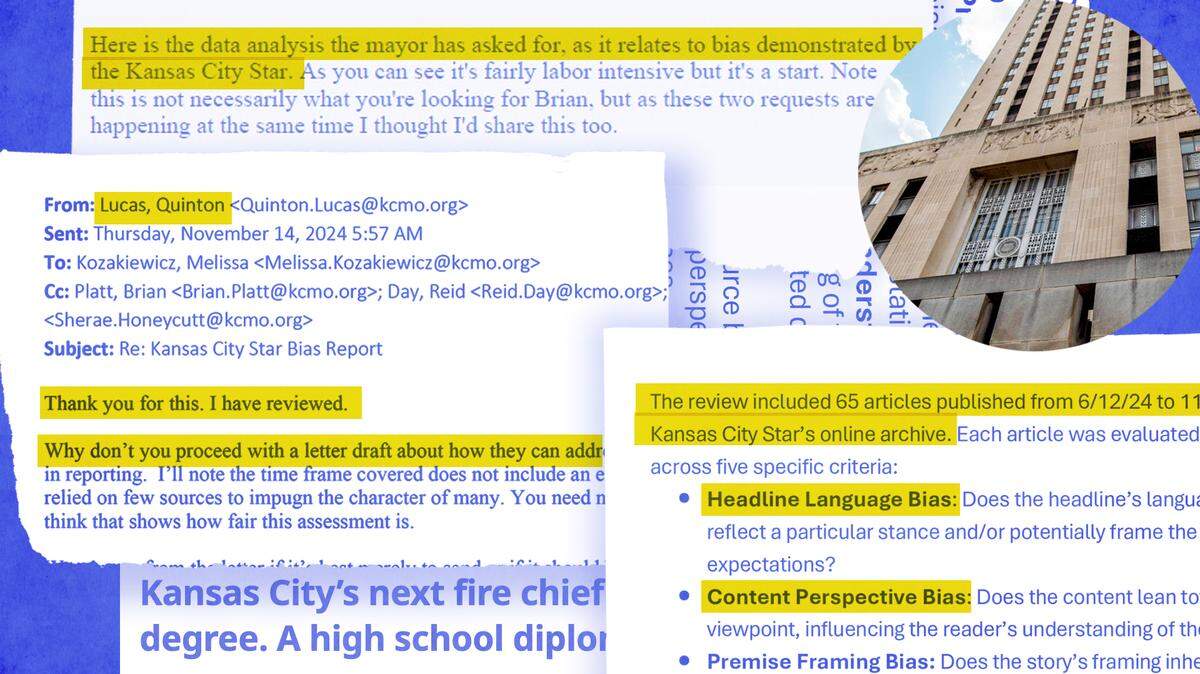
The first mention of the review — called “Kansas City Star Bias Report” — came in a Nov. 13, 2024, email from then-Assistant City Manager Melissa Kozakiewicz, who provided the emails to The Star. In the email, sent to Lucas, Lucas’ chief of staff, then-City Manager Brian Platt and a city spokesperson, Kozakiewicz included a copy of the audit, which reviewed 65 articles and opinion pieces published from June to November 2024.
“Per the request of City Leadership, I have completed a preliminary review…of recent Kansas City Star articles for bias,” Kozakiewicz wrote in the email. “As I understand it, this spreadsheet intends to inform the Mayor’s discussions with Kansas City Star editors and others as it relates to impartiality in the realm of local journalism.”
Lucas, in response, thanked Kozakiewicz. The mayor then directed her to write a draft letter to The Star to “address our fair concerns of bias in reporting.” The email chain included a copy of that draft letter, which was written by Kozakiewicz but never sent.
“I’ll note the time frame covered does not include an extensive period where they relied on few sources to impugn the character of many,” Lucas wrote. “You need not correct for that, but I think that shows how fair this assessment is.”
The email chain does not show how the audit was assigned to Kozakiewicz. But Kozakiewicz wrote in another email that “the mayor asked for” the review and she separately confirmed the mayor’s request in an interview.
Kozakiewicz, who was ousted from her role last year, said in a recent interview that the goal of the audit was to determine whether The Star was biased in its coverage of Lucas’ administration. She said she had never previously been asked to conduct a similar type of review.
“The mayor had expressed some concern on whether The Kansas City Star was fairly representing the city based on his instinct,” Kozakiewicz said in the interview. “And he wanted to see if his instinct was correct, so he asked me to look into it.”
The 2024 email from Kozakiewicz states that she used five criteria to evaluate The Star’s coverage for bias, including headline language bias and content perspective bias. She also provided Lucas and Platt with a conclusion based on her findings.
“Overall, the review demonstrated that while the majority of articles maintained balance in terms of content perspective, source inclusion, and comprehensive understanding, there was a notable presence of bias in headline language and premise framing,” the conclusion said.
The Star also obtained a copy of the spreadsheet of articles used in the audit. The articles include a variety of topics centered around City Hall, including the Kansas City Fire Department, housing, development and public safety.
The spreadsheet includes notes describing some of the articles’ perceived bias.
“Framing emphasizes KC’s failures, focusing on challenges without emphasis on ongoing efforts or plans,” one note said, referring to a story about homelessness in Kansas City.
“Framing leads readers to view city as neglectful of a public resource,” another note said in response to an article about Riverfront Park along the Missouri River.
‘Cause for concern’
The city’s previously unreported review of The Star has sparked concern from legal and First Amendment experts.
William Freivogel, a professor and former journalism school director at Southern Illinois University-Carbondale, drew parallels between the review and President Richard Nixon, who famously compiled a list of perceived enemies, and actions against the press by the Trump administration.
Freivogel said it was an inappropriate use of city resources to conduct a review of perceived bias by local media, saying the effort could create a chilling effect on the freedom of the press.
“It’s a poor use of resources,” Freivogel said. “They want to have better coverage that doesn’t make the government look bad and it’s the job of the media to be a watchdog.”
Gregory Magarian, a law professor at Washington University in St. Louis, who focuses on First Amendment issues, said that the audit itself may not cross any legal boundaries, but it “certainly creates cause for concern.”
“When the government investigates the media … it’s not inherently wrong, it’s not inherently a First Amendment violation, it’s not inherently intimidating,” he said. “But it certainly gets you to sit up and pay attention and say, ‘OK, what’s going on here? What’s the context for this? What might come of this?’”
Mark Funkhouser, who served as mayor of Kansas City from 2007 until 2011, said in an interview that the review was highly unusual, but he said he did not think it was an improper use of city resources.
“Is it odd? Yes. Is it unusual? I’ve never seen anything like it,” Funkhouser said. “But I would not go so far as to say it’s a waste of taxpayer resources … Working the media is like working the refs. It’s just something you have to do.”
Lucas responds
Lucas, in two lengthy statements to The Star, strongly denied his office’s role in directing the review despite the emails from Kozakiewicz that suggest she performed it at his request.
“It is our office’s recollection that this was voluntarily suggested and provided to us rather than requested by the mayor’s office,” Lucas said in an email. “We cannot speak to requests from other ‘City leadership,’ including those copied on the email.”
Lucas went on to further distance his office from the review, pointing to the fact that Kozakiewicz was a city employee who reported to the city manager instead of the mayor.
“Neither our mayor’s communications staff, nor our current or former Chief of Staff, played any role in compiling any study, nor did we do anything with the study or a subsequent email drafted by the then-assistant City Manager overseeing city communications,” he said.
When pressed on this, Lucas reiterated the idea that he did not play a role in directing the review.
“At the core of your inquiry, no, I did not wake up one morning after nine years of reading Star pieces that covered me at a time during which I can’t even remember particular bad coverage of me and decide it’s time for an audit of only one news source, and then order someone who doesn’t work for me to conduct it,” Lucas said in a follow-up email.
Kansas City’s two-term mayor appeared to shift blame for the review on Kozakiewicz, who he also said was a “good person and I really do wish her well.” He said the “recollections of myself and my staff at the time will differ from hers as to how and why she ended up conducting an audit of the daily newspaper in our city.”
“The facts, however, show clearly that when presented with her data and her email, the Mayor’s office and I elected to move forward without doing anything that her report and her email may have sought for us to address,” Lucas said.
Platt, who was ousted from his role as the city’s top executive in a highly publicized firing last year, declined to comment on the situation.
Former staffer goes public
Kozakiewicz, who worked at City Hall from 2021 to 2025, said she shared the email exchange with The Star after reading a line in a recent whistleblower lawsuit filed against the city by Beth Pauley, a former city performance auditor.
The core of Pauley’s lawsuit centers on City Auditor Marc Shaw, who served in an interim capacity before being appointed to the permanent role last month. Pauley’s allegations came just months after a trial in another whistleblower case that revealed Platt, the city’s former top executive, suggested it was acceptable to lie to news organizations.
Pauley’s lawsuit references an audit the city released in the wake of the trial, which is referred to as a communications audit. Pauley, according to the suit, complained about Shaw’s “perceived reluctance to include evidence in the communications audit that would balance the report and dissatisfy the Mayor.”
Kozakiewicz said she was curious whether the review of The Star for perceived bias was an example of information purposely left out of the communications audit.
In a follow-up written statement to The Star, Kozakiewicz expanded on her decision to go public with the emails.
“I’m sharing this because I saw the City Council voted to make Mr. Shaw permanent in the role,” she said. “If there are questions about his ability to remain impartial, this may be helpful to that discussion.”
Pauley declined to comment about the situation in an email to The Star. The City Auditor’s Office did not respond to a request for comment.