Kansas AG Kobach offers to delay enforcement of anti-trans law until March 26
AI-generated summary reviewed by our newsroom.
- Kobach paused license revocations and restroom enforcement until March 26.
- ACLU sued, saying SB 244 voided licenses overnight and broke Kansas constitutional rights.
- Judge took the restraining order request under advisement; decision hoped for Tuesday.
A court hearing in Douglas County ended Friday afternoon without clarity as to whether Kansas will be allowed to continue enforcing its new law policing transgender identity while a legal challenge works its way through the state court system.
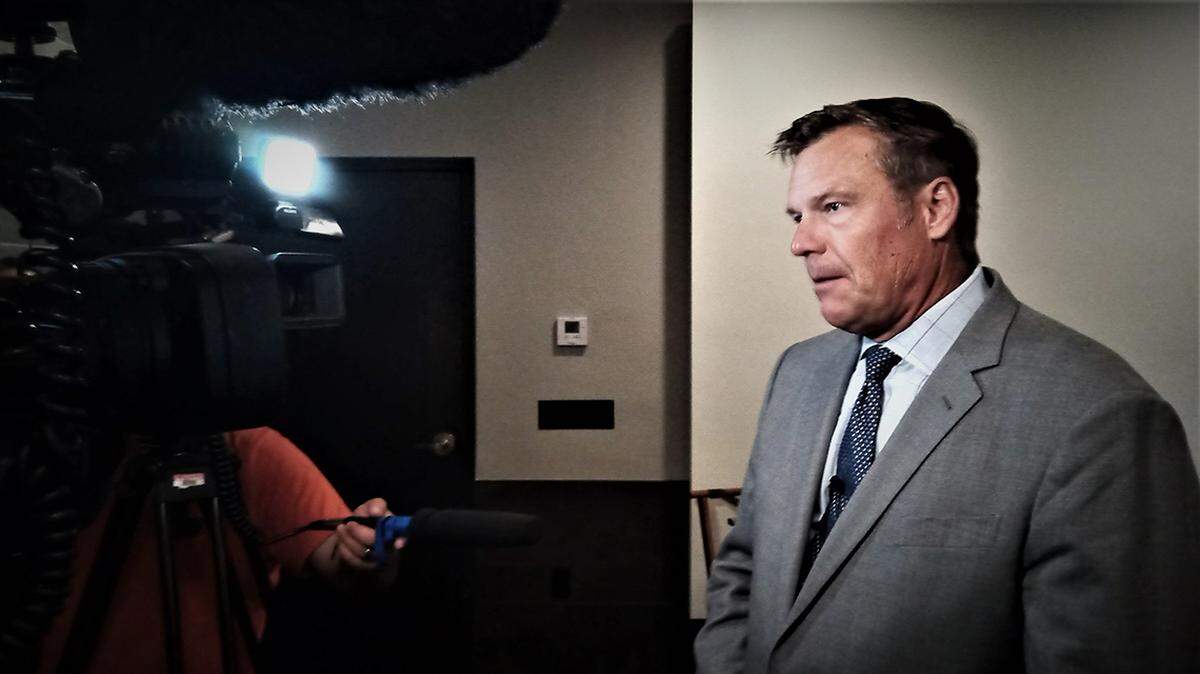
After hearing arguments for and against a temporary restraining order from American Civil Liberties Union staff attorney Harper Seldin and Kansas Attorney General Kris Kobach, respectively, District Court Judge James McCabria took the matter under advisement.
McCabria said he hopes to issue a written decision as soon as Tuesday.
Despite no immediate ruling, Kobach informed the court that the state would voluntarily refrain from invalidating anyone else’s driver’s license or adjudicating any complaints about trans people using restrooms on government property that don’t align with their sex assigned at birth until March 26, a month from the date that Senate Bill 244 became law.
The state is “more than willing to extend it to a month after it went into effect,” Kobach said of the bill, which was enacted into law by Republican supermajorities over Gov. Laura Kelly’s veto.
Of the 275 people who previously changed the gender marker on their driver’s license and received letters from the Kansas Department of Revenue informing them that their license must be surrendered and replaced, 138 people have already complied, Kobach said.
The damage was already done, the ACLU attorney argued.
“The immediate harm of this law was the overnight invalidation of driver’s licenses,” Seldin said.
Some trans Kansans told The Star that they received the KDOR letter last Wednesday, ahead of the law going into effect the next day. Others said they had still not received such a letter days after SB 244 became law.
The ACLU alleges that the law violates protections for personal autonomy, privacy, due process, freedom of speech, and equality under the law guaranteed in the Kansas Constitution. The lawsuit was filed on behalf of two trans men who live in Lawrence, identified in court filings under pseudonyms as Daniel Doe and Matthew Moe.
“This is about Daniel and Matthew’s right to be left alone by the government,” Seldin said, asserting that the goal of the new law is “to mark them with a scarlet ‘T’” that identifies them as trans any time they present their driver’s license or use a restroom in a government building.
“You can’t unring a bell on forcibly outing someone as trans,” Seldin said.
Kobach argues for anti-trans law
Kobach, who urged lawmakers to pass SB 244 after his previous attempts to block gender marker changes on driver’s licenses were struck down by the courts, said licenses and birth certificates must be “as accurate, objective, and unchanging as possible.”
“This is state speech,” Kobach said. “When I show you my driver’s license, that’s the state speaking.”
Despite the Kansas Court of Appeals determining last fall that Kobach failed to present compelling evidence of a law enforcement interest in preventing changes to gender markers on driver’s licenses, he reprised the argument on Friday.
“The officer cannot make the arrest if the sex on the driver’s license doesn’t match the warrant,” Kobach said.
McCabria, who was appointed to the bench by former Republican Gov. Sam Brownback, questioned Kobach about whether there were any laws on the books before SB 244 that restricted who could use which restrooms in Kansas government buildings.
Kobach said there were not. Sometimes, laws have to be passed to codify expected behavior “when social norms break down,” he said, asserting that most people would be uncomfortable if they had to use a restroom alongside someone who was assigned a different sex at birth.
McCabria pressed Kobach on whether he had data to support his claim. His examples were anecdotal.
“I don’t mean to sound overly idealistic, but we’re all human,” McCabria said.
Possible temporary restraining order
A courtroom packed with observers also heard from attorneys representing the Kansas Department of Revenue and the Kansas Department of Administration, both of which are named as defendants in the lawsuit.
“We were given effectively one week,” to implement the new law after the veto override, said KDOR attorney Ted Smith, who described the rollout as chaotic.
He also expressed sympathy for trans Kansans whose otherwise-valid licenses were revoked with little to no notice.
“They’ve done nothing wrong,” Smith said, adding that he welcomed Kobach’s decision to voluntarily halt license invalidation for the next three weeks.
A KDOA attorney said the agency would support the issuance of a temporary restraining order while the merits of the legal challenge are weighed.
Rep. Heather Meyer, an Overland Park Democrat, said in an interview Friday afternoon that she hopes McCabria will preemptively block the law, which she described as ”egregious, discriminatory and unnecessary.”
“We’ve already seen how detrimental this has been to our trans siblings across the state, how difficult it’s been for them to obtain new documentation to comply with the law,” Meyer said.
Willow Kessler, a Lawrence resident who attended Friday’s hearing, said her partner, who is trans, has already complied with the demand to surrender and replace her driver’s license.
“Now, with the (potential temporary restraining order), I’m wondering if we can get that reversed,” said Kessler, who is also trans but never updated the gender marker on her license.
During a break in the nearly three-hour hearing, Kessler chose to use the men’s restroom at the courthouse.
“During the second intermission, I went to the restroom and I decided to go into the men’s, right next to Kobach,” she said. “I was very chipper and chatty with him the whole time, and he was extremely uncomfortable, and that makes me think that maybe he doesn’t want what this law is actually going to do, which is put straight-passing trans people in restrooms where they don’t match.”
This story was originally published March 6, 2026 at 7:42 PM.