Missouri attorney general involves ICE in push to halt anti-gerrymandering group
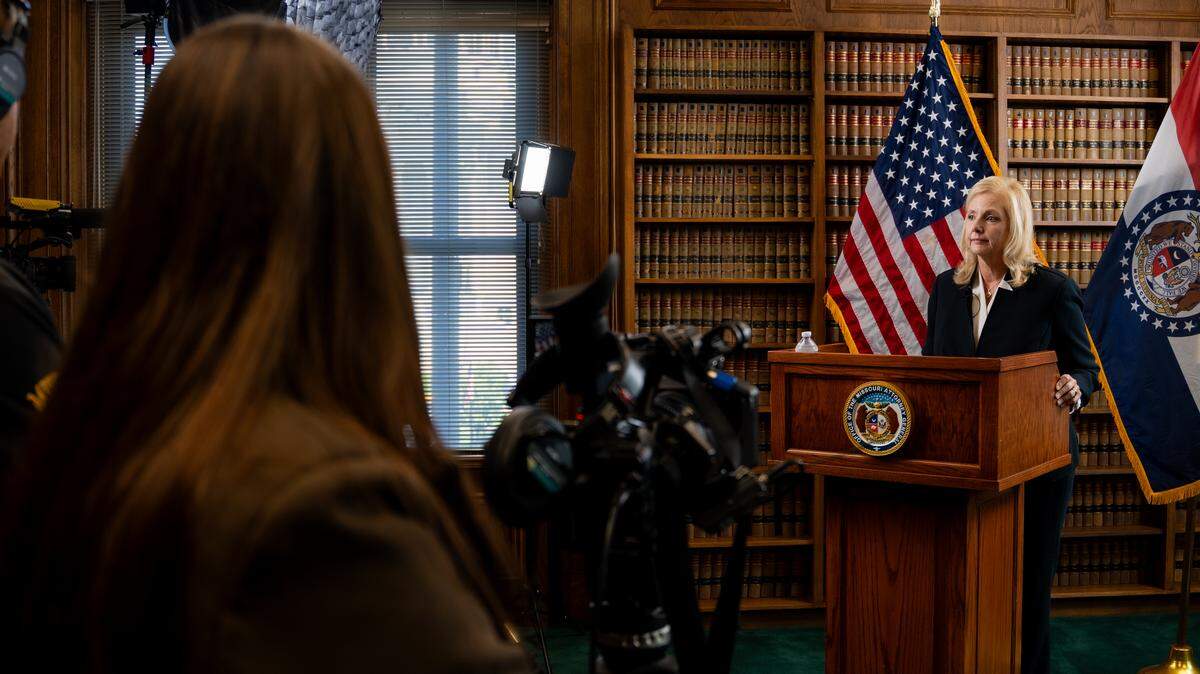
Missouri Attorney General Catherine Hanaway on Thursday involved federal immigration agents in her push to halt a campaign seeking to strike down the state’s congressional map.
Hanaway, a Republican, alleged in a pair of social media posts that a firm working with the campaign to collect signatures was “reportedly employing illegal aliens.” Hanaway wrote that her office “referred this matter” to U.S. Immigration and Customs Enforcement or ICE.
The attorney general did not provide any evidence to support her claims. A Hanaway spokesperson did not respond to a series of questions from The Star seeking more information.
But the allegations come as the campaign, called People Not Politicians, has faced a series of attacks from state officials, national Republican groups and mysterious consulting contracts. Campaign supporters have framed Hanaway’s posts as another attempt to halt Missourians from holding a statewide referendum on the congressional map.
“What the attorney general did, seemingly siccing ICE on people exercising their First Amendment rights, isn’t about the law; it is about political intimidation and thuggery,” said Richard Von Glahn, the campaign’s executive director.
Hanaway’s social media posts were aimed at Advanced Micro Targeting, or AMT, a company working with the campaign to collect signatures across the state. The campaign is working with AMT and volunteers to force a statewide referendum on the map.
Von Glahn said that Hanaway did not contact AMT before she made her allegations, which he said were false.
“She put this out without having done anything,” Von Glahn said. “Which is why we know it is not a legit investigation. It is about intimidation.”
Billy Rogers, the company’s president and founder, also called the allegations false in an interview. AMT uses the national company E-Verify for its employees and conducts a “pretty extensive” background check.
“It’s not true,” Rogers said. “We’re a real company that does real business and we abide by the law.”
A spokesperson for ICE did not immediately respond to a request for comment.
Hanaway’s allegations have also been roundly criticized by Democrats and other supporters of the campaign.
“Unelected, ultra-partisan attorney general making stuff up to interfere with Missourians’ constitutional right to hold politicians accountable,” House Minority Leader Ashley Aune, a Kansas City Democrat, wrote in a post that quoted Hanaway’s claims.
Some have also mocked Hanaway’s claim that the referendum seeks to “undermine the will of the people’s elected representatives,” which was a twist on the campaign’s slogan that the will of the people should decide the state’s congressional districts instead of politicians.
But some social media users have touted Hanaway’s claims. The Missouri Republican Party also re-shared both posts.
The top Republican in the Missouri Senate, in a statement provided by a spokesperson, used Hanaway’s allegations to highlight concerns about illegal immigration, saying that Missourians “deserve a system that is secure, transparent, and protected from outside manipulation.”
“I know General Hanaway would verify this and I think it brings to light one of the legislature’s concerns,” said Senate President Pro Tem Cindy O’Laughlin, a Shelbina Republican. “If illegal immigrants are being used to interfere in Missouri elections, that is a serious issue.”
Another Senate Republican, reached by phone, said he had not seen Hanaway’s claims.
“If it’s true, I’m glad she’s doing it,” said Sen. Mike Cierpiot, a Lee’s Summit Republican. “And, if not, we’ll figure it out. “
Inside the Missouri campaign
Hanaway’s allegations were not the first attempt to cast doubt on the campaign.
The Republican attorney general has also filed a federal lawsuit seeking to block the referendum, arguing that only lawmakers have the power to redraw the state’s congressional districts.
Meanwhile, Republican Secretary of State Denny Hoskins faces a lawsuit that alleges he illegally delayed the campaign by refusing to accept its paperwork and cast doubt on the validity of roughly 90,000 signatures.
The intense energy surrounding the campaign comes after a chaotic fall in which Missouri redrew the state’s congressional maps under pressure from President Donald Trump.
Six of the state’s eight districts are currently represented by Republicans, while Democrats hold two — one in Kansas City and the other in St. Louis.
The new map, signed by Republican Gov. Mike Kehoe, is intended to allow Republicans to control seven districts as Republicans nationwide seek to maintain control of Congress after the 2026 election.
The map takes direct aim at Kansas City and longtime Democratic U.S. Rep. Emanuel Cleaver, carving the city’s voters into three Republican-leaning districts. It also slices more than 70,000 minority voters out of Cleaver’s district, a move that faces fierce criticism in Kansas City.
People Not Politicians launched its referendum campaign shortly after the vote and almost immediately began collecting signatures to strike down the map. Referendum campaigns, outlined in the Missouri Constitution, allow voters to challenge most bills passed by state lawmakers.
Campaigners have until Dec. 11 — or 90 days after the legislature adjourned — to collect enough signatures in at least six of Missouri’s eight congressional districts to force a November 2026 statewide vote.
The campaign must collect the amount of signatures that equals 5% of voters in each of those districts, based on numbers from the most recent election for governor. That number would be around 106,000, according to the Missouri Secretary of State’s Office.
This story was originally published November 21, 2025 at 12:10 PM.