City’s opposition to Kansas ICE prison obstructs Trump’s goals, CoreCivic says
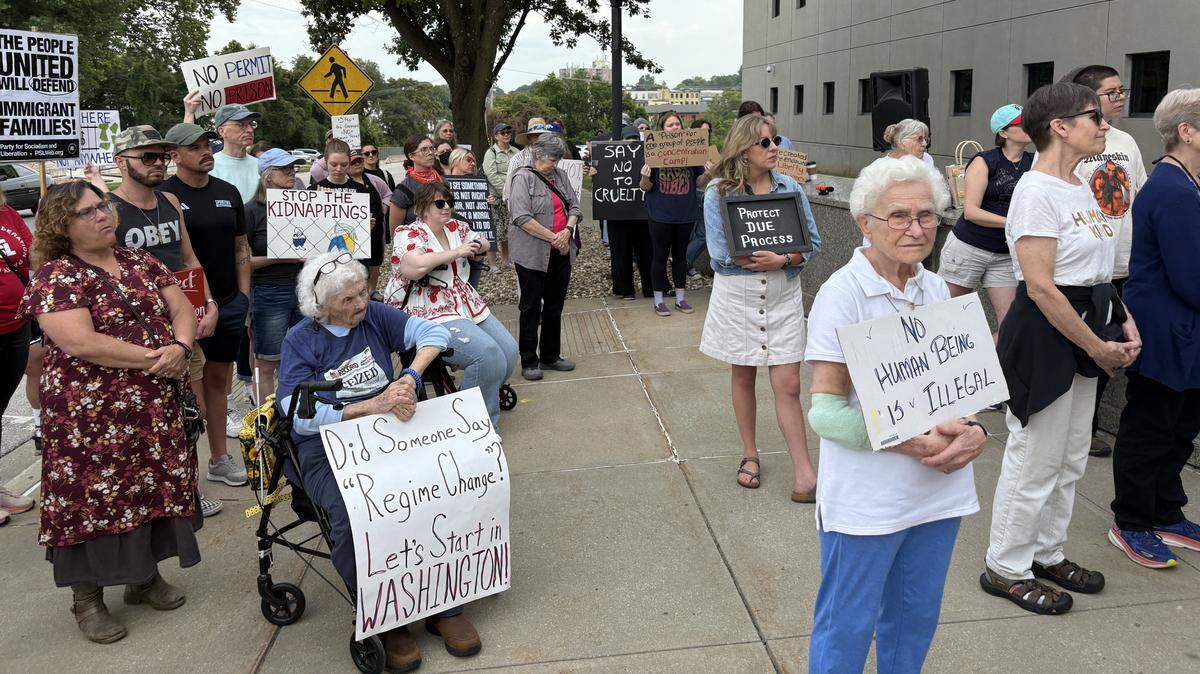
The city of Leavenworth’s efforts to block CoreCivic from reopening its jail facility as an immigrant detention center without a permit are an attempt to supersede federal laws and block President Donald Trump’s policy agenda, the for-profit prison chain argued in Kansas state court Wednesday.
Undeterred by adverse rulings that have so far prevented the company from accepting detainees under its contract with U.S. Immigration and Customs Enforcement (ICE), CoreCivic’s attorneys asked Judge John J. Bryant to dismiss the city’s lawsuit at a hearing in Leavenworth.
Bryant took the matter under advisement without issuing a ruling.
The city’s insistence that CoreCivic must apply for and receive a zoning permit to reopen its shuttered facility on the outskirts of town amounts to obstructionism against the Trump administration’s immigration policy, attorney Taylor Concannon Hausmann contented.
“It goes to the very essence of Supremacy to remove all obstacles to the federal government’s action within its own sphere,” Hausmann said, citing the Supremacy Clause of the Constitution, which places federal laws above conflicting state and local laws.
“Here, the city attempts to regulate the federal government’s immigration policies and operations by imposing requirements on its chosen contractor, and, in effect, subject those operations to city approval,” Hausmann said.
In court filings and hearings, the city has argued that to maintain legitimacy, it must be allowed to enforce its own laws, including a 2012 ordinance that requires jail and prison operators to secure a special use permit before opening.
CoreCivic, which opened its Leavenworth facility in 1992, was initially exempt from that requirement because the ordinance grandfathered in existing detention centers. But the facility was shuttered at the end of 2021 under an executive order from former President Joe Biden that barred the Department of Justice from renewing contracts with private prisons.
Its closure came amid deep community concerns over chronic violence, drug abuse and understaffing at the facility, which was previously operated under a contract with the U.S. Marshals Service.
CoreCivic initially complied with Leavenworth’s request to apply for a special use permit, but abruptly reversed course in March. Company officials have asserted that they can operate the facility by right because they never intended to abandon the property.
ICE prison polarizes Leavenworth
Leavenworth isn’t squeamish about prisons. CoreCivic’s rebranded Midwest Regional Reception Center is one of five correctional facilities in Leavenworth County, along with FCI Leavenworth, Lansing State Prison, the U.S. Disciplinary Barracks at Fort Leavenworth and a day reporting center owned by another private prison company, GEO Group.
Hausmann argued the local government’s adversarial stance toward CoreCivic reopening without a permit is “fueled by political discourse and polarization” over whether immigrant detainees should be brought to Leavenworth.
W. Joseph Hatley, an attorney representing the city, dismissed that notion in his remarks during Wednesday’s hearing.
“If the state of Kansas wanted to come in and contract with CoreCivic to house inmates in that facility, they would still have to have a permit,” Hatley said. “If the city wanted to contract, they’d still have to get a permit. They have to get a permit no matter who they want to contract with, so there’s no discrimination here.”
The Star requested a copy of the contract between CoreCivic and ICE for the Leavenworth facility in May. So far, no contract has been furnished.
Hatley asked Bryant to allow the city’s lawsuit to proceed, citing the judge’s previous rulings granting and upholding a temporary restraining order to prevent the facility from accepting detainees.
“It would really make no sense for the Court to have granted a motion for temporary injunction, finding the city was likely to succeed, and then turn around and dismiss the petition,” Hatley said.
Bryant revealed during the hearing that CoreCivic has asked the Kansas Court of Appeals to overturn his temporary injunction. He said he may wait to rule on the motion to dismiss and other pending motions until after the appeals court makes its determination.
As with previous court appearances related to the zoning dispute, Wednesday’s hearing was well-attended by community members from across the Kansas City metro, most of whom showed up to protest CoreCivic’s plans for an ICE prison.
Nicholas Cortez Brass of Merriam said he fundamentally disagrees with both the concept of illegal immigration and private prisons.
“Allowing corporations or corporatism to be involved in such a delicate human matter, allowing that greed to get in is just never a good idea,” Cortez Brass said.
Despite the city’s insistence that the lawsuit represents neither an official stance on Trump’s mass deportation plan or CoreCivic’s business model, Cortez Brass said the legal battle gives him hope.
“This lets me know that people still want to fight the good fight no matter what.”
This story was originally published August 6, 2025 at 4:20 PM.