Kansas City fears losing thousands of federal jobs. How much economic pain will follow?

Waterbird Coffee Company, a downtown Kansas City source for lattes, sits two blocks from the Richard Bolling Federal Building, where thousands of federal employees work. Co-owner Brian Denman estimates up to 20% of his shop’s customer base are federal workers.
He wonders what will happen to those employees – and his shop – if plans for major cuts to the federal workforce move forward.
“The thing I think about most is there’s a lot of regulars who I’ve been seeing here for the two years that we’ve been open and I’ve gotten to know a lot of those people,” Denman said. “To me, it’s kind of sad to see them be in a place where they don’t know what’s going to happen with their career, what’s going to happen with their jobs.”
Kansas City is bracing for a wave of federal job losses as President Donald Trump’s administration pursues sweeping cuts. Some 30,000 people work for the federal government across the metro region but thousands of jobs could eventually be lost. The Internal Revenue Service, Veterans Affairs, Social Security Administration and other departments with major presences in the region are all eyeing reductions.
The size and timing of those cuts will help determine the economic blast radius in Kansas City. Federal jobs, typically known for their stability, help undergird a network of other positions and businesses that support them, from contractors to coffee shops. Every job eliminated inflicts more economic pain.
The Star interviewed or reviewed the public remarks of more than a dozen economists, elected officials, business leaders and others to gauge the potential risk the anticipated job losses pose to the Kansas City economy. Most voiced deep uncertainty over how far the cutting will go, but some fear the Trump administration’s actions will flood the area with more unemployed workers than available jobs.
Others predicted the federal government will remain a major employer locally and cautioned against premature doom and gloom. Federal employment, while important, remains a relatively small slice of the Kansas City region’s entire job market, some noted.
How much damage is done to the local economy may very well depend on trends nationally. Kansas City will struggle more with significant layoffs if the overall economy is already cooling, economists said.
While the U.S. economy appears solid at the moment, Trump’s unpredictable tariffs and recent stock market sell offs have created a level of uncertainty that may lead businesses and consumers to pull back spending and investment. U.S. consumer sentiment has already begun falling.
The uncertainty itself risks damaging Kansas City.
“If people feel that their jobs are at risk or they’ve lost some jobs and if some goods and services become more expensive because of tariffs, that reduces consumption,” said Donna Ginther, director of the Institute for Policy & Social Research at the University of Kansas.
“These are negative shocks to economic activity.”
Thousands of jobs at risk
Numerous federal agencies have already fired probationary workers.
At the IRS campus near Union Station, some 100 workers were fired last month. Across the Kansas City metro, the number of fired workers most likely sits in the low hundreds, though lawsuits are ongoing that could eventually reinstate many of them.
But the more sweeping cuts are still to come as agencies develop plans for a reduction in force, the federal term for layoffs.
The IRS employs more than 4,000 people at its Kansas City campus. The agency is drafting plans to cut up to half of its entire nationwide workforce, the Associated Press reported this month.
The VA operates a medical center in Kansas City and clinics across the region, but wants to cut 80,000 jobs nationally. And the Social Security Administration plans to cut thousands of jobs nationally; the agency currently employs hundreds of workers in Kansas City and hundreds more in dozens of field offices across the agency’s four-state region.
About 2,400 jobs requiring at least a bachelor’s degree are posted in Kansas City, Ginther said. Not all of those will translate into actual jobs but they are a sign of job availability.
“If we get into the thousands, I don’t think the Kansas City metro can absorb all the workers that are losing their jobs,” Ginther said of federal job cuts.
At a rally in support of federal workers on Saturday held next to the IRS campus, Kansas City Councilwoman Melissa Patterson Hazley called the IRS firings a “direct blow to the fabric of our local economy.”
The terminations of civil servants jeopardizes not just the workers’ livelihoods but the wellbeing of the entire community, Patterson Hazley said. She called on demonstrators to “ask ourselves what is the true cost of this so-called efficiency” – a reference to billionaire Elon Musk’s Department of Government Efficiency initiative, which has helped drive cuts across the federal bureaucracy.
“Our federal workforce has long been a cornerstone of prosperity in Kansas City, providing jobs that support families and sustain local businesses and contribute to the services that keep our community strong,” Patterson Hazley said.
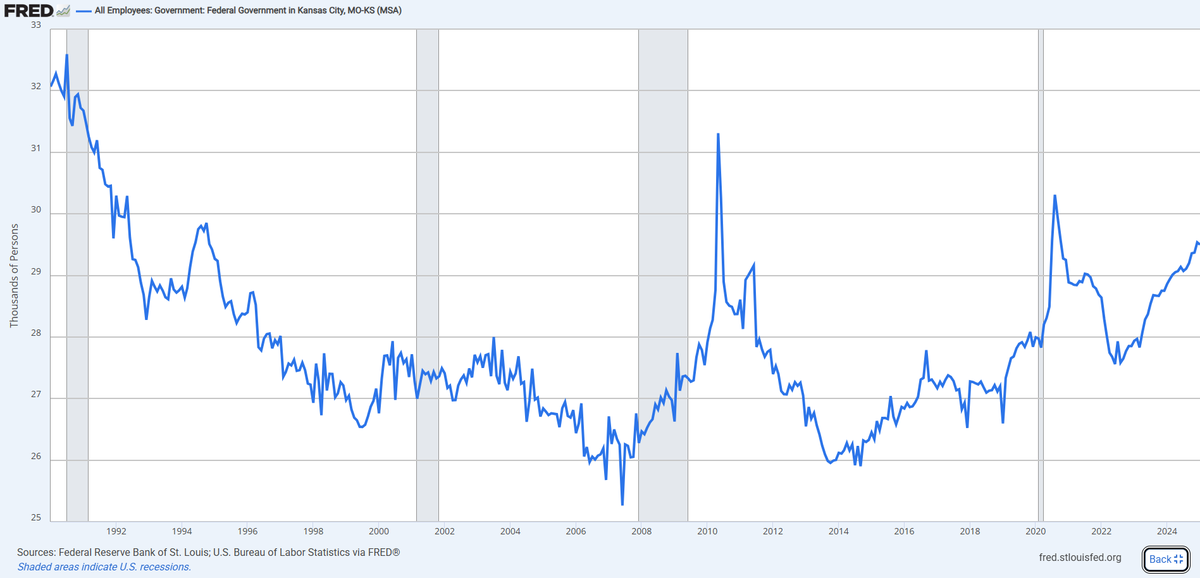
Federal employment in the Kansas City metropolitan statistical area – a region that stretches north to Caldwell County, Missouri, and south to Linn County, Kansas – has trended upward over the past decade. The region has gone from about 26,000 federal employees in 2014 to about 29,500 currently, according to data compiled by the Federal Reserve Bank of St. Louis.
A loss of 10,000 federal jobs, for example, would put federal employment in the region at its lowest level in at least several decades. In Fed data dating back to 1990, federal employment in the Kansas City region has never fallen below about 25,260 jobs.
Layoff effects could spread
About 1.1 million people in total work in the region. Erik Olsen, the University of Missouri-Kansas City department chair in economics, noted the number of potential federal job losses is small relative to the overall size of the Kansas City regional economy.
What concerns him more, economically, are the indirect effects of those anticipated losses.
“As you take jobs out of the local economy in the federal sector, it’s going to reduce the service sector and grocery and all those things that provide those services for local employees,” Olsen said.
In other words, businesses like Waterbird Coffee Company.
Denman’s shop, which opened in November 2022, is a quick walk for anyone who wants to grab a coffee on the way into City Hall, the Jackson County Courthouse or the Richard Bolling Federal Building.
The General Services Administration, which acts as a kind of landlord for the federal government, placed the Richard Bolling Federal Building on a list of properties designated for possible sale. Amid scrutiny, the GSA soon took down the entire list – but not before the impression had been left that the federal government could be looking to offload the 21-floor building.
The Social Security Administration, already anticipating job cuts, has a large presence in the building.
“If it were to close, then, yeah, I think that would definitely impact me,” Denman said.
But the uncertainty over federal jobs has been a “weird thing,” he said. Some people have told him he should prepare for more business because of the push by federal agencies to end remote work and mandate employees work in the office.
Denman, who spoke with The Star on Monday, said just that day he had talked to someone who was carrying a computer monitor because he was now going to be in the office full time.
“But then they’re also laying a ton of people off. And if the building closes then, you know, it’s like, a bunch of different things happening that can either positively or negatively affect me,” Denman said. “It’s hard to know what to make of it, honestly.”
If the Kansas City economy begins to cool, either because of feared job losses or larger concerns over economic uncertainty, entertainment and leisure spending will be one of the first areas where consumers will cut back.
So far that doesn’t appear to be happening in Kansas City restaurants, said Mike Burris, the Missouri Restaurant Association’s executive director for Kansas City and Southwest Missouri.
While restaurants are concerned about costs and the potential effects of tariffs, Kansas City Restaurant Week went great, he said, and establishments are looking ahead to the World Cup next year, when hundreds of thousands of foreign tourists are expected to descend upon the city.
“When you’re talking about customers, I don’t know that we’ve seen a drop in it,” Burris said.

Federal presence will remain
Even after the current workforce reduction, federal employees are likely to remain one of the largest, if not the largest, constituency of workers in greater downtown Kansas City, said Bill Dietrich, president and CEO of the Downtown Council of Kansas City.
About 124,000 people work in the greater downtown area, including about 12,000 federal employees, Dietrich said, citing estimates. A federal workforce reduction of 5-10% would still mean federal employees constitute perhaps the largest single group of workers in the area.
“They’re still going to need office space,” Dietrich said, though he acknowledged the General Services Administration may need less space over the long term.
If the federal government ultimately decides to offload the Richard Bolling Federal Building or other federal property, the sale could present opportunities for new occupants, potentially even new residences.
“I think we’re all watching anxiously and cautiously and to date not really a big – not really expecting a major space hit on the market,” Dietrich said.
Kansas City and Jackson County leaders are scrambling to keep federal workers who lose their jobs in the area. The Kansas City Council has instructed the city manager to help terminated federal workers fill some of the hundreds of open positions in the city’s workforce. Jackson County Legislator Manny Abarca has promised to pursue a similar measure at the county level.
When Kansas City Mayor Quinton Lucas delivered his State of the City speech in February, he said 30,000 federal workers and contractors in the region “were made to feel anxious about their career futures.”
Lucas spokesperson Megan Strickland said in a statement to The Star that the mayor was concerned about the impact of federal worker layoffs. The thousands of federal employees in the Kansas City “work hard every day to deliver vital services on behalf of the American people,” she said.
“More than a loss to the City’s earnings taxes or other revenue, layoffs affect members of our community who are mothers, fathers, sisters and brothers raising families, caring for parents, or just trying to live a fulfilling life in Kansas City,” Strickland said.
Strickland encouraged workers affected by layoffs to look for openings on the city’s website as well as a program designed to direct federal workers to local jobs.
‘Not just attacks on our jobs’
Top Missouri Republicans back the Trump administration’s workforce moves. Gov. Mike Kehoe said at a news conference last week that he supported initiatives to ensure “we right-size the federal government.”
Kehoe said his office is in touch with Missouri’s congressional delegation, which he said are going through the potential effects of those efforts on Missourians. “We’ll work through those issues and try to help the Trump administration make sure our government, just like our Missouri government, is right sized,” he said.
In response to questions, Kehoe spokesperson Madelyn Warren said in a statement that the governor generally supports efforts to increase government efficiency and ensure responsible use of taxpayer dollars.
“The Governor is also committed to ensuring Missouri – including the Kansas City region – remains strong and resilient, and will continue fostering policies that strengthen economic opportunities, promote private investment and job creation, enhance public safety, and encourage responsible government spending,” Warren said.
One Republican lawmaker is attempting to remove a federal agency from Kansas City – a move that would add to the region’s federal job losses. U.S. Rep. Mark Alford has asked the Small Business Administration to relocate its Kansas City office to Columbia, some of which is inside his district.
Federal workers in Kansas City are vividly aware of the threat to their jobs and are eager to remind the public of their central, if sometimes unseen, role providing core government services.
At the Saturday rally for federal workers, National Treasury Employees Union Chapter 66 president Shannon Ellis ticked through some of those services: ensuring Social Security checks arrive on time, providing medical care to veterans, and protecting air and water quality.
“The attacks on the agencies, on us, are not just attacks on our jobs,” said Ellis, whose union represents IRS workers in Kansas City. “They are attacks on the American people and the services they depend on every single day.”
Denman, the coffee shop owner, said he encounters stressed-out federal workers at his business. They’re worried whether, he said, they’ll have a job the next day – or even the next hour. What if the Richard Bolling Federal Building closes?
“I don’t know what’s going to come of those jobs,” Denman said. “They might not exist anymore, but I can say it’s been nice to offer them something, even if it is just a cup of coffee, that hopefully makes them feel a little bit better about the political climate situation that’s affecting them and their livelihoods.”
This story was originally published March 19, 2025 at 5:00 AM.