How a dispute between state leaders almost cost 1.3M Kansans their presidential votes
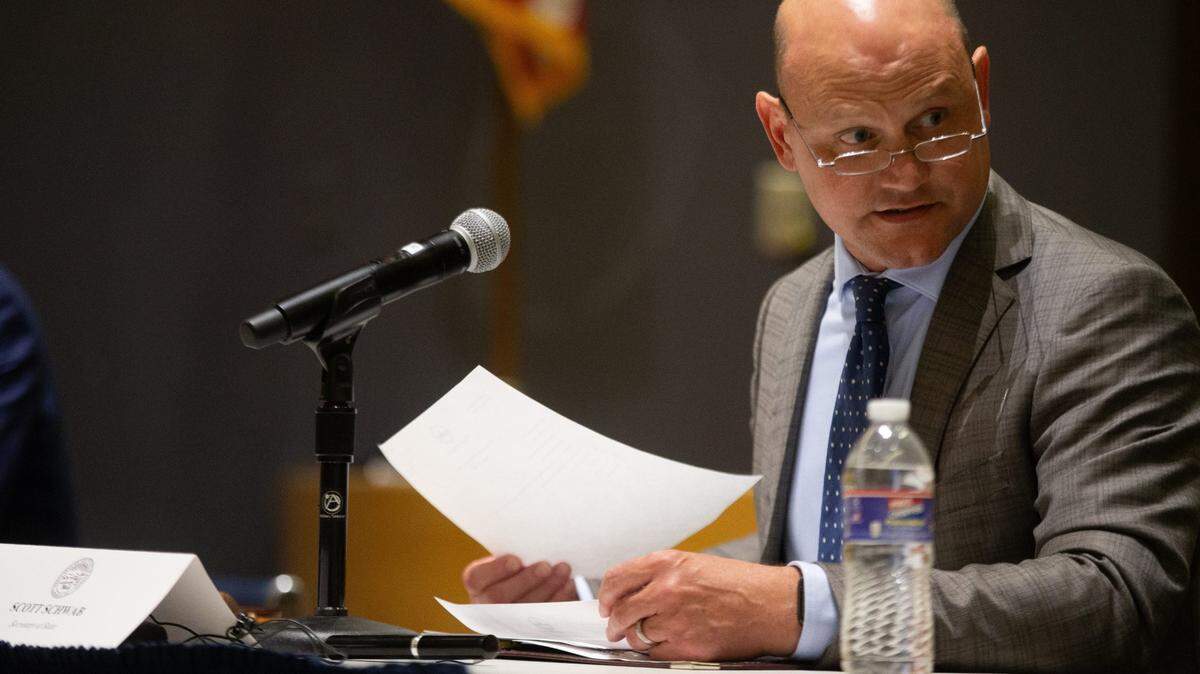
A squabble between the offices of Democratic Gov. Laura Kelly and Republican Secretary of State Scott Schwab could have cost Kansans their vote in the 2024 presidential election.
That’s according to records obtained by The Star and comments by their staffs, who each blamed the other for the problem.
Kansas, which voted overwhelmingly for Trump, missed a legal deadline for certifying its six Electoral College votes – a mistake that risked disenfranchising the state’s 1.3 million voters if members of Congress had objected.
It was the only state to miss the deadline. In a close presidential election, members of Congress could have used the error as a reason to not count the state’s votes.
The dispute appeared to center on whether the official form certifying the state’s electoral votes would use ‘A.D.’ – the abbreviation of “Anno Domini,” a Latin phrase that means “in the year of our Lord.”
Schwab, who is running for governor, had included the abbreviation. Kelly wanted it removed, according to Schwab’s spokesperson.
Kelly’s office would not confirm the reason for the dispute, originally attributing the situation to “drafting errors” before sending a second comment calling it an “administrative error.”
But records from Schwab’s office provided in response to an open records request show the original draft of Kansas’ certificate said “A.D. 2024” in two places. The final version did not.
It was the only difference between the two copies.
Will Lawrence, Kelly’s Chief of Staff, said the original document was sent to the governor’s office around mid-day on December 11, the day of the deadline set for states to submit the form, called a Certificate of Ascertainment, to Congress and the National Archives. The document was signed and submitted by December 12, one day late.
“The draft had not been approved by the Governor’s Office, and included an administrative error identified by our legal counsel,” Lawrence said. “This lack of planning by Secretary Schwab’s office resulted in the certificate being submitted late by his office to Congress. I sincerely hope Secretary Schwab and his staff are better prepared to handle these administrative issues in the future.”
Whitney Tempel, the communications director for Schwab, called this characterization “disingenuous.” She said Schwab’s office removed “A.D.” from the draft and sent it back the same day. She did not say what time.
“She refused to sign a document that had the phrase “in the year of our Lord” or “A.D.” by the signature,” Tempel said. “This does not mean that we were late.”
Records from the National Archives show that Kansas used “A.D.” on similar certificates in 2012, 2016 and 2020.
Kelly signed the Certificate of Ascertainment in 2020. Her office did not respond when asked whether it had employed a new policy that no longer included A.D. on ceremonial documents.
A new certification process
Other states varied on whether they used “A.D.” in their Certificates of Ascertainment, a practice in the legal community called “ceremonial deism.” Some states, like Georgia and Wisconsin, did not include it. Others, like Idaho and Connecticut, wrote “A.D.” Delaware and Hawaii wrote out “in the year of our lord.”
This was the first year where states were required to certify their electoral votes by a specific day: Six days before the electors are required to meet to cast the state’s votes, which is on the first Tuesday after the second Wednesday in December.
Daniel Weiner, the director of government and elections at the Brennan Center for Justice, said the legal deadlines were set in part so that there would be time to make revisions before the Electoral Votes were cast in the event of a mistake or legal challenge.
“It was unfortunate that they missed the deadline, but of course, we honored the will of Kansas’ voters. I think it was an important precedent in that sense,” Weiner said. “A squabble, justified or otherwise like this, is not going to be justification to disenfranchise the people of a state. And I absolutely think that should be the norm going forward.”
Star reporter Jonathan Shorman contributed to this article.
This story was originally published January 22, 2025 at 7:00 AM.