New voting restrictions a top priority for emboldened GOP supermajorities in Kansas
Kansas Republicans are wasting no time pursuing tighter voting restrictions as they aim to capitalize on expanded supermajorities in the House and Senate this year.
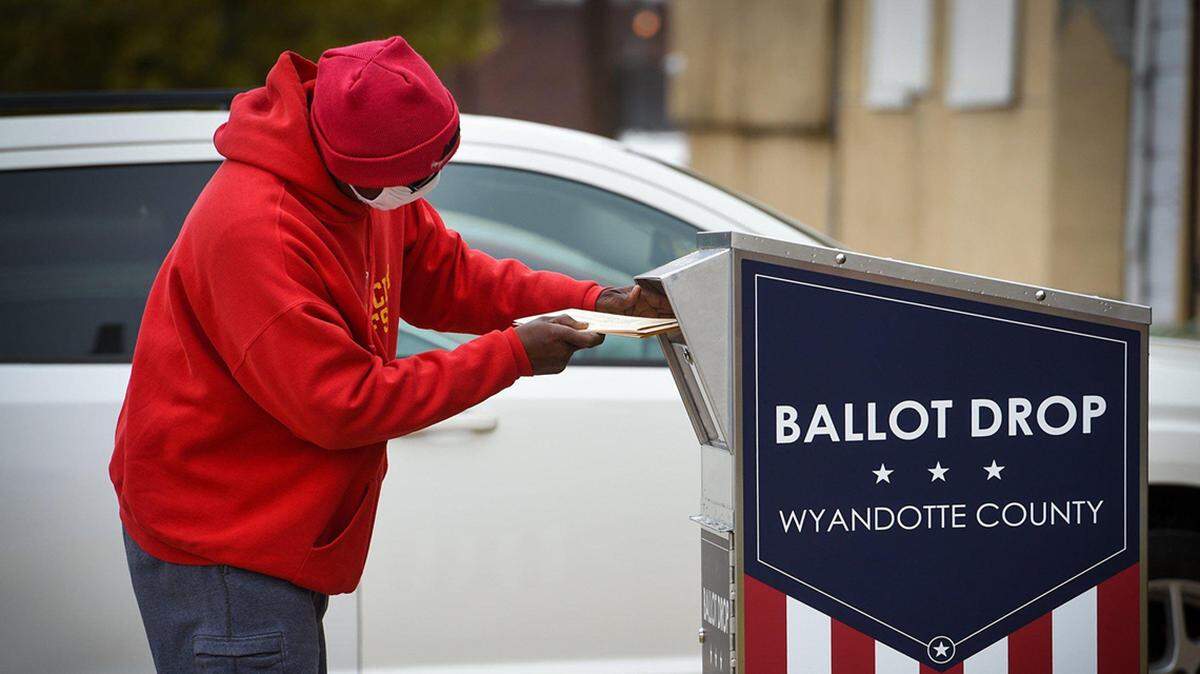
On Tuesday’s first day of committee meetings, GOP lawmakers introduced a series of familiar bills that would tighten regulation of ballot drop boxes and eliminate the state’s three-day grace period for late-arriving mail ballots.
Republicans also put forward bills banning ranked choice voting and seeking an amendment to the Kansas Constitution explicitly stating that non-citizens are not allowed to vote, despite the fact that voting laws already limit voting rights to citizens.
“Anybody who tells you that non-citizens aren’t voting in Kansas, they’re lying to your face because the truth is we don’t know,” said Rep. Pat Proctor, a Fort Leavenworth Republican who chairs the House elections committee.
A constitutional amendment, he said, would ensure that future initiatives to identify and scrub non-citizens from the voter rolls could survive legal challenges. Claims of widespread non-citizen voter fraud in Kansas and across the U.S. have never been substantiated.
Grace periods and drop boxes
One longtime priority of conservative lawmakers, eliminating the three-day grace period for postmarked ballots that arrive after Election Day, has renewed momentum. In October 2024, a federal appeals court panel determined that it’s illegal to count late-arriving ballots in Louisiana, Mississippi and Texas, a ruling voting rights advocates hope to appeal to the U.S. Supreme Court.
Kansas is one of at least 16 states and the District of Columbia that allows late-arriving ballots to be counted, according to data compiled by the Center for Election Innovation and Research, a nonprofit group that works to build confidence in elections. Many of those states accept ballots for much longer than Kansas, including Washington State, which counts postmarked ballots up to three weeks after Election Day.
“Will limiting the freedom to vote make life more affordable for Kansans and improve their quality of life? No,” said Senate Minority Leader Dinah Sykes, a Lenexa Democrat, at a press conference Tuesday.
Sykes criticized efforts to eliminate the grace period and warned that Republicans could renew their fight to ban the use of ballot drop boxes, an effort that stalled out in 2023.
Rather than an outright ban, Proctor’s committee has taken up a bill that would grant Secretary of State and gubernatorial hopeful Scott Schwab the authority to uniformly regulate where drop boxes can be located and what security measures must accompany them. A similar bill passed in the House last year but not the Senate.
In Leavenworth County, the only available drop box is located in front of the sheriff’s office and features a mounted camera, Proctor said.
“But I’ve also been to counties where the drop box is a slit in the side of a county courthouse where you can put your ballot, your property tax payment or your license renewal form. Not as secure,” Proctor said.
Rep. Silas Miller, a Wichita Democrat on the elections committee, said drop box security is important but doing anything to make them less accessible to voters would be a step in the wrong direction.
“I’m not a fan of restricting voter rights at all. Making it harder for people to vote is not American or Democratic in my opinion,” Miller said.
“It’s going to disproportionately impact certain people. It’s going to make it harder for people that are working two, three, four jobs, which I’ve been there.”
Ranked-choice voting
The bill aiming to prohibit ranked-choice voting, a process that allows voters to rank their preferred candidates in order of preference, comes on the heels of Missouri voters approving a measure banning the little-used practice after a Republican push to do so.
Ranked-choice voting is not used in Kansas statewide elections and no Kansas municipalities use it in local elections, the secretary of state’s office told lawmakers last year. The Kansas Democratic Party did use ranked-choice voting to determine the winner of the state’s 2020 presidential primary.
Sen. Mike Thompson, a Shawnee Republican who chairs the state and federal affairs committee that took up the ranked-choice voting ban, said the novel voting method would be costly to educate voters on and could ultimately disenfranchise people.
“It’s complex. It’s confusing to a lot of people. Heck, it’s confusing to me. I’m having a hard time explaining it,” Thompson said. “I just think for statewide elections and things like that, I don’t think there’s a place. They do use it in some local elections, and I think that will be part of the discussion. Where does it make sense and where does it not make sense?”
Proctor said he’s “not a fan” of ranked-choice voting and his committee would strongly consider any bill related to it that the Senate sends their way.
This story was originally published January 15, 2025 at 12:37 PM.