Missouri’s new governor is keeping a lot of the same people in charge. Why that matters
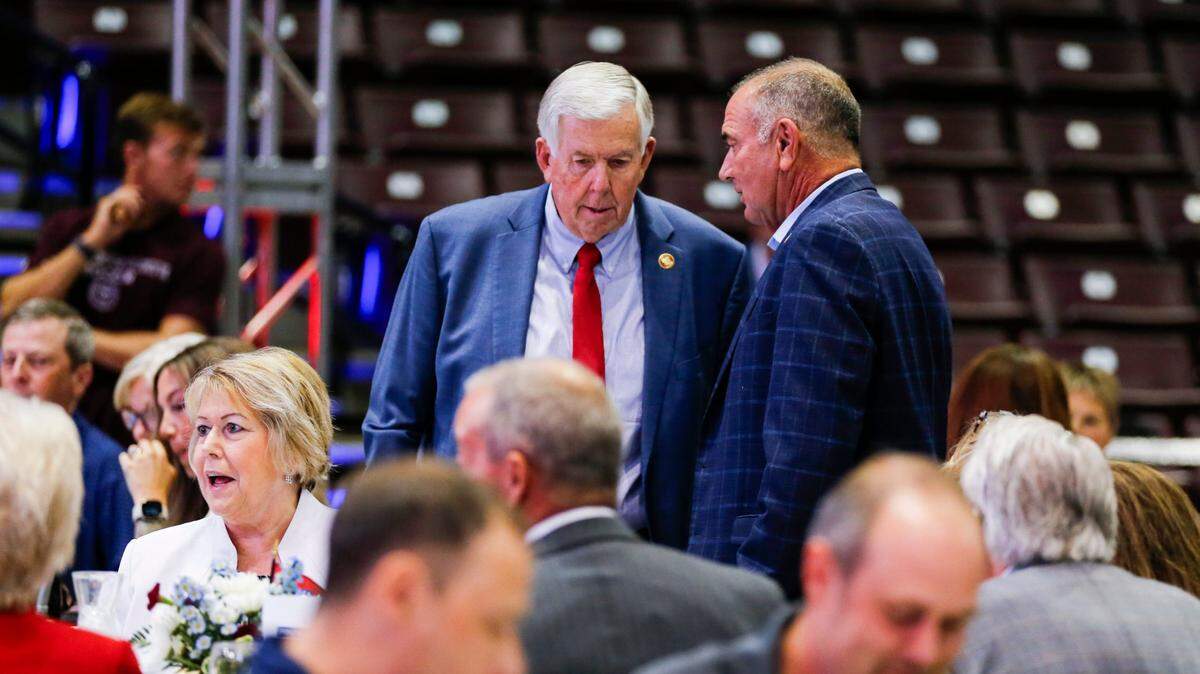
Missouri Gov. Mike Parson will leave office in January — but many of his top deputies are sticking around.
Gov.-elect Mike Kehoe, who began rolling out his cabinet picks shortly after he won the November election, has so far announced he is retaining at least five — nearly half — of Parson’s appointees to lead key state agencies. The officials collectively play a key role in guiding the operation of state government.
The holdovers include the officials in charge of overseeing the day-to-day management of state government, crafting the state’s yearly spending plan, managing economic growth and tourism, promoting the agriculture industry, handling unemployment programs and directing Missouri’s prison system.
Together, the appointments signal that Kehoe, who spent the past six years as lieutenant governor, is relatively content with the way those government agencies have operated under his predecessor.
In one instance in which Kehoe did not retain one of Parson’s choices — the director of the Missouri Department of Public Safety — he chose Mark James, who held the same position under former Republican Gov. Matt Blunt until he left office in 2009.
State senators and policy advocates who spoke with The Star largely framed Kehoe’s picks for state agencies as non-controversial, a sign of what could be a rather seamless transition from one Republican governor to another. However, Kehoe still has not announced his picks for six other state agencies, including two that oversee health care and child services.
“This is the first time that…you’ve had a transition from one Republican executive to another Republican executive in recent history,” said James Harris, a Jefferson City-based Republican consultant.
Harris, who recruited and vetted potential appointees under Blunt’s administration, said he suspects that Kehoe and his transition team are comfortable with many of the agency heads who will remain in their positions.
“They like maybe some of the policy or efforts different agencies are pursuing,” he said.
Kehoe spokesperson Gabby Picard emphasized Kehoe’s experience working with members of Parson’s administration during his time as lieutenant governor and in the Missouri Senate. She said Kehoe believes that Parson’s administration “created a solid foundation to build on in the years ahead.”
“Parson Administration leaders who have an interest in continuing their service to the State of Missouri are and will continue going through an interview process with the transition team to determine their potential fit in the new administration,” Picard said in an email.
While meeting with potential candidates, Kehoe laid out his vision for the state and the departments, Picard said. This included an emphasis on his expectation that cabinet leaders spend eight hours a month meeting with state regulators to review the necessity of regulations.
Republican infighting
But while Kehoe has retained several of Parson’s top officials, he still has not announced his choices for some of the state’s most influential agencies such as the Missouri Department of Social Services and the Missouri Department of Health and Senior Services.
Those appointments, which will administer the state’s rollout of health care policy, could still prove to be controversial, potentially in the Missouri Senate. Senators, who must confirm Kehoe’s picks, have been divided amid fierce Republican infighting over the past several years.
The state Senate collapsed into a complete meltdown last legislative session when a group of hard-right senators held up a series of Parson’s appointments as a bargaining chip. The 25 appointments included Parson’s picks to lead the Department of Social Services (DSS) and the Department of Health and Senior Services (DHSS).
Sen. Mike Cierpiot, a Lee’s Summit Republican, said he hasn’t heard of any opposition to Kehoe’s appointees so far. He said he broadly supports the Republican’s choices.
“I would give a lot of deference to who the governor, of either party, who they want to put in the positions to lead to help their administration, because it’s kind of somebody they have to work with,” Cierpiot said. “Unless there’s a real problem, I would always defer to the person picking them.”
But Cierpiot added that he anticipates Kehoe will make changes to DSS and its Children’s Division, which handle the foster care system and investigate child abuse or neglect.
Darrell Missey, the Children’s Division’s sixth director under Parson, resigned from the position last month. The division has faced significant turnover in leadership over the years, intense scrutiny and calls for reform over issues such as staffing shortages, missing foster kids and unlicensed boarding schools.
“I would guess they have trouble getting somebody to take that job,” Cierpiot said. “It’s just a subject matter that’s very difficult because when families break down and kids are in crisis, there’s no easy fix.”
‘Maintaining some stability’
Ahead of the Nov. 5 election, Kehoe’s Democratic opponent for governor, House Minority Leader Crystal Quade, had criticized Parson’s previous choices to lead state agencies, arguing that the Republican had prioritized politics over experience.
“What I have seen under the Parson administration is a lot of folks appointed to positions who don’t have experience in those roles,” Quade, a Springfield Democrat, told The Star’s editorial board in September.
However, as Kehoe has started to announce his picks — many of which retain Parson’s previous appointees — Democratic lawmakers have not raised significant alarm about his choices.
“Quite frankly, I’m grateful to see Gov.-elect Kehoe is moving in a direction of maintaining some stability in folks who have understanding of these departments,” said Sen.-elect Maggie Nurrenbern, a Kansas City Democrat. “They should essentially be a job that doesn’t get a lot of headlines, that should stay out of the news for all the wrong reasons.”
Nurrenbern went a step further and praised Kehoe’s decision to keep Dan Haug, the state’s longtime budget director. The choice was particularly important as the state will attempt to navigate an anticipated downturn in funds caused, in part, by a series of tax cuts enacted over the years, she said.
“He has had the unique experience of serving under multiple administrations, Democratic and Republican,” Nurrenbern said of Haug. “I think his institutional knowledge about the budget is truly one of a kind.”
Oftentimes a new administration is met with turnover in top agencies, said Peverill Squire, a political science professor at the University of Missouri-Columbia. However, Squire said he expects there won’t be a major contrast between the Parson and Kehoe administrations.
Squire pointed to the fact that Parson appointed Kehoe as lieutenant governor and supported his campaign for governor. That “continuity situation” could make life easier for Kehoe, who will be able to work with people he already knows, Squire said.
“I think barring any sort of major scandal that emerges … to the extent things are running reasonably well, there’s probably no incentive for Kehoe to try to shake things up,” Squire said. “He probably doesn’t want to head in a direction particularly different from where Parson had taken us.”
Kehoe’s pick to oversee prisons
One agency that has been particularly rife with controversy is the Missouri Department of Corrections.
Kehoe announced last month that he would be keeping Trevor Foley as head of the department. Foley, who has worked in state government since 2001, was appointed by Parson to lead the agency late last year.
The agency has faced near-constant pressure for years amid concerns over prison health care, a growing number of deaths within Missouri’s prison system and a flurry of related lawsuits.
But Lori Curry, executive director of Missouri Prison Reform, which advocates for incarcerated individuals, said she was relieved when Kehoe announced he was keeping Foley. Curry said her organization did not have a good history working with Anne Precythe, the previous director.
When Parson appointed Foley as Precythe’s successor last year, Curry said she didn’t know what to expect. It was around the time that Othel Moore was killed while incarcerated in Jefferson City. Moore’s death was ruled a homicide, and four corrections officers were charged with his murder.
Curry said she spoke with Foley about Moore’s death and asked him to look into it.
“He responded, which was something different than what Precythe would have done, she never responded to anything I sent her,” Curry said. “And he did say it would be looked into and it was.”
That experience, Curry said, gave her hope that things would be different under Foley. That has continued over the past year in which Curry would reach out to him with concerns and he would address them.
“I hope this continues, that he continues to look into things,” Curry said. “I hope that it’s indicative of the next four years for the Department of Corrections and maybe some additional accountability.”
For Harris, the Republican consultant, Kehoe has spent the past six years often working hand-in-hand with Parson’s administration. That experience means he and his team have good working relationships with many people serving in Parson’s cabinet.
“Any new governor will probably have changes on maybe priorities within agencies,” Harris said. “But I think that is an…indication that the governor-elect feels comfortable with what many of the directors are doing and work that the various agencies are doing.”
This story was originally published December 11, 2024 at 6:30 AM.