Missouri business groups are suing to overturn voter-approved minimum wage increase
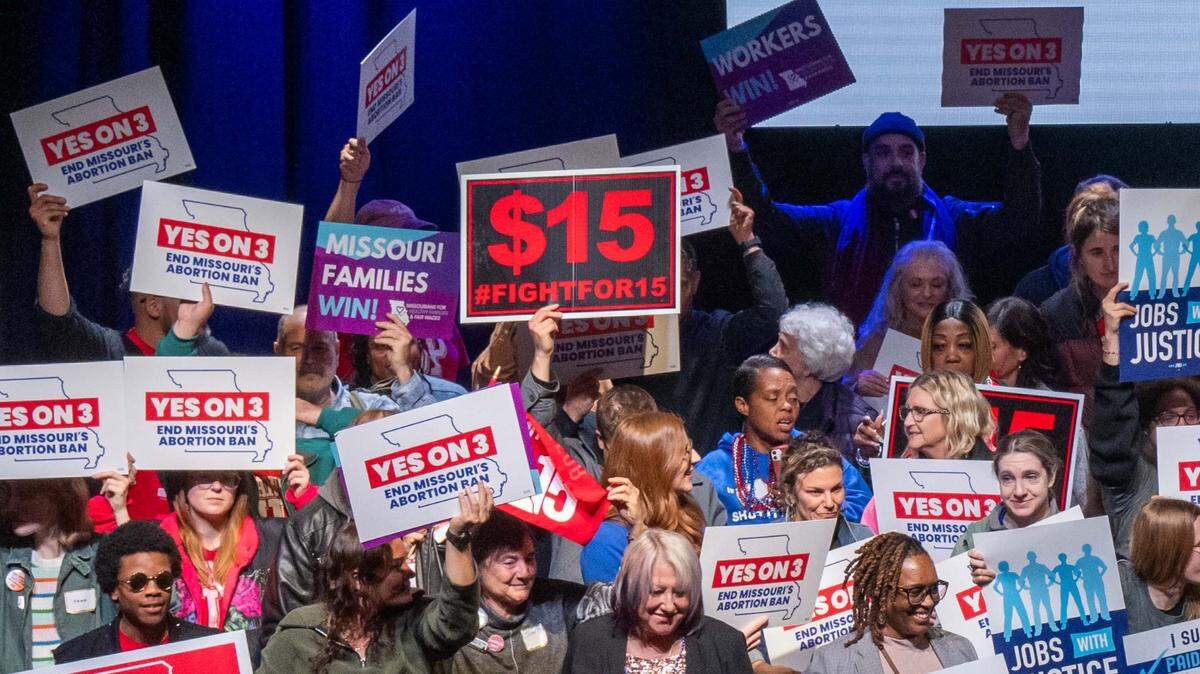
A coalition of Missouri business advocacy groups are suing to toss the election results in which voters raised the state’s minimum wage and guaranteed paid sick leave to workers.
The election challenge, filed Friday, asks the Missouri Supreme Court to set aside the results of Proposition A, which 57.6% of voters approved last month. It raises a series of issues, including an allegation that the question violated a requirement that ballot measures only deal with one subject.
“While Proposition A is bad policy and will have extreme and detrimental effects on Missouri’s businesses, that is not the basis of this action,” the petition said. “Instead, the election irregularities and the constitutional violations are so significant that the election results must be overturned and Proposition A must be declared invalid.”
The challenge names Secretary of State Jay Ashcroft and state Auditor Scott Fitzpatrick as defendants, who were both in charge of crafting the measure’s fiscal estimates and summaries.
The coalition challenging voters’ decision includes representatives from the state’s leading business organizations, including the Associated Industries of Missouri, the Missouri Chamber of Commerce and Industry, the Missouri Forest Products Association, the Missouri Grocers Association, the Missouri Restaurant Association and the National Federation of Independent Business.
The legal challenge comes as Missouri Republicans have been angered over recent statewide votes on issues seen as progressive, including last month’s votes to raise minimum wage and legalize abortion in the Missouri Constitution. Republican lawmakers are also weighing legislative efforts to limit both measures.
The major campaign supporting Proposition A, called Missourians for Healthy Families and Fair Wages, released a statement denouncing the lawsuit on Monday. The statement included a quote from Terrence Wise, a low-wage worker and leader with Stand up KC, who criticized the move.
“Missouri’s working class, in lockstep with allies across the state, went to the ballot box on November 5 to overwhelmingly voice our need for paid sick days and fair wages in a free and fair election,” Wise said. “It’s sickening to me that corporations are trying to steal our victory away and quiet the will of the voters who made this win possible.”
Wise, who is also a leader with the Missouri Workers Center, added that the lawsuit was “un-American.”
“With Prop A we have a chance for change and hope, and we will come together as low-wage workers and Missourians — Black, white, and Brown — to defend it,” Wise said.
Friday’s filing marks a way for business groups to challenge the election results without legislative action. It alleges that the measure violates the single-subject requirement because Proposition A contained the minimum wage increase and the earned sick leave requirement.
The ballot measure gradually raises the minimum wage. The current minimum wage of $12.30 an hour will grow to $13.75 an hour on Jan. 1, 2025, and to $15 an hour in January 2026. The wage will then be adjusted annually based on inflation.
It also requires employers with 15 or more workers to provide one hour of paid sick leave for every 30 hours worked. According to the proposal, the earned sick leave provision would not apply to government workers, retail or service employees who work for a business that makes less than $500,000 a year, people who are incarcerated, golf caddies, and babysitters, among others.
In addition to the single-subject concern, the election challenge takes issue with the exemption for government employees and alleges that it violates the equal protection clause of the U.S. Constitution.
It also alleges that the measure’s summary statement and fiscal note summary — the estimates of how much the measure would impact government funds — were misleading.
Incoming House Minority Leader Ashley Aune, a Kansas City Democrat, criticized the lawsuit in a statement on Monday, saying that Proposition A “protects employees and helps provide a path to the middle class.”
“Missourians would be better served by employers doing right by the workers who keep their businesses running—rather than trying to overturn the will of the voters with meritless litigation,” Aune said.
Direct democracy
Successful post-election challenges are typically unheard of in Missouri. However, Friday’s challenge comes just months after the state Supreme Court tossed the results of a 2022 vote in which voters approved a measure forcing Kansas City to pay more for its police.
The extraordinary decision found that Missourians were misled by statewide officials when they approved the measure, a major victory for Kansas City Mayor Quinton Lucas who sued over the ballot question. The court ordered a new election, which was held in August.
Lucas’ challenge centered on a measure that state lawmakers put on the ballot. In recent years, lawmakers have grown increasingly frustrated with progressive-leaning measures that citizens have placed on statewide ballots through the state’s initiative petition process.
The minimum wage increase, abortion rights, Medicaid expansion and marijuana legalization all got to statewide ballots through voter-led initiative petitions, a more-than-100-year-old process that allows voters to bypass lawmakers and approve policy measures.
Missouri Republicans, who control every statewide office and both chambers of the General Assembly, have targeted this mechanism for direct democracy in recent years. They argue that amending the state constitution has become too easy, giving outside groups too much influence.
However, Democrats and initiative petition defenders argue the current process allows voters to directly participate in democracy.
This story was originally published December 9, 2024 at 11:38 AM.