Missourians approved an abortion rights amendment. But what happens next for access?
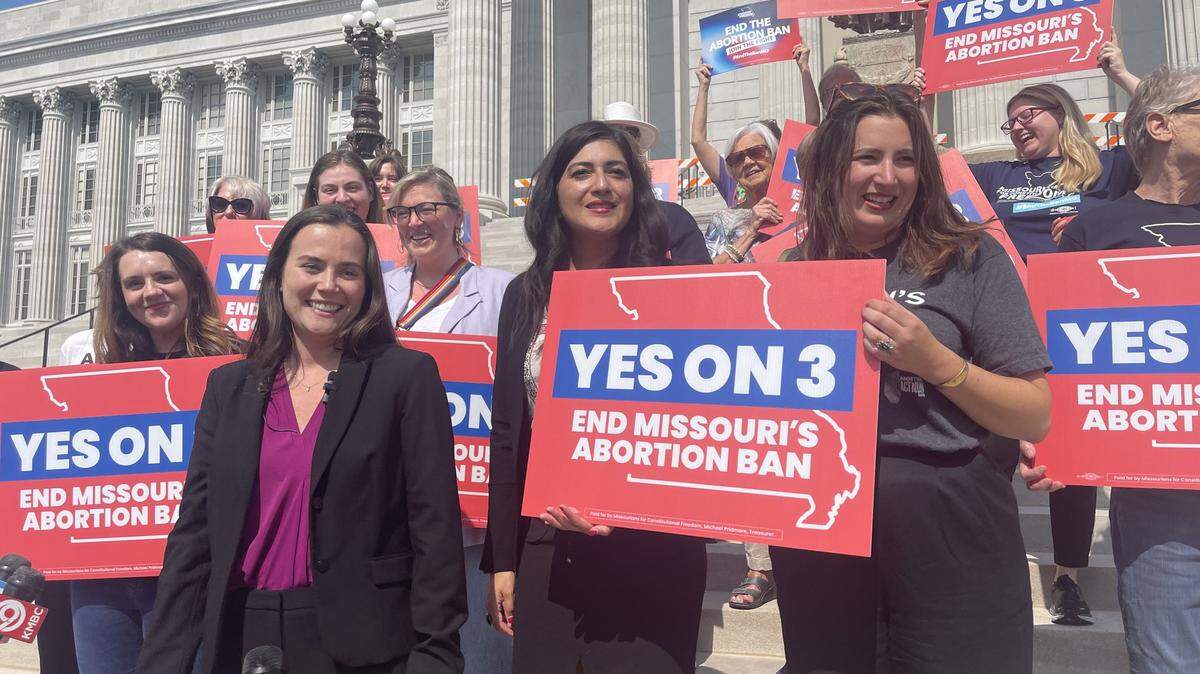
Missouri abortion rights advocates scored a historic victory on Tuesday after voters enshrined the right to an abortion in the state constitution, effectively overturning the state’s near-total ban.
But what happens next?
As supporters celebrate, the timeline of restoring abortion access in Missouri will likely be decided in the courtroom.
Missouri, led by staunch anti-abortion politicians, had for decades imposed restrictions on abortion providers that ultimately led to the near-total ban in 2022. Abortion rights supporters will likely move quickly to strike those regulations — and the abortion ban — down in court.
At the same time, Republican lawmakers have already signaled plans to file legislation that would put a constitutional amendment on the 2026 ballot to weaken, or completely strike down, the right to an abortion.
While the process of restoring access in the state remains murky, what is clear is that Tuesday’s victory for abortion rights marks a new chapter in the fight over reproductive rights in both the state Capitol and in the courtroom.
“I do think Missourians will be frustrated, but at the end of the day, there has been an incredible amount of momentum and interest and support to restore abortion access, and you have to start somewhere,” Emily Wales, the president and CEO of Planned Parenthood Great Plains, said before Tuesday’s vote. “We will do everything we can to restore access as quickly as possible.”
Abortion access will not return to Missouri overnight, according to constitutional experts, lawmakers and abortion rights supporters and opponents. But the amendment offers a path for supporters to strike down the abortion ban and restrictions, allowing doctors and providers to eventually offer the procedure again.
The amendment, called Amendment 3, enshrines the right to reproductive freedom, including abortion, in the Missouri Constitution, severely preventing the state from restricting abortion before fetal viability. However, under the amendment, lawmakers can ban post-viability abortions.
Amendment 3 will officially take effect 30 days after Tuesday’s vote. That deadline is almost certain to jump-start a series of legal battles over how far-reaching the amendment can protect the right to an abortion.
A key focus for abortion rights advocates will be the cluster of TRAP laws or “targeted regulation of abortion providers,” that lawmakers have enacted over the years.
The regulations, which include a 72-hour waiting period before women can obtain an abortion, effectively caused the number of abortions in Missouri to drop from 6,163 in 2010 to 150 in 2021 before the ban was enacted.
Court decisions regarding restrictions on medication abortion, the most commonly used form of abortion, will also be a major factor in how soon Missouri would allow telehealth abortion access.
The court battles over Missouri’s TRAP laws will likely center on a key passage in the amendment that states “the right to reproductive freedom shall not be denied, interfered with, delayed or otherwise restricted unless the government demonstrates that such action is justified by a compelling governmental interest achieved by the least restrictive means.”
Mary Ziegler, a law professor at the University of California-Davis, said the language in the amendment gives abortion rights advocates “real firepower” to strike down the restrictions. But the state Supreme Court will have the final say over whether the restrictions are removed, she said.
While abortion rights providers remain optimistic that the courts will move quickly to restore access, others were more cautious in the lead-up to Tuesday’s vote. Pamela Merritt, a longtime abortion rights activist originally from Missouri, predicted that it could be years before clinics reopen in the state.
Merritt predicted that certain restrictions would be struck down, but not enough for clinics to open up on either side of the state, in Kansas City and St. Louis.
“That’s not going to be permanent,” she said. “But that’ll probably be the pattern for five to 10 years.”
Kansas City Mayor Quinton Lucas was more optimistic about access being restored, saying before Tuesday’s vote that Amendment 3 would “make an incredible difference” and signaled that restrictions on abortion would be struck down in court.
“This is a constitutional amendment. I do believe judges swore an oath to uphold the Missouri Constitution,” he said. “I believe that if the voters support Amendment 3, then we will seek reproductive health care and access to birth control, abortions with reasonable restrictions, back in the law of the state of Missouri.”
Republican response
Before Tuesday’s vote, publicly available polling consistently showed broad support for abortion access in Missouri. In the days and weeks leading up to Election Day, Republican lawmakers began previewing their response to the measure if it passed.
“The platform of the Republican Party continues to be pro-life,” said Jean Evans, a former executive director of the Missouri Republican Party. “I think you’re going to continue to see people fight for, you know, pro-life issues, and they may address that in different ways.”
The amendment allows lawmakers to restrict abortion after viability and the GOP-controlled legislature would almost certainly pass a ban on abortions late in pregnancy. Any post-viability ban would be required to allow at least three exceptions – for the life, physical and mental health of the woman.
Several Republican lawmakers, along with anti-abortion lobbyist Sam Lee, have also said they expect lawmakers to propose restrictions to abortion access if Amendment 3 passed. One of those options is to put a constitutional amendment on the 2026 ballot to repeal or weaken abortion access.
“We’re really going to have to look at a game plan in order to mitigate some of the effects if Amendment 3 does pass,” said Sen. Denny Hoskins, a Warrensburg Republican running for secretary of state.
Sen. Mike Cierpiot, a Lee’s Summit Republican, framed the amendment as “unfettered access to abortion,” a common argument among Republicans opposed to the amendment.
“Once (voters) understand what they’ve actually done, if it passes, I think there’ll be an appetite to make some changes in that to make it more reflective of where people are,” he said. “I think Republicans went too far when we didn’t allow for exceptions for rape and incest. And I think the pro-choice people have gone too far.”
While Republicans were poised to maintain control in Missouri, Democratic lawmakers have suggested that they would fight to restore access if Amendment 3 passed.
Sen. Barbara Washington, a Kansas City Democrat, pointed to the fact that Democrats mounted a record-breaking filibuster last session in response to legislation that would have weakened direct democracy in the state.
There will be lawsuits to stop the implementation of Amendment 3 and legislation to “attack it at every measure,” Washington predicted.
“So there’ll be a fight, and Democrats are ready to fight,” she said. “We fought this last year for 50.5 hours and we’re ready to go as long as we need to to protect the rights of all Missourians.”
This story was originally published November 5, 2024 at 10:44 PM.