‘A breakdown’: Kansas missed signs dead ex-official worked both sides of $425K grant
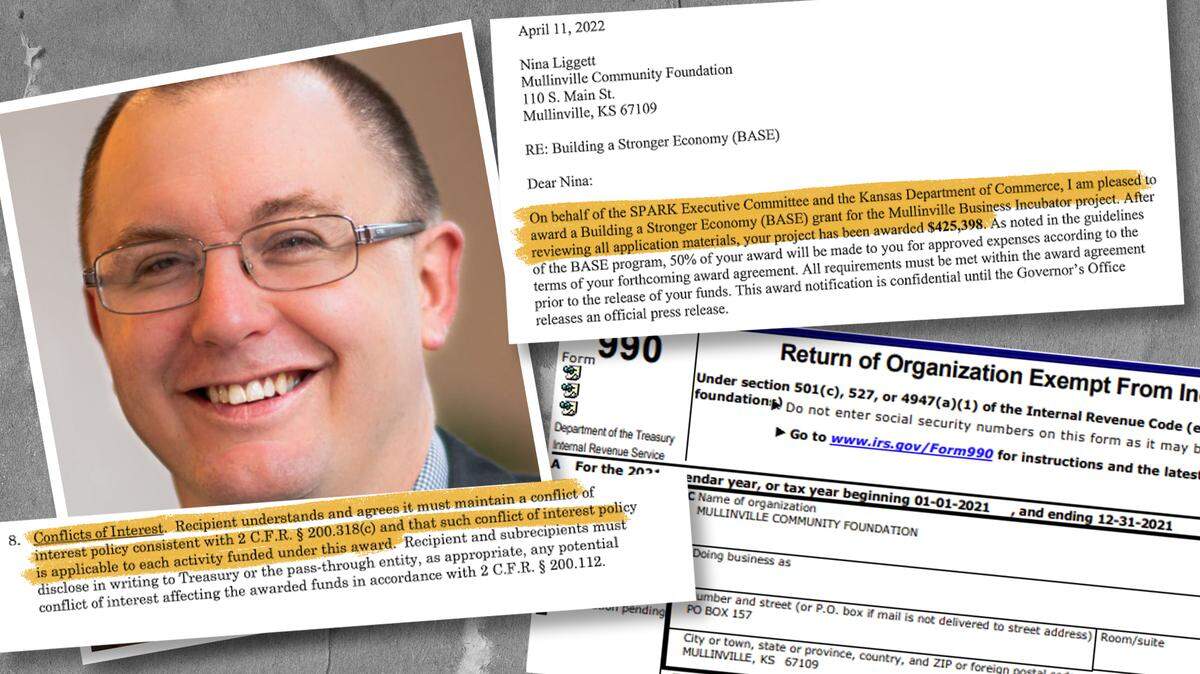
A former Kansas Department of Commerce official suspected of embezzling public funds handled money for a community foundation that received a $425,000 grant while he oversaw the same grant at the state agency that awarded it, an apparent conflict of interest now coming under scrutiny.
Two top Commerce officials — Lt. Gov. David Toland, who leads the agency, and Robert North, the agency’s general counsel — signed off on the grant amid warning signs that the official was working on both sides of the grant.
The former official, Jonathan L. Clayton, died in August in a single-vehicle crash as he faced mounting suspicion of wrongdoing and as a past felony conviction in Pennsylvania became more widely known in Kansas. Until October 2023, Clayton had been the director of economic recovery at Commerce, where he oversaw more than $100 million in programs funded by federal pandemic dollars. The agency didn’t conduct a criminal background check before hiring him.
Clayton’s death has attracted significant attention, coming after he went missing on Aug. 3 and before an apparently posthumous email from him made allegations of misconduct involving Commerce, which the agency denies. The Kansas Bureau of Investigation in late August said it had found no evidence of foul play, but the investigation was continuing.
In April 2022, Commerce approved a Building a Stronger Economy, or BASE, grant of $425,398 for the Mullinville Community Foundation. The group focused on improvements in Mullinville, a town of roughly 200 in western Kansas where Clayton grew up.
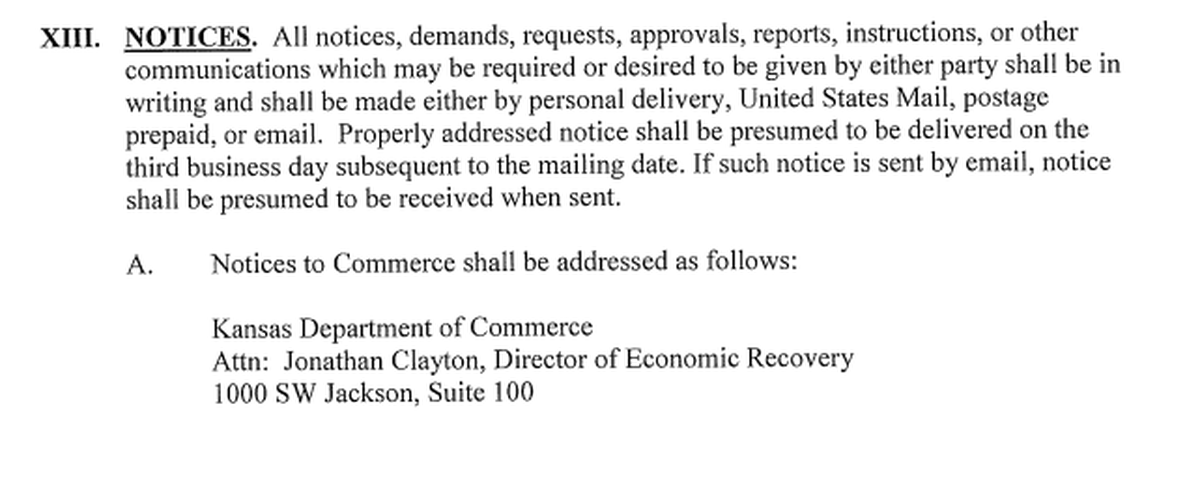
The grant agreement listed Clayton as the official point of contact at Commerce. The document directed the foundation to send all notices, requests, reports and other communications to him.
But Clayton, 42, was also on the Mullinville Community Foundation board of directors at the time, serving as secretary-treasurer. The position gave him entrée into the group’s finances, access he is now suspected of abusing, while the state official tasked with keeping an eye on the grant was him.
At least some portion of those funds are missing.
“It was just all in Jonathan’s hands,” Rob Roberts, a foundation board member, said in an interview. “And he said he was getting this money, and we got this money, and I had no dealings with the money or anything like that.”
Roberts, a semi-retired Army veteran, said he had known Clayton since the “day he was born.” He was a likable kid, Roberts said.
“After he graduated he went away and I don’t know what all he did and then he came back and wanted to help the town, he said,” Roberts recounted. “He wanted to help himself, I guess.”

Documents raise red flags
Even as Mullinville reels from Clayton’s suspected wrongdoing and sudden death, how he managed to oversee a grant worth hundreds of thousands of dollars that he was also involved in spending raises uncomfortable questions for Commerce. Anti-fraud experts interviewed said Commerce’s controls against conflicts of interest clearly broke down and that the arrangement shouldn’t have happened.
Grant documents obtained by The Wichita Eagle and The Kansas City Star show red flags that with review should have made the conflict apparent, including that the phone number listed for the foundation on the grant application belonged to Clayton. An image of a foundation check included in the application was signed “J. Clayton.”
Additionally, Clayton’s hometown was known inside Commerce. When the agency initially brought on Clayton in 2020 as a regional project manager, a news release announcing the hire identified Mullinville as his hometown. Publicly-available business records also show Clayton was one of four people who incorporated the foundation in 2021.
Witt O’Brien’s, a risk management and emergency response firm hired by Commerce, is investigating Commerce’s awarding of the BASE grants. Clayton, in an email apparently sent automatically after he went missing in early August, alleged that he had helped alter the scores of grant applicants at the direction of Toland, who Democratic Gov. Laura Kelly appointed to lead Commerce in 2019 and then as lieutenant governor in late 2020.
Commerce has denied the allegations. Kelly has defended Toland and her office has said Toland initiated the investigation.
“Taking the facts at face value, there was clearly a breakdown in the conflict-of-interest controls at both the Department of Commerce and the Foundation,” Bob Westbrooks, a former executive director of the federal Pandemic Response Accountability Committee, wrote in an email.
Commerce spokesman Patrick Lowry said in a statement on Thursday that the agency “took action on Jonathan Clayton’s employment at the time the agency became aware of his involvement on behalf of the Mullinville Community Foundation.”
Lowry didn’t say when that happened, but Clayton in his posthumous email wrote he was told to resign on Oct. 6, 2023. Commerce filed a lawsuit against the Mullinville Community Foundation on Aug. 7 — four days after Clayton went missing.
Mullinville conflicts
Mullinville, a speck of a town along U.S. 400 about 120 miles west of Wichita, has been losing residents for years. The 2010 Census recorded a population of 255. By 2020, it was 197. An estimate two years later placed the number at 188.
Amid that reality, Clayton and three others incorporated the Mullinville Community Foundation in May 2021. The initial business filing listed Clayton’s post office box as the group’s official mailing address.
“For the betterment of the Mullinville, KS community and surrounding area,” the filing listed as the foundation’s purpose.
In February 2022, the foundation submitted its BASE grant application. It requested $425,398 — the exact amount approved.
Toland, the Commerce secretary, told the foundation in an April 11, 2022, letter that he was awarding the foundation the BASE grant. A grant agreement dated July 15, 2022, was signed by North, the Commerce general counsel.
The grant would center on two projects.
One would focus on repairs for the Mullinville Business Incubator, a building along Main Street aimed at fostering small businesses. Repairs and weather-proofing were needed to help the incubator grow and attract more tenants. It had only one business tenant — CK Vintage, a shop operated by Christopher King, who was Clayton’s husband. It is also Mullinville City Hall.
A second project would help revitalize an old high school building that previously housed an antique mall. The loss of the antique mall had harmed the state’s sales tax revenue and finding a way to open new business in the old school building could generate revenue and jobs, the application said. It is owned by the Mullinville Recreation Commission.
CK Vintage moved out in 2023 when Clayton and King moved to Peabody. Neither building has attracted any new businesses to Mullinville.
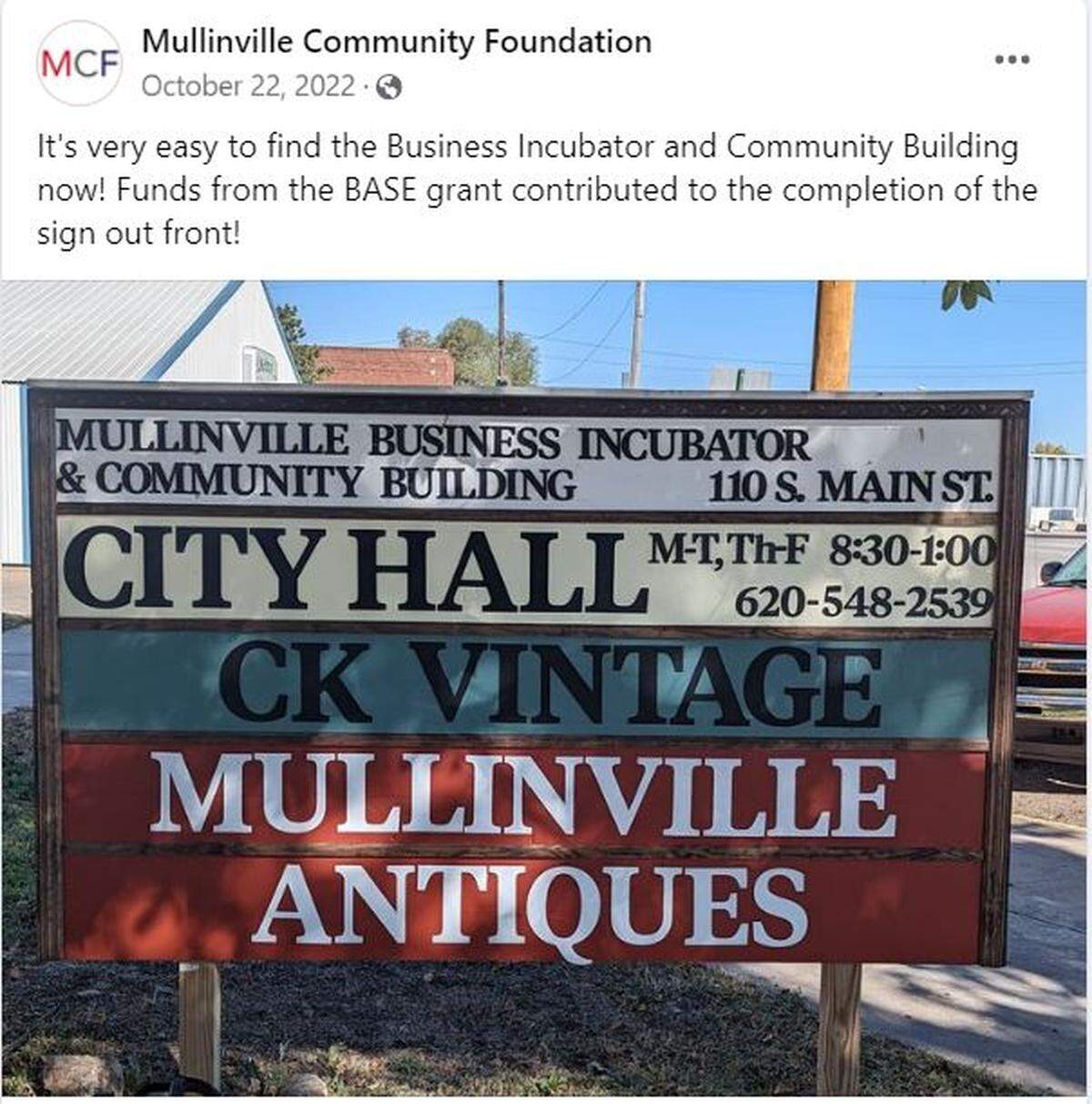
The true aim of the project was to renovate and repair two neighboring buildings that local governments couldn’t afford on their own, Mullinville Mayor Andy Kimble said in a phone interview.
The city building would get a new roof and ADA-compliant front doors, and the high school building would get a new roof and interior upgrades.
Clayton had family and financial connections to both properties that represented conflicts of interest that should have barred him from being involved in the grant process under state and federal rules.
His stepmother, Susan Clayton, is a city council member for Mullinville and the secretary for the Recreation Commission. His husbandowned the only business within the incubator — CK Vintage — which is located in the same former elementary school as the city building. Clayton ran an antique mall that operated on weekends at the former high school owned by the Recreation Commission, Kimble said.
Susan Clayton declined to be interviewed for this story.
Kimble said the improvements to the city building were finished, but the project at the Recreation Commission’s building was not completed. Records show the Mullinville Community Foundation has $211,251.67 in unspent funds.
‘That’s the worst part’
Clayton’s involvement in applying for the grant, administering the grant, controlling the grant money and then potentially directly financially benefiting is an extreme example of what goes on with nonprofit funding every day across the country with little oversight, said Cindy Miles, president and CEO of Kansas Alliance for Nonprofits.
Miles said a lack of accountability for problems of self-dealing and conflicts of interest incentivizes bad behavior while putting ethical nonprofit organizations at a disadvantage. It can put nonprofits in a position where they feel they have to cheat to survive, she said.
“Sometimes, when you look at a lot of nonprofits that receive government funding, it really is about who you know and who’s on your board and who you have connections with,” Miles said. “And it’s frustrating.”
The BASE grant program was highly competitive, with 35 projects selected in the first round out of 440 cities and organizations that applied. In total, 72 projects received funding through two rounds of funding.
Clayton claimed in an email sent after his disappearance that Toland chose who received grant funding in the first round based on political considerations, rather than which projects were most deserving.
In August, Commerce said in a statement that Clayton’s allegations of wrongdoing by the agency related to the awarding of BASE grants “are categorically false.”
While projects such as the Mullinville Incubator project received funding almost right away, critical projects like a new water treatment plant for the city of Osawatomie, which provides treated drinking water to employees and patients at the Osawatomie State Hospital, had to wait.
Other projects denied funding during the first round included a wastewater treatment project in Tonganoxie, street funding in Goodland and other small infrastructure projects across the state.
“That’s the worst part about this — when anyone acts outside the law or ignores conflicts of interest — the good actors with worthy projects suffer,” Miles said.
While Kimble said the project was important to the city of Mullinville, it wasn’t critical to the survival of the city or economic development in the state of Kansas.
“It wasn’t make or break for the city,” Kimble said. “Yeah, we appreciated the help we got on our building. I’m not going to deny that.”
The BASE grant also failed to spur any economic development, the Department of Commerce’s primary objective.
The majority of the money from the BASE grant would have covered storm damage at the high school, a move that was necessary because the Recreation Commission couldn’t afford to carry insurance on the building. Besides Clayton’s antique mall business on weekends, the former high school was unoccupied — before and after the grant was awarded.
“We’ve got an incubator that’s sitting empty if you want to start a business,” Kimble said. “I don’t want to get advertising that way, but if somebody needed to set up a satellite office for once or twice a month to come out and do business in this part of the world, you know, they can use it for that.”
Kimble said he was aware of Clayton’s potential conflict of interest. He said Clayton assured him that he and Commerce had come up with a plan to avoid it.
“In one of the conversations I remember with Jonathan, the way he explained it to me when that particular grant came onto the table for the group to discuss it he had to leave and not be part of the discussion. That is how he explained it to me on that side,” Kimble said.
“So, yeah . . . he was on both sides of that grant because he was on that foundation, he wrote the grant, and then turned it in to the Department of Commerce. But that’s the way he explained it to me, and that’s all I know because I wasn’t in the room when that happened.”
Commerce aiding investigations
Federal regulations require organizations awarded federal grant dollars to prevent conflicts of interest — a policy noted in the Mullinville Community Foundation’s grant agreement.
Lowry, the Commerce spokesman, said the agency is aware of federal policy regarding conflicts of interest and had taken “all necessary and appropriate actions” to meet federal requirements.
“Commerce has also requested and is assisting local, state, and federal agencies investigating Clayton’s volunteer work with community-based organizations in Kiowa and Marion counties who might be victims of fraud,” Lowry said.
The agencies include the U.S. Department of Treasury Office of Inspector General, the FBI, Kansas Bureau of Investigation and the Kiowa County Sheriff’s Office, according to Lowry.
Commerce has also changed its conflict of interest policy since the Mullinville Community Foundation BASE grant, though Lowry didn’t say whether Clayton helped spur the change. The old policy placed the onus on employees to recognize and disclose conflicts.
“Associates are responsible for recognizing the potential for conflict of interest,” it read.
By contrast, the new policy, which took effect in June, requires employees to disclose all outside employment or service on boards and commissions to their supervisor.
Westbrooks, the former executive director of the federal Pandemic Response Accountability Committee, said in general grant management positions at the Kansas Department of Commerce should be required to regularly disclose all outside positions, whether paid or volunteer, to identify potential conflicts of interest before they occur.
“That is a separate preventative control,” Westbrooks said.
In Kansas, state employees must also complete statements of substantial interests, which list any organizations where an employee or their spouse sit on the board of directors or are an officer.
Clayton’s statements of substantial interest never listed his board membership on the Mullinville Community Foundation. Instead, it said he sat on the Mullinville Community Building Association Board.
It’s unclear whether Clayton was referring to the foundation or another organization. Those disclosures are filed with the Kansas Secretary of State’s Office and can be reviewed by the Kansas Governmental Ethics Commission. But no one at the ethics commission checks the disclosure statements for accuracy unless an issue is reported to them.
‘A little concerned’
Even setting aside the conflict of interest, experts said Clayton likely shouldn’t have been working at Commerce in the first place given his financial felony conviction.
Clayton previously pleaded guilty to charges in Pennsylvania stemming from his time as an administrative assistant at vRide, a ridesharing platform in Philadelphia. Clayton was accused of stealing more than $200,000 from vRide, in part to help fund a fledgling theater operated by him and King.
In 2018, Clayton was sentenced to months of house arrest, followed by five years of probation and ordered to pay more than $200,000 in restitution (he still owed about $195,000 as of June).
“This guy was prosecuted, found guilty, the records were all there. Somebody in Kansas should have identified that. So that’s really where it starts,” said Ron Steinkamp, a St. Louis-based fraud prevention and detection expert.
Kelly’s administration has said a FBI-involved background check wasn’t performed because no state law authorized a check into the positions Clayton held at Commerce. Kelly has voiced support for changing the law to open up the positions eligible for the checks.
Kansas lawmakers last week authorized a state audit into the pre-employment screening process used by Commerce to vet job applicants working with financial matters. A separate audit will examine the process used to award the first round of BASE grants.
The audits are separate from the outside investigation into the BASE grants that Commerce initiated.
Commerce is also suing the Mullinville Community Foundation. In a petition filed Aug. 7 in Kiowa County District Court, the agency seeks an order requiring the foundation to immediately return any unspent grant funds and to repay the full $425,398.
Commerce said in the court document that it had provided notice to the foundation that it was in default under the grant agreement four times in June and July. Judge Sidney R. Thomas in late August ordered the foundation not to spend or withdraw any funds from its bank account.
Roberts, the foundation board member, said he doesn’t know what is going to happen to the funding. He said all he knew was that Clayton said he “had all this money.”
Whether Clayton did, Roberts doesn’t know.
“Jonathan’s a very likable young man, he really was,” Roberts said. “And I felt like we could really trust him.”
This story was originally published September 20, 2024 at 5:30 AM.