Kansas Republicans want to require abortion providers to ask patients why they sought care
Kansas Republicans want women seeking abortions in the state to tell them what led to their decision.
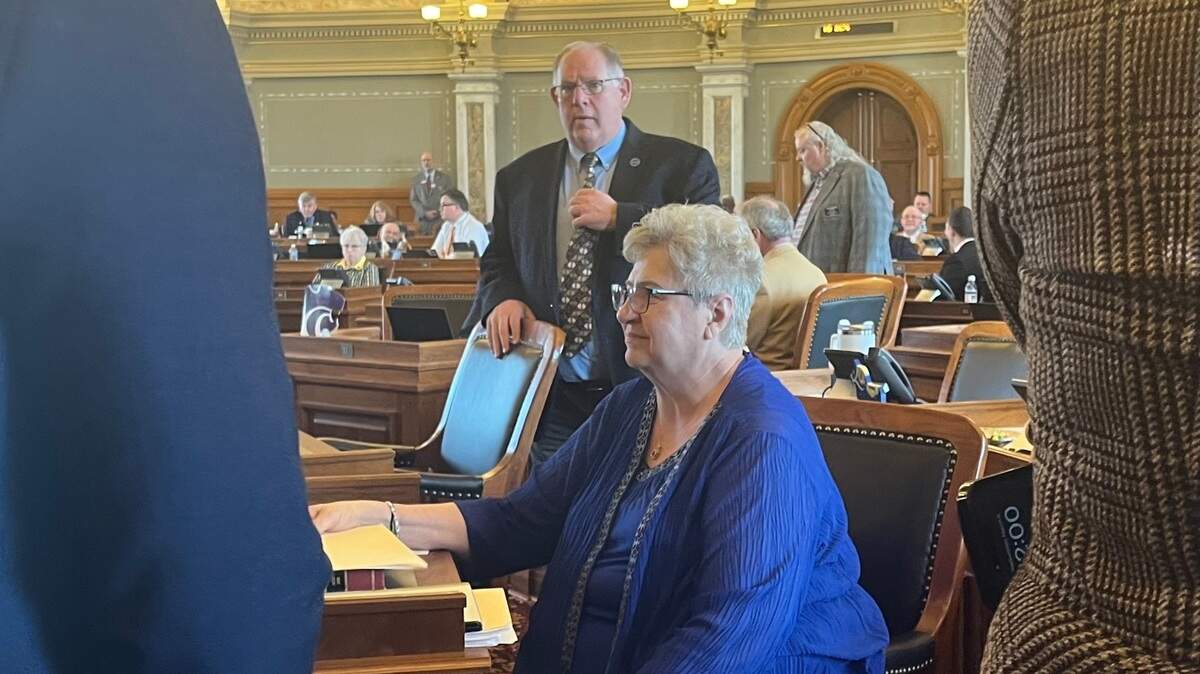
Following their first debate on abortion rights this year, the Kansas House in a voice vote on Wednesday advanced a bill requiring more consistent and detailed reporting on abortions obtained in Kansas, including a survey for patients to choose the most important reason they sought their abortion from a pre-prepared multiple choice list.
The House voted 81 to 39 to pass the bill Thursday. It now heads to the Senate.
The proposal represents the latest attempt by anti-abortion activists and lawmakers to legislate on the topic in a way that doesn’t violate strict protections for the procedure within the state constitution. Kansans overwhelmingly voted to retain those protections in 2022.
Currently, the Kansas Department of Health and Environment releases an annual report on the number of abortions performed in the state, the method used for those abortions and the state where the patient came from.
According to the Guttmacher Institute, a research group that supports abortion rights, 46 states require some form of abortion reporting. Of those, 16 ask about a patient’s reason for obtaining an abortion with nine of them asking about reasons beyond rape, incest, fetal abnormalities and health of the mother.
The proposed legislation would ask KDHE to release that report twice a year and include reasons each patient sought an abortion based on a list of 11 options crafted by Kansans for Life, the state’s largest anti-abortion organization. The list includes a variety of possible reasons including health issues, financial stress, threats to a person’s career and family pressure.
Patients will have the option to decline to answer.
Advocates say this information will help lawmakers better support women with unplanned or unwanted pregnancies. Jeanne Gawdun, a lobbyist for Kansans for Life, said the data could guide decisions on addressing “social concerns” leading to abortions.
“Today we have an opportunity to have more services for women when they get in these positions,” said Rep. Brenda Landwehr, a Wichita Republican. “As policy makers we need to understand what is occurring and what else we can do to help these women make a more informed decision, now if they decide to have an abortion that’s their decision.”
But abortion providers said the requirements are an unwelcome intrusion on a private medical decision that oversimplifies abortion. That, she said, could include asking a patient who is a rape and incest victim whether the rape or incest played a larger role in their decision.
“It’s really interfering with the provider and patient relationship in a way that is stigmatizing to both,” said Katie Baylie, Legislative Director for Planned Parenthood Great Plains Votes.
Gawdun said the bill simply asks for data abortion providers already provide to research groups like the Guttmacher Institute. However, Baylie said any research study on reasons for abortion is entirely voluntary and Planned Parenthood clinics in Kansas do not ask their patients for this sort of information.
“There is nothing in this bill that is more invasive or intrusive than the status quo,” said Rep. Ron Bryce, a Coffeyville Republican and physician who argued any medical appointment already mandates intrusive and detailed questions.
Rep. Lindsay Vaughn, an Overland Park Democrat, argued that lawmakers already have information at their disposal to know what financial and social issues may contribute to a decision to have an abortion. The bill, she argued, would be used to target those having abortions, rather than solve social issues.
“We already know that these issues exist yet this body continually fails to act on them,” Vaughn said. “If we really cared about women, why are we still waiting for a hearing on Medicaid expansion?”
The reporting bill is one of several sought by anti-abortion advocates this year, including a measure that would ensure an unborn child be considered for child support, a bill making it illegal to coerce someone into an abortion, and measures to provide tax breaks or state support to anti-abortion crisis pregnancy centers.
Proponents have argued these measures are important to ensure support for pregnant women as laws governing abortion are overturned in Kansas courts. Kansas still bans abortions at or after 22 weeks and requires parental consent for the procedure. But laws governing information that must be provided to patients and mandating safety requirements beyond that of a normal medical clinic have been blocked by courts in the years following the state Supreme Court’s 2019 decision finding a right to an abortion.
“We want to offer as much assistance as can be to help these women who want to choose life to meet their needs,” Gawdun said. “That’s what everything we’re doing this year is about.”
But Baylie said this is a clear example that these organizations, and anti-abortion lawmakers, have disregarded the will of the voters who opted to retain abortion rights in 2022 and are a pathway toward ultimately banning abortion.
“They’re doing these policies like the personhood bills or the more incremental policies that have the same goal but they can fall under the radar because they’re not as egregious or they’re under the guise of being something that may help people,” she said.
Clarification: An earlier version of this story stated that the bill asked patients to rank their reasons for seeking an abortion. The bill asks patients to identify the most important reason for their abortion.
This story was originally published March 6, 2024 at 2:09 PM.