After 13 years, Kansas is no longer in court over school funding. Will it stay that way?
When the Kansas Supreme Court ruled in 2019 the Legislature had developed a constitutional plan to fully fund public schools, the justices kept oversight of the case.
For the past five years, lawmakers knew that if they failed to uphold the plan and fully fund K-12 education, the court could step in. But this week the court released their jurisdiction.
Democrats and public education advocates are now voicing anxiety that the Republican-controlled Legislature will feel freer to rewrite the state’s school funding law in ways that will drop funding below constitutional levels. GOP lawmakers are already pushing to overhaul how special education dollars are counted and how schools measure success.
Republican leaders say they’ve lived up to promises they made to the Supreme Court years ago to abide by the court’s decision, called Gannon. Still, even some rank-and-file lawmakers are hearing concerns from within their districts.
“I just hope it continues,” Rep. Dave Younger, a Ulysess Republican and former school superintendent, said.
“I’ve had superintendents call me and they’re worried, they’re worried about it. I’m worried about a generation of kids, that we might go back to the days where it’s not funded.”
The Supreme Court retained jurisdiction in 2019 so they could ensure the Legislature implemented the phased-in funding proposed in the school finance plan. “That has occurred,” Chief Justice Marla Luckert wrote in an order Tuesday releasing jurisdiction.
The order came after Kansas Attorney General Kris Kobach, a Republican, in November asked the court to give up control of the case.
Democratic Gov. Laura Kelly sought to file an amicus brief urging the court to retain jurisdiction but the court rejected the brief. In a copy of a brief provided to The Star, her administration argued the Legislature could not be trusted to maintain constitutional funding after fulfilling the “bare minimum for constitutional compliance.”
Her office warned that the Legislature will have the opportunity to rewrite the school finance formula when the current statute expires in 2027 and that any deviation from constitutional funding would now require years in court to resolve – the latest school finance lawsuit was filed just a few years after a separate case closed in 2006.
The order prompted celebration among Republican lawmakers that the appropriate balance between the Legislative and judicial branches had been restored.
“I think it was timely, I think it’s fair and I think we all need to move on and allow the Legislature to make good decisions for our schools,” said Rep. Kristey Williams, an Augusta Republican and Chair of the House K-12 Budget Committee.
As lawmakers begin to consider the school budget for next year, Sen. Renee Erickson, a Wichita Republican and vice chair of the Senate Education Committee, said the removal of the court’s jurisdiction wouldn’t change anything.
“This narrative that is being put out by the legislative establishment that ‘oh, the evil Legislature is going to start cutting schools’ is beyond the pale,” she said. “We all want what’s best for kids. What we want to do, though, with the money they are receiving is make sure that kids are getting the best quality education and holding them accountable.”
“For decades they used lack of funding as a reason why students were not achieving. We’re saying, now you have the money, we’re great with that. We want to see the results.”
But Democrats point to proposals Republican lawmakers have pursued in recent years that they say would have violated the lawsuit settlement.
For instance, earlier this year the House K-12 Budget committee held a hearing on a bill that would have changed how schools calculated their populations for funding purposes. Kelly vetoed that same policy last year arguing it would have reduced rural district funding and violated the state’s constitutional obligation to fully fund schools.
Senate Minority Leader Dinah Sykes, a Lenexa Democrat, said the finance lawsuit served as an effective deterrent in the past four years when lawmakers considered small changes to the K-12 funding formula.
“I think we will see them more emboldened and chipping away at the funding or sending more to private schools, and I think we will be back in court in a couple of years,” she said.
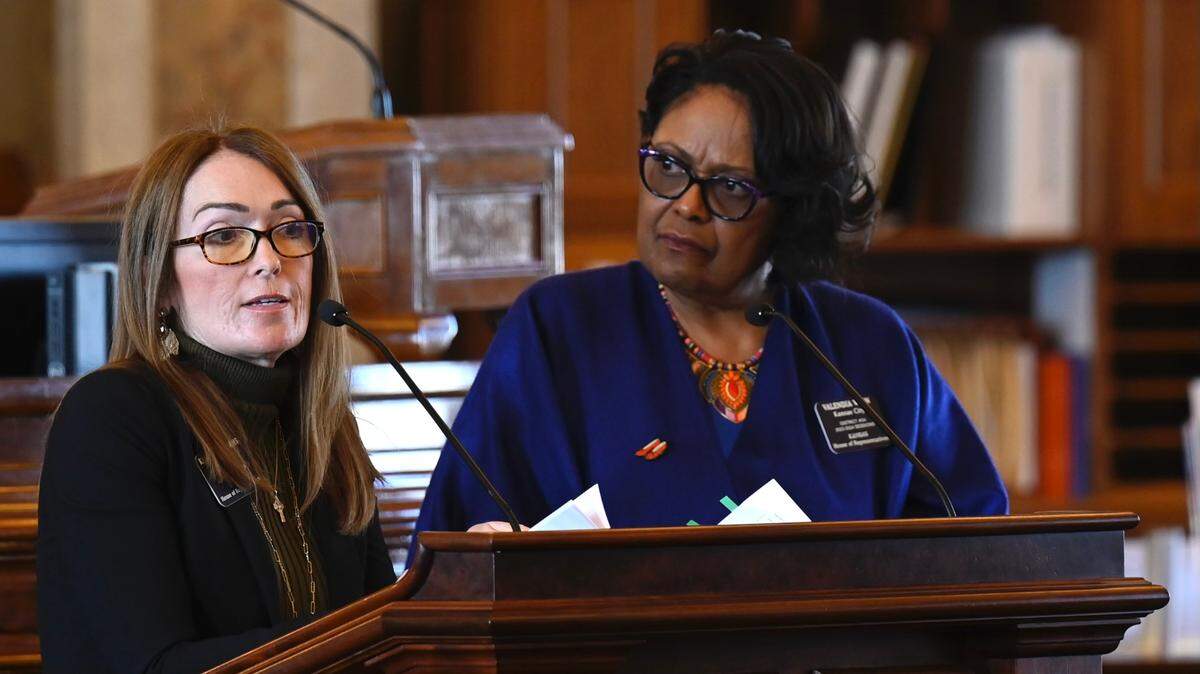
Rep. Valdenia Winn, a Kansas City, Kansas, Democrat, said she was optimistic full funding would remain but saw bills, like one heard in the House K-12 budget Committee Wednesday, that reduced funding to schools that didn’t meet goals for at-risk students as red flags.
“Filing another lawsuit is very simple, it’s a piece of paper,” Winn said, noting that lawmakers would remember the years of litigation and want to avoid a return.
The question of constitutional funding will likely also come up as lawmakers contemplate special education funding. For years the state has fallen short of the amount of funding specified in state statute, but lawmakers this year are looking to alter the funding formula rather than simply infuse more funds as public education advocates want.
Schools have said they have had to pull from general education funds in recent years to serve special education students.
“We need to continue to work to help legislators understand how important special education funding is to the whole picture of constitutional Gannon funding,” said Leah Fliter, a lobbyist for the Kansas Association of School Boards.
Concerns over continued funding, Rep. Adam Thomas, an Olathe Republican, said, reflect a heavy focus on the negatives rather than productive negotiations for schools.
“I don’t think we’re facing a Legislature that’s going to just come in and go ‘well the court’s out of it we can just do whatever we want,’” Thomas, who chairs the House Education Committee, said.
Lawmakers are already beginning discussions about what changes could or should be made to the state’s school finance formula when the existing statute expires in 2027.
In the meantime, Sen. Brenda Dietrich, a Topeka Republican and former superintendent, urged cautious optimism.
“I’m sure that people were worried if we would go back to those days where we didn’t have funding for education and we had to beg for every dollar,” she said. “I’m not going to get overly worried because the Legislature makes and repeals laws. There’s a process that we go through. So I think people need to watch and wait to see what happens.”
Correction: An original version of this story misidentified Sen. Brenda Dietrich’s party. She is a Republican.
This story was originally published February 9, 2024 at 5:00 AM.