Missouri lawmakers begin session with looming GOP infighting, ethics probe and elections
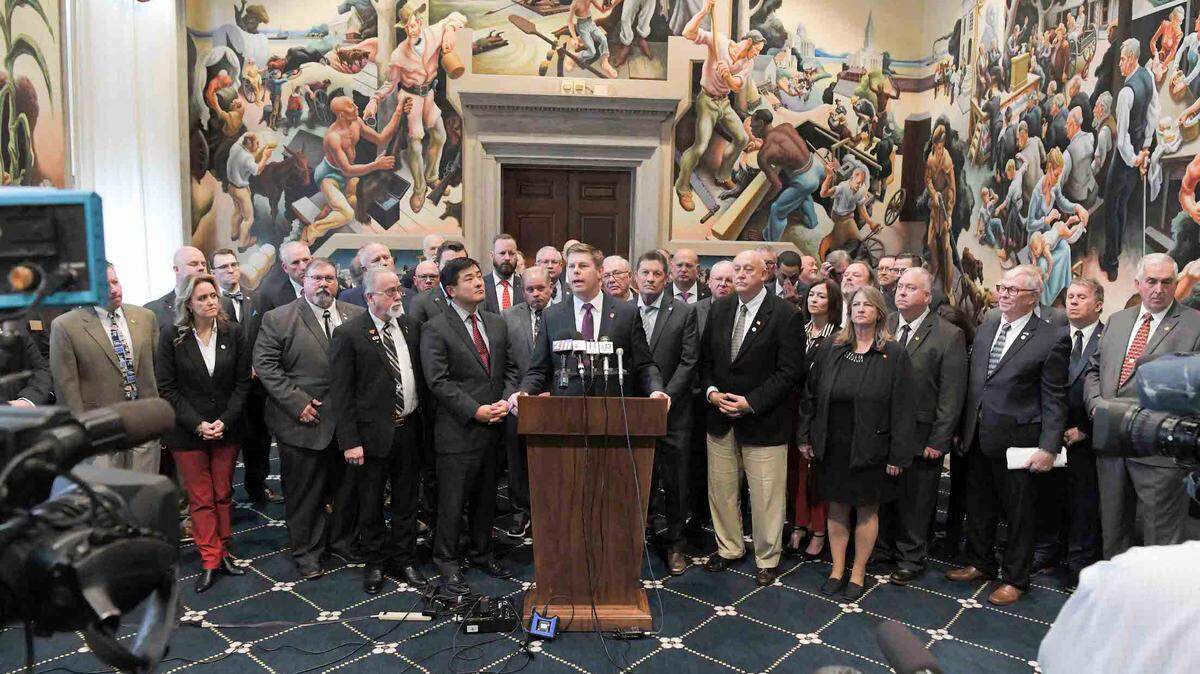
The Missouri House speaker is under an ethics investigation. Hard-right senators could derail work in the state Senate. Lawmakers running for higher office may seize on floor debates to boost their campaigns.
As the Republican-controlled Missouri General Assembly began its annual legislative session on Wednesday, GOP infighting in all parts of the Capitol threatens to thwart action on a variety of key issues.
But House Speaker Dean Plocher, a St. Louis-area Republican, tried to project confidence, even as a House committee investigates him behind closed doors amid a myriad of scandals, including revelations that he received government reimbursements for expenses already paid by his campaign.
“That’s all just doom and gloom and drama,” Plocher, a candidate for lieutenant governor, told reporters as he was flanked by a crowd of GOP lawmakers.
“I want to get past the drama. I believe the drama is going to be behind us shortly,” Plocher said. “Now, what the Senate does, that’s their ballgame.”
Lawmakers are already concerned by the looming expiration of the state’s Federal Reimbursement Allowance, which funds Missouri’s Medicaid system. Some lawmakers expect partisan fights to erupt over renewal of the tax, which occurred in 2021 and forced lawmakers into a special session.
Senate President Pro Tem Caleb Rowden, a Columbia Republican, said it will be clear “fairly early” in the session whether Republican senators can work together and stop some of the infighting that has plagued the chamber over the last three years.
“We’ll see,” Rowden said in a phone interview. “I think if everybody focuses on policy, we can have a good year. If people care more about their futures or settling political scores or whatever, then, you know, it may not be so good.”
While Democrats have welcomed the failure of several GOP-led priorities due to Republican infighting, Senate Minority Leader John Rizzo, an Independence Democrat, said it’s bad for Missourians.
“When they’re fighting, we’re not getting things like child care. We’re not raising teacher salaries. We’re not giving benefits out to senior citizens, whatever it might be that Missourians need or want — the thing of the day or moment,” Rizzo said.
“I don’t know if anybody really wins when they fight, but the Missouri taxpayers certainly lose.”
Plocher, during his opening speech on the House floor, outlined several Republican priorities this year, including recruiting and retaining police officers, stemming the fentanyl crisis, reviewing Missouri’s property tax assessment process and a so-called “parents’ bill of rights” — a familiar slogan for legislation that would allow parents to push back against classroom lessons surrounding race and LGBTQ issues.
But just a year after Missouri lawmakers left Jefferson City without passing some of their major GOP-led priorities, including an attempt to make it harder to amend the state constitution, divisions remain among Senate Republicans. A hard-right faction of senators, formerly called the Conservative Caucus, have rebranded as the “Missouri Freedom Caucus.”
State Sen. Denny Hoskins, a Warrensburg Republican running for Missouri secretary of state, said in a text that the group’s members — which include six senators and at least four representatives — welcome all Republican lawmakers “who want to support and push forward the Missouri Republican Party Platform.”
Hoskins attacked Rowden, saying he would rather negotiate with Democrats “to water down conservative priorities instead of working with Freedom Caucus members to pass conservative bills.”
On the House side, Rep. Tony Lovasco, an O’Fallon Republican, said lawmakers are generally less likely to accomplish things during an election year in which some will use floor debates and cameras to campaign.
“I’m a little pessimistic,” he said. “I think there’s also a lot of cases where people are running against their colleagues for various seats, in which case, they’re in a kind of perverse situation… and people are going to use that strategically.”
House Republicans are also awaiting the results of an ethics investigation into Plocher that is expected to examine his campaign finances as well as his firing of his chief of staff, who may have been a whistleblower and alleged threats against a House staffer related to his push for an expensive IT contract.
“Any time a speaker is an outgoing speaker in his last term, I think he’s less effective,” Lovasco said. “So I think he’s got that working against him, you know, from day one. Whether the news and the headlines or whatnot affects the caucus cohesiveness, I mean, that remains to be seen.”
State Rep. Dan Houx, a Warrensburg Republican, voiced more optimism than some of his colleagues.
“Every time I’ve been up here in an election year and people go ‘oh, you can’t get anything done,’ it always seems like we do get a lot of stuff done,” Houx said. “I don’t believe that pessimistic side of it.”
Missouri Democrats, who typically have to work with the fractured GOP majority to advance their priorities, enter the session with several key issues of their own, including boosting teacher pay, increasing money for K-12 schools, pushing for stricter gun laws, increasing access to child care and attempting to repeal the state’s near-total ban on abortion
House Minority Leader Crystal Quade, a Springfield Democrat running for governor, acknowledged the upcoming elections, as well as “a lot of things that have happened over the past few months, pitting our Senate and House chambers against each other more so than usual.”
“We are apprehensive to what the Republican majority will be able to accomplish this year,” Quade told reporters. “But we are hopeful that there may be some room for some bipartisan things.”
For Rizzo, the Independence Democrat, this year will decide which direction the Missouri Republican Party goes in. The session, along with upcoming elections, “will dictate what the Republican (Party) looks like in the state of Missouri for the next 10, 20 years,” he said.