‘Lose-lose situation.’ Kelly faces calls from education groups to veto school funding bill
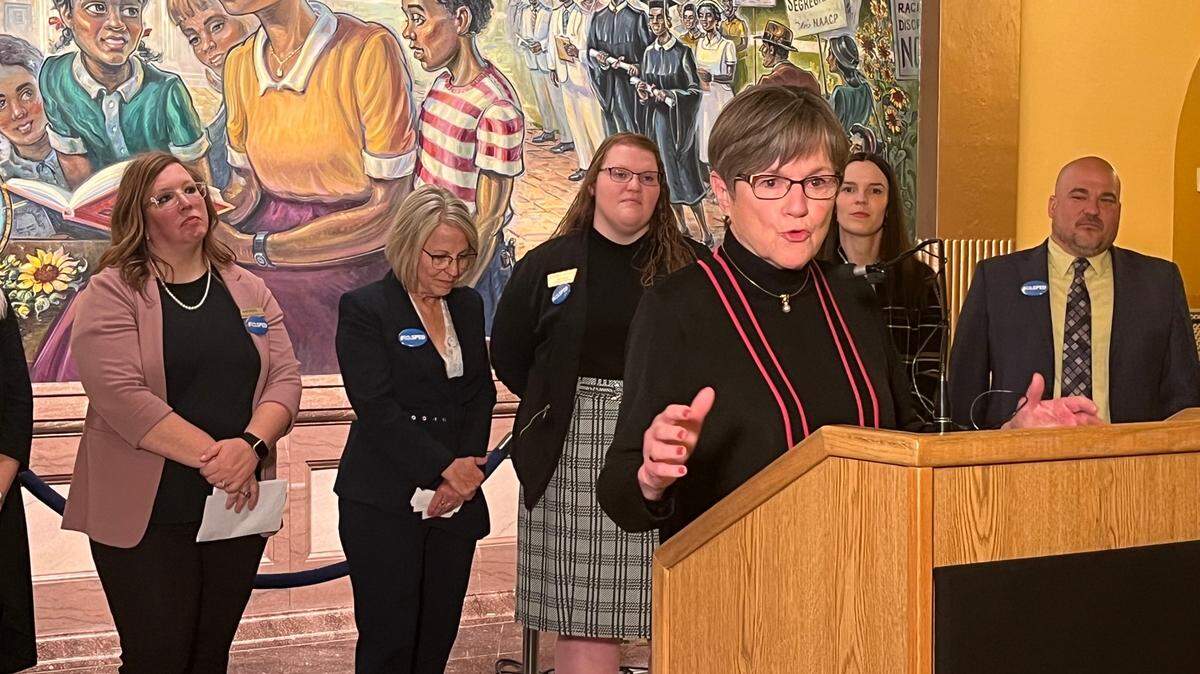
Days before the end of the Kansas legislative session, Democratic Gov. Laura Kelly stood on the third floor of the statehouse, flanked by a dozen Kansas teachers, and affirmed an unwavering support for public education.
“I will not sign a bill that cuts funding for schools,” she said.
“The issue is fully funding our schools and not diverting our public funds to private schools,” she added.
Kelly’s position will soon be tested.
Kelly must decide by May 18 whether to sign or veto a bill that fully funds Kansas’ K-12 schools but ignores her request for enhanced special education funding and expands a tax credit scholarship program for private schools. Public education advocates — key allies of Kelly’s since her first term — are calling for her to veto the policy and call a special session on school funding.
“What we would wish for would be a clean funding bill that complies with the Gannon school finance decision that adds some significant special education funding,” said Leah Fliter, a lobbyist for the Kansas Association of School Boards.
But requiring Kansas lawmakers to return to Topeka and take another shot at education funding does not guarantee a desirable result for Kelly or her allies. And it grants the GOP-controlled Legislature a fresh opportunity to pursue other policies Kelly will oppose.
“This is a lose-lose situation and it really comes down to how much is she willing to lose,” said Alexandra Middlewood, a political science professor at Wichita State University.
Possible special session
Kansas lawmakers formally completed their work for the year last month, forfeiting their opportunities to override any final vetoes from Kelly.
The one exception is K-12 funding. The state has a constitutional obligation to fully fund public schools. If Kelly rejects the Legislature’s proposal, she will be obligated to call a special session to bring the body back to Topeka to either override her or try again.
Kelly, however, cannot limit the Legislature’s work once they are back.
The school funding bill lawmakers passed included an expansion of eligibility for the existing tax credit scholarship program for private schools. It also adjusts the formula for calculating how many students are in a district and receive funding. The change allows schools to use their current year enrollment or their previous year enrollment.
“A lot of the districts who are going to lose either get a lower amount or actual end up negative it’s just that they didn’t know that was coming,” Fliter said. “They’ve already been budgeting and signing contracts based on what current law is and so they’re left kind of, they feel like, holding the bag.”
Current law doesn’t allow schools to use their current year enrollment to calculate population but allows them to pick the highest number of students from the previous three years.
For three straight years Kansas Republicans have separated the education budget from the broader government budget and tied policy changes to the funding.
In 2021 and 2022 Kelly approved those policy changes, accepting an open enrollment policy and moderate expansion of the tax credit scholarship in exchange for full funding.
Rep. Kristey Williams, an Augusta Republican who chairs the House K-12 Budget Committee, said lawmakers would be quick to seek an override if they are brought back for a special session.
“It needs constitutional funding regardless of what small items may be included in the policy; the number one thing has been achieved and the Legislature has spoken,” she said.
Despite repeated pleas for increased special education funding — the state hasn’t reached its statutory requirement for funding since at least 2011 — Williams said she would remain reluctant to infuse those funds this year.
Williams has pushed for a deeper study of the special education funding rather than “throw money at an issue that there is an emotional outcry for.”
Senate Minority Leader Dinah Sykes, a Lenexa Democrat, voted against the funding bill on Kelly’s desk. But she said a special session was unlikely to fix the issues with the bill.
“If it could just be education that’s one thing but honestly I don’t know that it gets any better,” Sykes said. “They don’t have the appetite to put more money in schools and they want to divert those funds to private schools.”
Instead, Skyes said, a special session would be an opportunity for GOP leaders to take another shot at sending a flat tax bill to Kelly or new legislation restricting the rights of transgender Kansans.
Untapped veto power?
Middlewood, the political science professor, said accepting the bill would likely upset Kelly’s most ardent supporters but it wouldn’t harm her or her party in the long run.
However, Kelly could also open up a legal argument if she attempts to use her line-item veto power on the tax credit scholarship expansion and other policy components of the funding bill she opposes.
“That doesn’t help us get money and the funding for special education but it helps in terms of the negative things in it,” Sen. Cindy Holscher, an Overland Park Democrat, said.
A line-item veto could easily result in a court battle between Kelly and the Legislature over the power of the governor.
The Kansas Constitution grants Kelly the power to veto individual lines of appropriations bills. In recent memory, no governor has attempted to use the line-item veto power on any bill other than the primary budget bill.
Stephen McAllister, a constitutional law professor at the University of Kansas and former Kansas solicitor general, said in an email last month that he believes that power extends to the education budget.
But Williams, the Augusta Republican, said the Legislature considers the bill to be a policy bill and therefore not subject to line item vetoes. Kelly attempting a line-item veto, Williams said, would violate the separation of powers between the executive and legislative branches.
“It would not be acting in good faith,” she said.
This story was originally published May 9, 2023 at 7:00 AM.