‘Erasure of a community’: What Kansas’ anti-trans bill means if lawmakers override Kelly
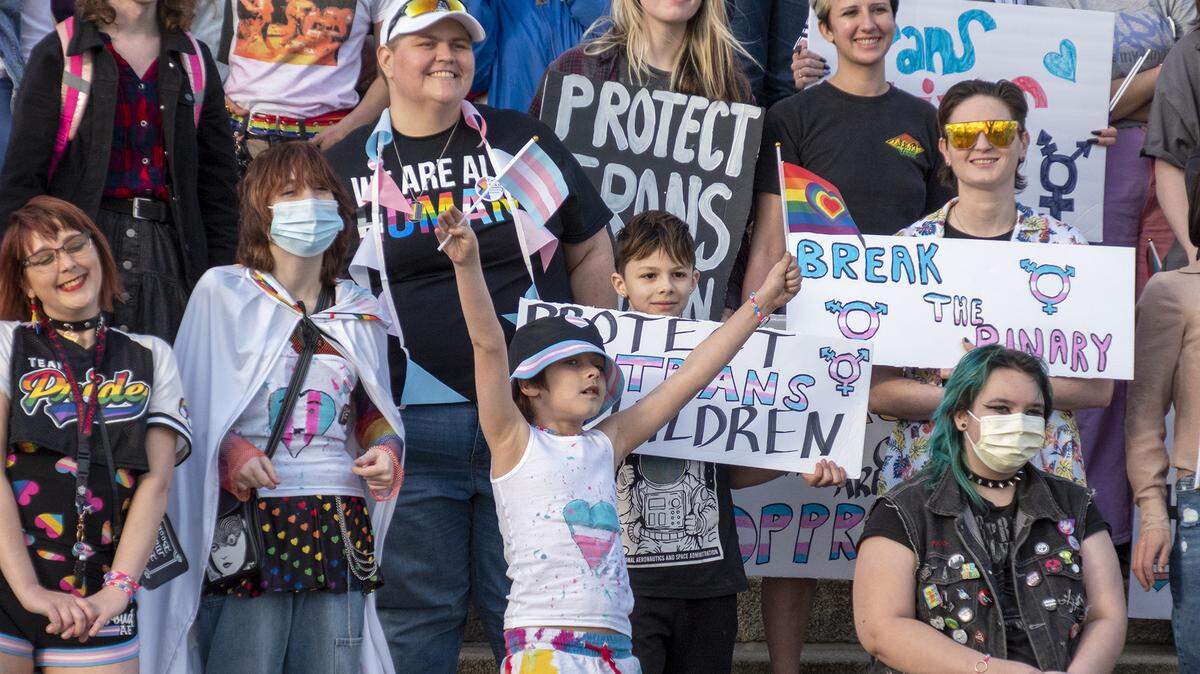
Aidan Campbell, a 22-year-old Lawrence resident, still uses a women’s restroom when he’s out in public. His driver’s license identifies him as female, in accordance with his sex assigned at birth.
But Campbell identifies as trans-masculine and has recently begun considering using a men’s restroom and taking steps to change his driver’s license identifier to male.
A bill which Kansas lawmakers are hoping to pass this week over Gov. Laura Kelly’s veto would change that calculation, taking what Campbell views as a personal and situational decision and turning it into a legal one.
“It’s whatever I want to do and what I’m comfortable with,” Campbell said. “This is taking choices out of my control. Taking choices away from me. Both as a nonbinary person and as a trans-masculine person.”
The bill, dubbed the “women’s bill of rights” by supporters, establishes definitions for male and female based upon reproductive capabilities. It then says the state has an interest in maintaining single-sex spaces in bathrooms, locker rooms, prisons and domestic violence shelters.
Republican lawmakers pledged to attempt to override the Democratic Governor Laura Kelly’s veto of the bill when they return to Topeka Wednesday. If they succeed, Kansas will be the first state in the nation to enact the language, which has been pushed by the anti-transgender group the Independent Women’s Law Center.
The bill appeared to hold a veto-proof majority in the House and Senate when lawmakers passed it earlier this month, but the House will need to retain the support of two Democrats, Kansas City Rep. Marvin Robinson and Wichita Rep. Ford Carr.
‘Erasure of a community’
The language of the bill is broad, leaving open questions for advocates and opponents as to what happens if and when it becomes law.
The Independent Women’s Law Center, the national organization that authored the bill, told lawmakers in testimony that it “doesn’t change current law. It simply fortifies existing law.”
The bill’s advocates argue that the aim is simply to define man and woman in state law to prevent judges from imposing a definition contrary to theirs. They say that there is a risk to female-designated spaces if gender definitions are changed from historic understandings and individuals born with male genitalia are allowed to use them.
Brittany Jones, a lobbyist for Kansas Family Voice a conservative Christian policy group, said she viewed the bill as preventative by giving courts a definition of how to define male and female in law. She said she expected the bill’s impact to show through litigation and as new policies are created.
“In order to protect women’s rights you actually have to know what a woman is,” she said.
But LGBTQ advocates worry the bill cold hold wide impacts for transgender, nonbinary and intersex Kansans by making it harder for them to fully participate in society.
According to Kelly’s office, the bill’s enactment could force state agencies to violate anti-discrimination policies and therefore lose federal funding.
“We really don’t know at this point what all this bill would mean and the effect if this bill does become law,” said D.C. Heigert, legal fellow at the ACLU of Kansas. “It does much more than just provide a definition but how much more is up in the air.”
Heigert said the bill lists a series of spaces where the state has an interest in protecting single-sex spaces but does not clearly explain how the definition it is establishing applies. Those spaces include bathrooms, locker rooms, domestic violence shelters and prisons.
The result, Heigert said, could be lawsuits against entities that have policies allowing people to use whichever space aligns with their gender identity. It could also have a chilling effect and discourage those policies from being enacted in the first place.
“We’re already seeing school boards and school administrators having an hesitancy to protect trans students’ rights and a bill like this is only going to make this so much worse,” Heigert said.
Definitions in the bill of mother and father, Heigert said, may have implications on court proceedings related to adoption and child welfare.
Lynn Hatcher, a spokeswoman for the Independent Women’s Law Center, said the bill would ensure lawmakers get to decide whether those spaces are “single-sex.”
“The Women’s Bill of Rights preserves the legislature’s authority to determine whether, and in what circumstances, rape crisis centers, domestic violence shelters, athletic teams, lockerooms, and dormitories should remain single-sex or be opened to biological males who identify as female,” she said in an email.
“And by adopting the federal intermediate scrutiny standard for evaluating sex-based programs, WBoR prevents judges from declaring unconstitutional programs specifically designed to promote women’s entrepreneurship and opportunity.”
Heigert and Nigel Morton, a Kansas organizer for Unite for Reproductive and Gender Equity, said the narrow definitions of the bill could also result in discrimination against cisgender women who are not able to have children or whose appearance do not fit societal norms.
“Worst case scenario it means violence for not looking the way that somebody believes you should look,” Morton said.
Two Kansas transgender women told the Star they didn’t plan to comply with the bill if it becomes law.
“There’s no change without civil disobedience,” said Iridescent Riffel, a University of Kansas grad student.
Court actions will be necessary to change the law, she said, and she’s willing to violate the law to bring on a challenge.
“It’s gonna make our lives worse. It’s going to make our lives hell,” said Aphra Maria Karaya, a transgender woman who lives in Kansas City, Kansas. “I’m going to go into places I’m going to go because I’m a woman.”
But many people, Karaya said, would stay in the closet because of the law.
“This is like an erasure of a community,” she said.
Legal fallout
Ellen Bertels, an attorney for Kansas Legal Services, which provides free legal assistance to transgender Kansans seeking to update their names or gender on official documents, said the language of the bill would make changing gender markers on state-issued IDs impossible.
“If an individual is not able to be recognized legally by their gender identity and must be recognized on state documents as their sex assigned at birth, that effectively bans gender marker changes,” Bertels said. The ability to change a gender marker, Bertels said, is affirming for her clients and helps shield them from some forms of discrimination and harassment.
Bertels said the bill would likely violate a 2018 court agreement in which Kansas agreed to allow gender marker changes and acknowledged the state would be found in contempt of court if it banned the practice in the future.
“Even if the veto is overridden and the policy goes into effect, the likelihood that it gets taken up in court as a violation of that consent agreement, is pretty good,” Bertels said.
If the policy takes effect, advocates predict that the inability to change a gender marker could result in increased discrimination for transgender Kansans.
Riffel said the ability to change is key for validating one’s identity. But it also helps transgender folks travel in airports without questioning or harassment.
“Having those legal marker changes gives access to our identity, which is our identity,” Riffel said. “And it’s something that really isn’t up for debate even though some people want to seem like it is.”
In addition to potential litigation over license markers Kelly’s office said Kansas’ state hospitals, prisons, and educational and economic development programs aimed at women could fall out of compliance with federal guidelines in order to comply with the law. This risks millions in federal funds, the office said.
The Kansas Coalition Against Sexual and Domestic Violence testified earlier this year that more than $14 million in federal funding to Kansas domestic violence agencies could be forfeited if they were asked to comply with the law because federal grants include a non-discrimination requirement.
Jones, the lobbyist for Kansas Family Voice, said lost funding wasn’t likely.
“There’s a history of winning those disputes in court,” Jones said.
But that concern was highlighted in Kelly’s message vetoing the bill which focused on the economic downfalls associated with discriminatory policies.
“By stripping away rights from Kansans and opening the state up to expensive and unnecessary lawsuits, these bills would hurt our ability to continue breaking economic records and landing new business deals,” Kelly said. “I’m focused on the economy. Anyone care to join me?”
This story was originally published April 25, 2023 at 6:30 AM.