GOP presidential front-runners are skeptical of Ukraine aid. Why is Pompeo leaning in?
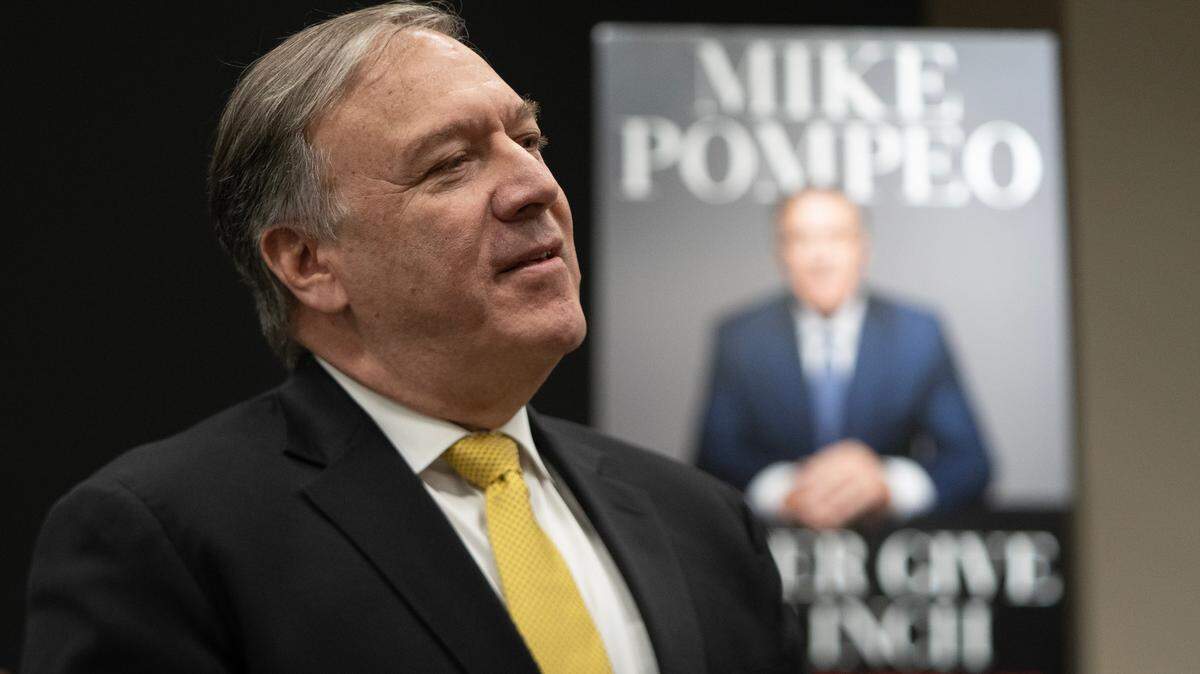
Last week, former Secretary of State Mike Pompeo visited Irpin, a town outside of Kyiv that was bombarded by rockets when Russia launched its invasion last year, thrusting the country into a more than years-long conflict.
Pompeo’s trip to the embattled country was an attempt by the former top diplomat to emphasize the importance of the United States’ continued support of Ukraine, according to Champion American Values, the political action committee he founded. He met with Ukrainian President Volodymyr Zelenskyy. He spoke at an event organized by a Ukrainian businessman. He visited the capital city of Kyiv.
But it came as Pompeo is mulling a potential bid for president — and struggling to pick up support.
“He’s clearly doing the sort of things a president does and clearly staking out a lane as the muscular, Reaganesque foreign policy candidate,” said David Kensinger, a longtime Republican consultant and aide to former Kansas Gov. Sam Brownback, who made an unsuccessful bid for president in 2008.
Pompeo’s lane currently looks more like a bike path than a highway. While he has not formally announced, Pompeo has struggled to attract more than 3% of Republican voters in early polling, and often hovers around 1%. A nationwide book tour and a speech at CPAC have done little to help him boost that number.
With his visit to Ukraine, Pompeo, who was stationed in Europe toward the end of the Cold War, appears to be highlighting his biggest strength — foreign policy. The West Point graduate and three-term Wichita congressman picked up foreign policy experience as director of the CIA and Secretary of State, though his tenure was widely criticized by the lifelong diplomats in Washington.
But more than a year into the war, some in the Republican base appear ready to move on. In a February poll by OnMessage, a Republican consulting firm, and the American Principles Project, a socially conservative think tank, 50% of Republican voters said they would be less likely to support a candidate who prioritizes funding and military support for Ukraine.
“I think a lot of people are just kind of skeptical of the ‘why’ and where it’s going,” said Jon Schweppe, the policy director for the group. “That’s changed. Tucker [Carlson] probably had an impact on this. You look at polling really early on and it was heavy support.”
The two front runners in the Republican field, former President Donald Trump and Florida Gov. Ron DeSantis, who has not formally announced yet, both have expressed skepticism toward continuing to support Ukraine.
Trump has spoken positively about Russian President Vladimir Putin and has stuck to blaming President Joe Biden, saying the invasion wouldn’t have happened if Trump were president.
DeSantis initially said the U.S. should not get tangled up in a “territorial dispute” between Ukraine and Russia in a written response to Fox News host Tucker Carlson, before calling Russian president Vladimir Putin a war criminal in an interview with Piers Morgan.
The skeptical approach on Ukraine aid taken by the Republican Party’s two presidential front runners highlights a growing divide between elected Republicans on whether to add to the more than $30 billion the U.S. has already sent in equipment to support the war effort. Increasingly, members of Congress are voting against efforts to fund the Ukrainian military, or supporting legislation to increase oversight over how the money is spent.
One of the most vocal opponents of the funding is Sen. Josh Hawley, a Missouri Republican. Hawley has spoken about how he believes the U.S. is sending too much equipment to Europe, which he believes will leave the U.S. vulnerable to China, who he perceives as the country’s biggest threat.
As the war has stretched on — and Congress has continued to fund aid packages — there has been growing support among conservatives for Hawley’s position. Amid growing push back on the amount the U.S. is sending, House Speaker Kevin McCarthy has pledged that there won’t be any more “blank checks” for Ukraine.
The debate comes as the Republican Party is trying on an “America First” foreign policy stance taken by Trump, where some conservatives are clamoring for less foreign involvement after around two decades spent in wars in Iraq and Afghanistan.
A 2017 study found that communities that had a high casualty rate in the wars in Iraq and Afghanistan could were a factor in Trump’s 2016 presidential victory, as he appeared more resistant to military involvement than former Secretary of State Hillary Clinton.
“I think that the Washington foreign policy establishment is not only out of line with where the voters are on foreign policy, they are contemptuous of where the voters are on foreign policy,” said Dan Caldwell, the vice president of the Center for Renewing America, a conservative think tank founded by former Trump administration officials.
“While Mike Pompeo was Secretary of State, arguably as CIA Director too, he was somebody who continually undermined President Trump’s desire to take a different course with Russia,” Caldwell said. “He was somebody in the administration taking a more confrontational approach with Russia and ultimately I think helped put us on a path to this conflict.”
James Carafano, a vice president on national security and foreign policy at the Heritage Foundation, said he believes the foreign policy stance of conservatives doesn’t break down easily between those who believe in involvement and those who believe in isolation — many of the people calling for less support for Ukraine are calling for a more aggressive approach to China.
But he said none of the factions have a majority of support among the Republican base, largely because he doesn’t believe foreign policy is a top issue for Republican voters.
Instead, he contended they’re more focused on domestic issues like transgender rights, education, immigration, border security and the economy.
“People are interested in Ukraine, but if this were a real issue, we’d be seeing people in the streets protesting and we’re not,” Carafano said. “I kind of think that this is really not the tension within the Republican Party and within the conservative movement that people think it is.”
Carafano said foreign policy is more of a test for candidates than something they can campaign on. Generally, he said, voters tend to agree with the candidates they like.
“You’re not adding people when you take these positions on foreign policy, all you’re doing is pleasing people,” Carafano said. “Either because they already believe that or because they like you.”
But for Pompeo, foreign policy might be his best shot at building support in a potentially crowded primary where some of the leading candidates are focused on a more nationalist approach to foreign policy guided by Trump’s “America First” approach.
“Trump and DeSantis are both going to be in the skeptical of Ukraine camp because that’s where a lot of Republican base voters are, so it probably makes sense for Pompeo to take this different lane and make an argument for traditional Reagan peace through strength foreign policy,” Schweppe said.
Pompeo isn’t the only potential candidate who supports funding Ukraine. Former South Carolina Gov. Nikki Haley, who was U.S. Ambassador to the United Nations under Trump, has taken a similar approach, as has former Vice President Mike Pence.
But to Kensinger, who thinks Trump and DeSantis are reading the electorate wrong, Pompeo’s personal experience serving in the Army during the end of the Cold War makes him particularly willing to stand up against Russian aggression in Eastern Europe.
“This is something Mike Pompeo has to do,” Kensinger said. “I mean this guy captained a tank crew on the Czecho-Slovak border, he’s not going to roll over for the Russians now.”
This story was originally published April 13, 2023 at 6:00 AM.