Kansas Republicans keep pushing to aid private schools. Do they have a chance?
The Kansas Senate at about 3 a.m. Friday failed to pass a sweeping program to funnel public money to private schools. Yet exhausted supporters appeared frustrated but not defeated.
“After we get some sleep and re-evaluate options – nothing’s ever dead here,” state Sen. Renee Erickson, a Wichita Republican who helped negotiate the bill, said as she exited the statehouse in the predawn hours. Top Republicans have signaled they plan to take a fresh vote on the proposal when the Legislature returns in late April.
The bill would use federal dollars to provide additional funding for special education, a priority of Democratic Gov. Laura Kelly. But it would also meet a goal Republicans have pushed for years: an expansive voucher-like program steering thousands of dollars to students not enrolled in public schools.
The voucher-like proposal, dubbed school choice by supporters, faces opposition not only from Democrats but also many Republicans representing rural districts. It stands virtually no chance of becoming law in its current form, based on interviews with lawmakers, Kelly’s stances and simple legislative math.
While special education funding is tied to the proposal, lawmakers have not ruled out passing that in another form if the broader measure fails.
At stake is the level of public support Kansas children will receive to help pay for private schooling, as well as what level of services public schools can provide to students with special needs.
The bill would provide roughly $5,000 to any Kansas student below 250% of the federal poverty line who is not in public schools — a program lawmakers called the Kansas Educational Enrichment Program (KEEP) that many liken to vouchers. It also includes a $72 million increase in special education funding using federal COVID-19 relief dollars and $1,000 grants for each public school student under 250% of the federal poverty line.
Kelly originally established KEEP using federal dollars to provide $1,000 grants to make up for learning loss during the pandemic. The funds could be used on educational expenses but not private school tuition. The proposed bill would dramatically expand the program.
At the core of the likely failure of the proposal is a decision by Republican leaders to pursue an aggressive conservative education agenda while using special education funding as leverage over Kelly and Democrats. The governor, reelected in November, has made fully funding special education a key priority; Kansas hasn’t provided full funding since 2011.
“We’re having a head to head battle over choices for parents and students,” Kansas Senate President Ty Masterson, an Andover Republican, said at a town hall over the weekend.
“Republicans would like to see a lot more opportunity for the kids and for parents to have choice in that. Very little ability to do that with Laura,” Masterson said, referring to the governor. “Although we have a working relationship, she’s very much anti-choice in school.”
By advancing new programs that could funnel millions of public dollars toward private schools, Republicans have effectively put Kelly, who ran as the “education governor,” in a position to veto such a plan if the Legislature passes it.
“My first priority is protecting our public schools and making sure they’re strong and fully funded, which we’ve done every year I’ve been in office. That’s why I am firmly opposed to any effort to take money from our public schools,” Kelly said in a statement.
“We’ve been down that road before and we’re not going back, because it’s bad for all of our students — including our special education students.”
Much of the public education community, including associations representing school boards, administrators and teachers, are arrayed against the bill.
Leah Fliter, a lobbyist for the Kansas Association of School Boards, said the bill could cost Kansas millions while siphoning support from public schools. There’s no guarantee, they say, that students will do better at the private schools given that there are very few guidelines for them.
Lauren Tice Miller, a lobbyist for the teachers union KNEA, said the impact of the bill was nearly impossible to calculate. “That’s one of the biggest problems,” she said.
Democrats have warned that the school choice bill would result in unforeseen costs to Kansas’ public school system without ensuring an improved education.
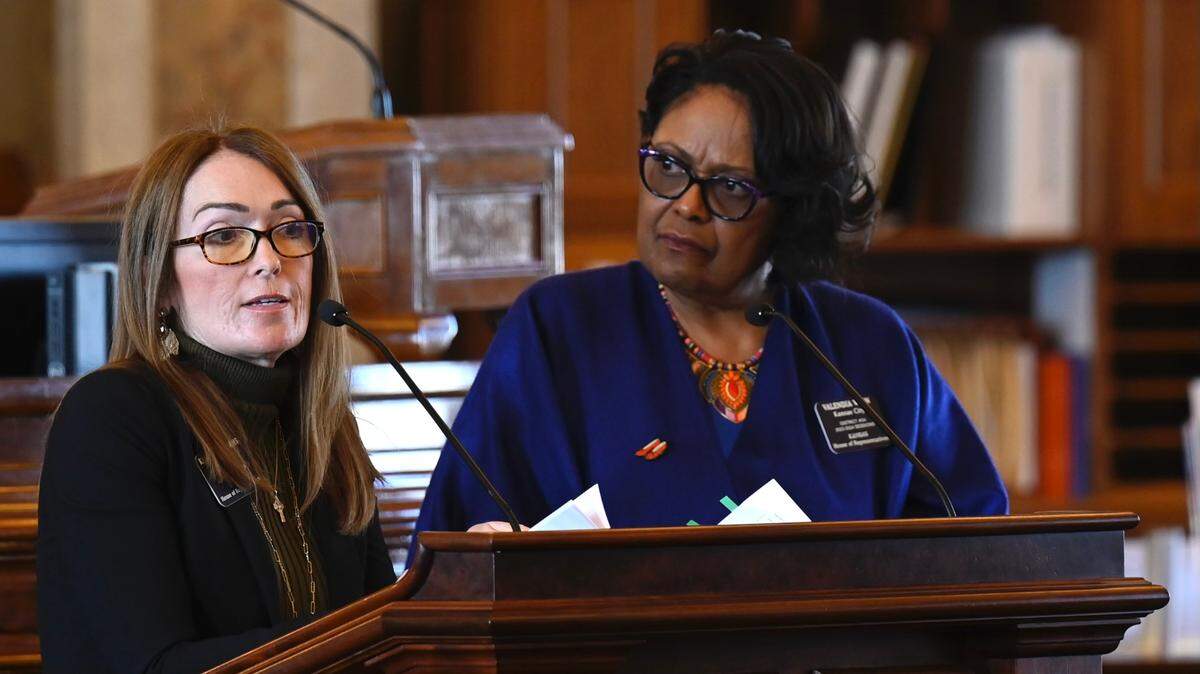
“Just remember how it will impact your school, your district, your communities,” state Rep. Valdenia Winn, a Kansas City Democrat, said during floor debate on the bill Thursday night.
At the same time, top Republicans failed to win over a number of rural GOP legislators. These lawmakers in many instances are loath to support legislation that would take any funding out of public schools, which are often a pillar of rural communities.
“I can appreciate the discussion where we talk about the student rather than the building in the sense of the institution. But in my communities, the institution and the students go hand in hand,” said state Rep. Ken Rahjes, an Agra Republican whose district spans a large chunk of northwest Kansas.
The education bill passed the Kansas House 65-58, just two votes more than the bare minimum needed to pass legislation, but well short of the 84 votes necessary to override a veto by Kelly. The measure failed in the Kansas Senate, 17-20. Even if supporters can eventually get the 21 votes needed to pass the Senate, it’s a far cry from the 27 needed for a veto override.
Already, some key Republican lawmakers are signaling that aid for students to attend private schools may be dramatically reduced to have any hope of reaching a compromise with Kelly.
State Sen. Molly Baumgardner, a Louisburg Republican who chairs the Senate Education Committee, said GOP leadership and the governor’s office will need to discuss scaling back the size of the program. She floated the possibility of limiting the size of the KEEP grants for private school tuition to $1,000, rather than $5,000.
“I think that that’s perhaps a starting point,” Baumgardner said.
State Rep. Kristey Williams, an Augusta Republican who chairs the House K-12 Education Budget Committee, said she is open to whatever changes are necessary to win the Senate. She voiced hope that Kelly might still come on board.
“I see there’s a way we can work together to provide the KEEP grants and awards and I think that kids in Kansas need an opportunity to try something different and to have the best possible education that they can,” Williams said early Friday.
Democrats say that regardless of whether the Legislature passes the bill, they expect Republican leadership to continue pushing voucher-like legislation, with little accountability for private schools receiving state dollars.
Kansas Senate Minority Leader Dinah Sykes, a Lenexa Democrat, said the push could come back to haunt Republicans in competitive Johnson County districts.
“There’s some Republicans who regret taking that vote and they had their arm twisted,” she said.
Lawmakers may still try again to pass the current bill. Masterson and others have noted that three Republican senators – Sens. Chase Blasi, Carolyn McGinn and Tim Shallenberger – missed the pre-dawn vote last week
In 2021 McGinn, from Wichita, voted against a bill that would have created a similar school choice program called educational savings accounts. That bill failed on a 20-20 vote. Blasi and Shallenberger were not yet in the Senate.
After the Friday vote, Masterson acknowledged that the sweeping school choice policy he supports.
“The Republican caucus wants school choice and the Democrats and a segment of ours don’t,” Masterson said. “And under a Democratic governor it’s pretty hard to get a super majority.”
This story was originally published April 12, 2023 at 5:30 AM.