Biden signed a $1.7 trillion spending bill. Here’s what’s in it for Kansas and Missouri
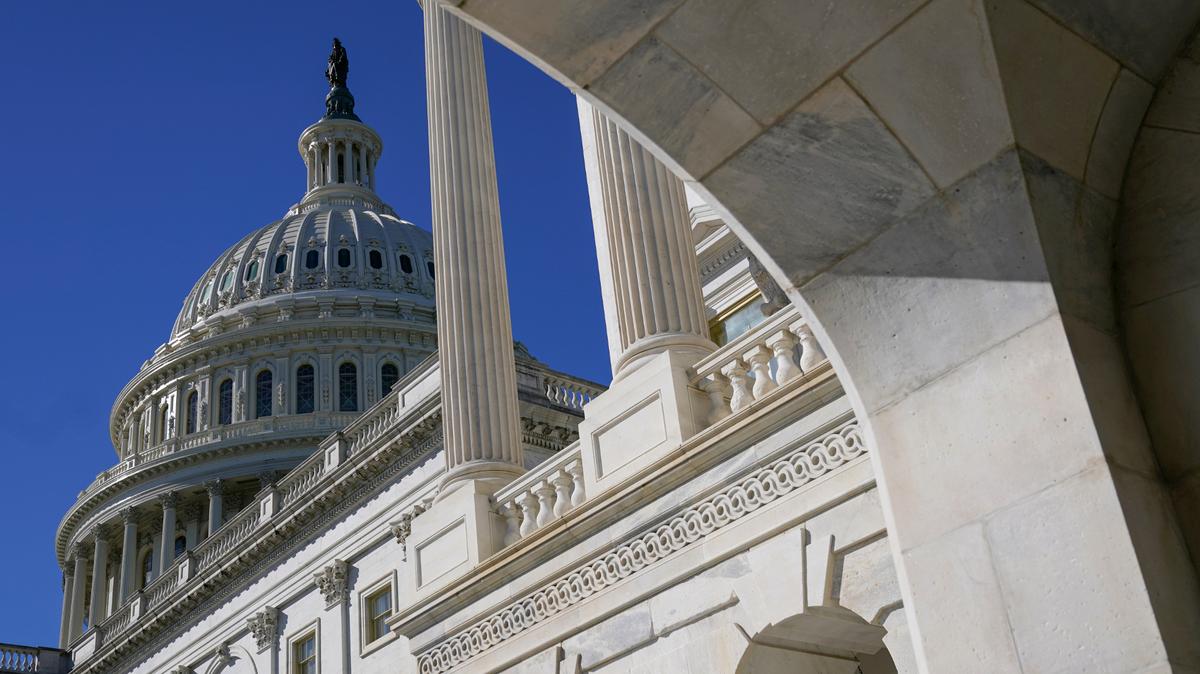
Right before leaving town for the holidays, Congress passed a 4,155 page, $1.7 trillion spending bill to cover the government’s expenses in the 2023 fiscal year.
President Joe Biden signed the bill into law on Thursday night.
The large spending bill had a number of initiatives tucked in. It included a reform to the more than 150-year-old Electoral Count Act to eliminate the loopholes that former President Donald Trump and his allies attempted to exploit in order to reverse the outcome of the 2020 presidential election. It also included a measure, pushed by Missouri Republican Sen. Josh Hawley, that bans TikTok from government-owned devices.
The bill also provided lawmakers with an opportunity to secure funding for specific projects in their district. Often called earmarks, this type of funding was banned between 2011 and 2021 after a series of scandals involving members benefiting from money they directed to their district. They were brought back last year, under the new name “Congressionally Directed Spending” and stricter transparency laws in approving lawmakers’ requests.
Combined, lawmakers were able to secure more than $229 million for projects in Kansas and more than $493 for projects in Missouri.
Here are some takeaways from the funded projects.
Higher education
Sen. Roy Blunt, a Missouri Republican who is retiring this week, was able to get $61 million for construction at the University of Missouri in Columbia’s NextGen Precision Health Institute. The institute is a research facility hosting biomolecular research, computational and engineering disciplines, veterinary and human medicine and some of the university’s industry partners.
That appropriation was the highest of any in Kansas and Missouri. The University of Missouri also got $20 million for radioisotope production facilities and another $20 million for the design and planning work for its Next Generation Research Reactor, a request from Republican Rep. Blaine Luetkemeyer.
The University of Kansas Medical Center received more than $40 million for its cancer center. Sen. Jerry Moran, a Kansas Republican, was able to secure $28 million for the planning and construction of a research facility for the center and an additional $15 million for facilities and equipment.
Missouri State University got more than $41 million, the majority of which will go toward the Ozarks Health and Life Science Center at Temple Hall. The center will house classrooms, labs and offices. In his appeal for the funding, Blunt pointed out that enrollment in Missouri State University’s College and of Natural and Applied Sciences has has gone from 1,000 to 2,400 since Temple Hall was built.
Infrastructure
Blunt also secured $28.6 million for a project that will put a deck over part of Interstate 670 that goes through downtown Kansas City, called the South Loop Park Project. While he requested $65 million, the city is currently in the process of raising money for the project.
Rep. Emanuel Cleaver, a Missouri Democrat, also secured funding for some infrastructure projects in Kansas City, including $4 million for recreational opportunities in the neighborhoods that were fractured when Bruce R. Watkins highway was built.
On the Kansas side, Democratic Rep. Sharice Davids secured $5.4 million for the College Boulevard Bridge over the Indian Creek reconstruction. Davids listed the bridge as one of the most structurally deficient in the district.
Moran also secured millions for water projects across the state, including $19.1 million for water reclamation and reuse in Garden City.
Police funding
Moran secured $10.8 million in funding for police departments throughout Kansas.
Most of the money came in sums that were less than $1 million and will be used for the departments to get things like body-worn cameras, license plate readers, body scanners and mobile camera technology.
The Kansas City, Kansas Police Department got $905,000 to establish a “Real Time Crime Center.”
Moran and Blunt were also able to get money for military bases in both Kansas and Missouri. Blunt got $31 million to build a new hospital at Fort Leonard Wood and Moran got $15.9 million for the planning and design of barracks at Fort Riley.
Who got the most
Retiring Blunt was able to secure the most out of anyone in the Missouri and Kansas delegation. He brought in more than $343 million in earmarks. Moran secured $193 million for projects throughout Kansas.
Among the House delegation, Cleaver secured $34 million in funding, largely from the Department of Housing and Urban Development. Rep. Billy Long, who is retiring after an unsuccessful Senate run, was able to get $28 million for projects in his southwestern Missouri district, including $8.5 million for Christian County Emergency Services.
Davids brought in $27 million for her Kansas district. Luetkemeyer brought in more than $37 million for his central Missouri District, while fellow Republican Rep. Sam Graves got more than $30 million for his northern Missouri district. Democratic Rep. Cori Bush also secured more than $18 million for the St. Louis area.
Sitting it out
Some lawmakers from Missouri and Kansas didn’t get any projects funded in the annual spending bill.
In the House, Reps. Ann Wagner, Jason Smith and Vicky Hartzler, all Republicans from Missouri, did not appear on the lists of approved projects released by the House and Senate Appropriations Committees. On the Kansas side, Reps. Ron Estes and Tracey Mann, both Republicans, also did not have any projects on the list.
In the Senate, neither Sen. Roger Marshall, a Republican from Kansas, nor Hawley, a Republican from Missouri, appeared on the lists of approved projects.
All of those lawmakers voted against the bill.