Jerry Moran’s campaign paints him as above politics. Is that possible after Trump?
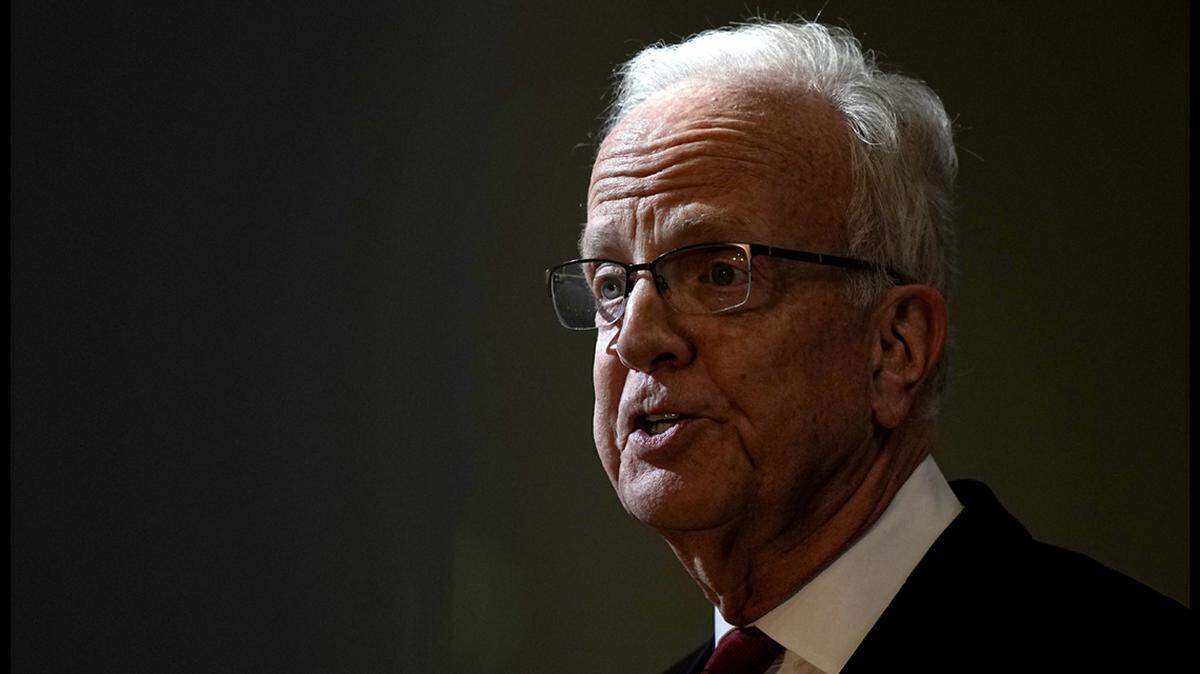
On any given day in the U.S. Capitol, it is relatively easy for a senator to find a microphone.
As they cross from their office buildings into the Capitol to vote on legislation, they pass a horde of reporters who might corner them to ask a question. If they take the elevator up to the second floor, where senators enter the chamber, they’ll again see a gaggle of journalists.
Instead, Sen. Jerry Moran, a Kansas Republican, avoids the press by taking the back stairs.
It’s a decision that epitomizes how Moran, 68, approaches his role in the U.S. Senate, a position he’s held since 2011.
In a partisan era where political statements are often categorized as “attacks” or “blasts,” Moran moves through the halls of the U.S. Capitol quietly. As he’s poised to win a third term in the U.S. Senate, Moran has leaned into this understated approach, using the contrast to paint himself as above politics while keeping former President Donald Trump at a distance.
“The people who are on TV all the time, many times they have a lot of difficulty passing legislation, because people have preconceived notions about them,” said former Sen. Pat Roberts, a Kansas Republican who served with Moran. “And Jerry avoids that. He’s not a hot dog, he’s not going to beat his own drum at all.”
Moran’s reelection campaign hasn’t attracted much attention or publicity. He is leading his opponent, former Kansas City, Kan. Mayor Mark Holland, by 21 percentage points, according to a poll released Wednesday by Emerson College and Nexstar Media Group. Moran has raised $7 million compared to Holland’s $844,380.
Over the course of that campaign, Moran has once again kept a low-profile, eschewing the type of cultural politics that has come to define this political era and many of Moran’s contemporaries.
“Kansas common sense tells us to listen to others,” Moran says in one of his ads. “To treat our neighbors with respect and to work together. Washington often forgets this, but I haven’t.”
Moran is a conservative; a metric political scientists use to judge whether a politician is liberal or conservative places him in line with former Sens. Sam Brownback and Pat Roberts.
He voted against a bipartisan attempts to address gun violence and fund infrastructure projects. He is anti-abortion rights and has signed on to bills that would impose a federal ban on abortions after 20 weeks, prior to the U.S. Supreme Court’s decision to eliminate a constitutional right to an abortion, which he supports. He voted to eliminate the Affordable Care Act.
Moran was the only Kansas Republican in Congress to vote to affirm the 2020 presidential results and the first Republican in the Kansas delegation to recognize Joe Biden as the president-elect. But like Sen. Roger Marshall, a Kansas Republican who voted to overturn the election results, Moran voted to acquit Trump at his second impeachment trial for incitement of insurrection following the Jan. 6 attack on the Capitol.
But Washington has changed to the point where, for some, a willingness to work with a member of the opposing party makes a politician a “moderate.”
“Moran just gets a general pass for being a moderate and he’s not,” Holland, 53, said. “His voting record is every bit as extreme as Roger Marshall’s.”
Small town politics
In late October, Moran went on a campaign tour of farms across Kansas. At a stop in Topeka, standing near his campaign sign planted in front of a John Deere tractor, Moran’s five minute stump speech focused on high gas prices and his work for farmers and ranchers in Washington, D.C.
“It is possible to go to Washington, D.C., and get surrounded by people who think they know everything,” Moran told reporters after the event. “I’ll put my faith in the folks back home.”
Moran grew up in Plainville, a small western Kansas town about 30 minutes north of Hays, where he eventually launched his political career. Roberts, who also grew up in a small town, albeit on the other side of the state, said spending time in a smaller community can arm someone with the tools to be an effective politician.
“I think you learn a lot if you come from a small town,” Roberts said. “Number one, everybody’s somebody.”
Moran was first elected to Congress to represent Kansas’ 1st Congressional District in Congress, a sprawling mass of a district that takes up the western half of the state that’s often called “the Big First.” Both Moran and Roberts are among a list of Kansas senators who have gone from representing the Big First to serving in the U.S. Senate. The list also includes Marshall and former Sen. Bob Dole.
He built his political reputation on a goal of meeting voters at town halls in all 105 counties in the state — a tactic that is sometimes criticized by people who want Moran to give more focus to the state’s population centers, like Johnson County. Around 300 people attended a town hall Moran held in Olathe in July 2021, the last time he held a town hall in Johnson County.
Roberts said Moran’s willingness to show up at public events — sometimes just to listen, not to speak — was unique among politicians. Ryan Flickner, the senior director of advocacy at the Kansas Farm Bureau, said senators like Roberts and Dole set an expectation that people would be able to see their federal politician at least once a year.
“I would argue that then-Congressman Moran probably took it to another level,” Flickner said.
Moran cites his upbringing as a reason for being willing to work on bipartisan legislation in Congress. One of his most notable attempts came this past year, when he worked with Sen. Jon Tester, D-Montana, to pass a bill that would expand health benefits for veterans who were exposed to toxic burn pits when serving overseas.
In a written statement to the Star, Tester said Moran was a “fierce advocate for veterans and a good friend.”
The bill — which nearly didn’t pass because of a political battle between Republicans and Democrats over the revival of a plan to pass legislation to address climate change that the Democrats christened “the Inflation Reduction Act,” — was supported by President Joe Biden and signed into law.
Moran also played a role in helping pass a widely bipartisan bill that provided federal funding to spur the domestic production of semiconductors — a piece of legislation that Democratic Rep. Sharice Davids has touted on the campaign trail.
“I think he learned very early, how to reach across the aisle and reach bipartisan agreements. In other words, get something done,” Roberts said. “I hasten to add that now that’s extremely difficult, given the ideology that has taken over on both sides. And if you’re an ideologue, you have a pretty hard time bringing them over to your side.”
The efforts at bipartisanship don’t satisfy Moran’s critics, who say he’s simply pretending to be a moderate politician. He’s rarely among the 10 swing votes Democrats look to in order to pass legislation, unlike Sen. Roy Blunt, a Missouri Republican who is retiring this year. Blunt was one of the key senators to back a bill to address gun violence that passed earlier this year.
“Jerry Moran pretends to be a moderate, which is in some ways more disingenuous than a Josh Hawley or a Roger Marshall, who actually tell everyone they’re not moderate and don’t pretend to be anything different,” Holland said. “Jerry Moran votes extreme and pretends to be moderate and it’s disingenuous.”
Moran’s contemporaries have fully embraced the culture wars. Marshall, Kansas’ freshman Republican senator, has pushed to get a television ratings designations for shows that have transgender characters. Hawley, a Missouri Republican, has said he believes the left is attacking American culture and society. Missouri Attorney General Eric Schmitt has pledged to take a blow torch to President Joe Biden’s agenda.
In an interview with The Star’s editorial board, Moran made it clear that he wouldn’t run ads focusing on things like transgender athletes, which Republicans in tight races have leaned on. Instead, he’s run ads touting Kansas, talking about his efforts to address a sexual abuse scandal in gymnastics, criticizing Biden for the economy and talking about veterans.
“I think he sees no benefit in getting in the middle of a fray,” said Sandy Jacobs, a city commissioner in Hays that is friends with Moran. “That doesn’t help him or his constituents. He listens, he participates.”
The day of the event in Topeka, the gubernatorial race was consumed with a controversy over a misleading claim that Democratic Gov. Laura Kelly’s administration had funded an event with drag queens, pushed by Kansas Attorney General Derek Schmidt, the Republican nominee.
Moran, who was campaigning alongside Schmidt, refused to talk about it.
“You’re not going to take me there,” he told a reporter.
The Trump endorsement
In February 2021, just a few weeks after Moran voted to acquit Trump for incitement of insurrection, the former president endorsed the Kansan’s reelection campaign.
“Senator Jerry Moran is doing a terrific job for the wonderful people of Kansas. Strong on Military, Vets, the Border, and our Second Amendment, Jerry has my Complete and Total Endorsement for his re-election in 2022!” Trump’s endorsement said.
It was serendipitous timing, coming right before CPAC, a high-profile conservative conference led by Wichita native Matt Schlapp. At the time of the endorsement, there were rumors in Kansas Republican circles that Schlapp was considering a primary campaign against Moran.
Without a Trump endorsement, any serious primary challenge had little chance of defeating Moran by courting Trump’s conservative base.
Asked about how he was able to secure the endorsement, Moran credited the National Republican Senatorial Committee, saying he assumed it worked with Trump. He said he did not make any trips down to Mar-a-Lago, the way the Republican candidates running for U.S. Senate in Missouri attempted to court the former president.
Moran doesn’t follow in the mold of Sen. Mitt Romney, a former presidential nominee and Utah Republican who is outspoken in his opposition to Trump. Nor is he like Sen. Lindsey Graham, who appears to cherishes his proximity to Trump’s power. Moran, instead, largely kept Trump at an arm’s length — neither completely embracing nor confronting the famously temperamental former president.
He was critical of the insurrection on January 6, 2021 and was the only Republican member of the Kansas delegation to Congress who didn’t object to the certification of the 2020 presidential election. Still, he voted against impeaching Trump, using the line adopted by members of Republican leadership that it wasn’t legal to impeach Trump after he had left office.
Holland, the Democrat running against Moran, said the senator has not denounced the former president or extreme elements of the Republican Party enough.
“The Republican Party has been bought and sold by Donald Trump and the conspiracy theories and lies that go with that,” Holland said. “The Republican Party is all extreme. That’s what’s left of it.”
Asked about Trump, Moran used a line often employed by Republicans who don’t care for the former president but are wary of alienating his ardent supporters.
“President Trump’s policies in many arenas were ones that are certainly supported by Kansans and approved by them, but the stuff that came with it was very damaging,” Moran told the Star’s editorial board.
He said that he was more inclined to support a “Kansan” for president in 2024 — alluding to the possible presidential campaign of former Secretary of State Mike Pompeo — than he was to support the former president.
In particular, Moran has been outspoken in his concern about the lack of trust in institutions, particularly claims that the 2020 presidential election was stolen. He has attempted to push back against some of the claims by reassuring voters about elections officials and has said he’s open to supporting a bill that would make it more difficult for members of Congress to object to the certification of a presidential election.
“You need to trust the basic institutions that allow our society to function, that protect our freedoms and liberties,” Moran said in September. “And a constant attack on those institutions diminishes the chances that we continue to live in the country that provides the freedom and liberty that we have today.”
Since winning the August primary, Moran has particularly attempted to stay above partisan politics. He didn’t join the other Kansas Republican candidates on the ballot on a bus tour of the state in October — he cited a scheduling conflict — choosing instead to campaign with a few of them on a farm tour where they kept the focus on agriculture and the economy.
“I think he’s doing such a good job for everybody that he’s sort of apolitical really,” Roberts said. “I think a lot of his people are Democrats. And on the hard right, I think they understand that that would just be a wasted effort.”
Star reporters Jonathan Shorman and Katie Bernard contributed reporting.
This story was originally published November 3, 2022 at 10:35 AM.