Kelly administration, Schmidt campaign react to declining test scores in Kansas after COVID
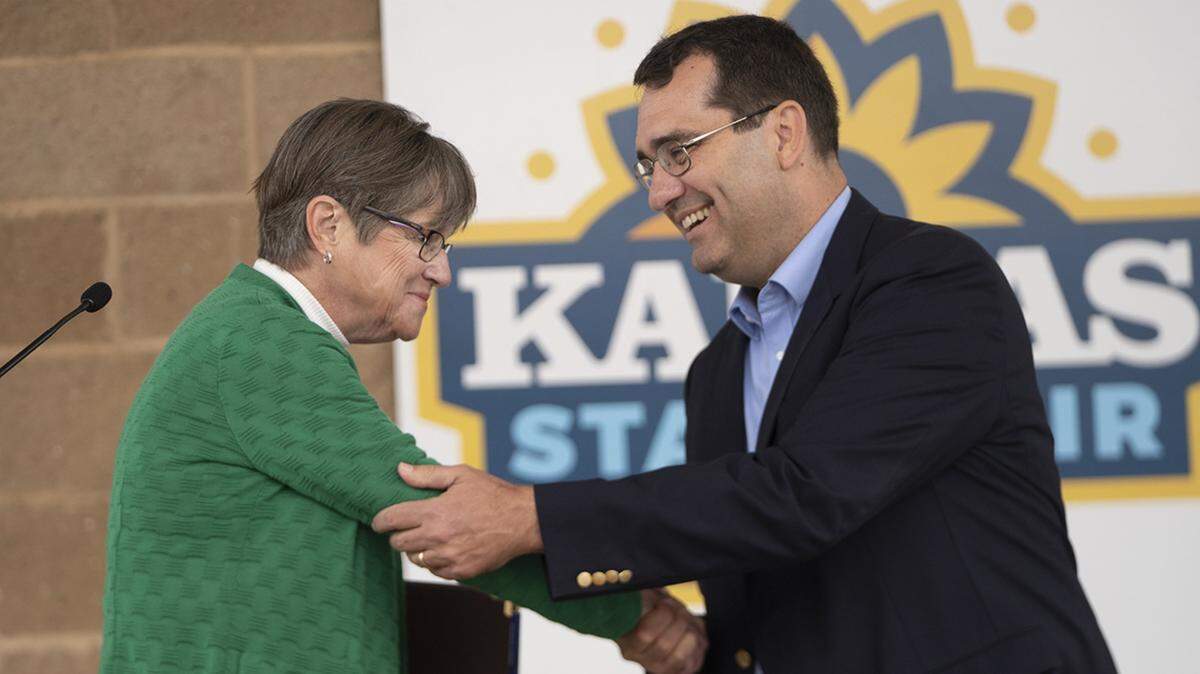
Kansas Republican Derek Schmidt’s campaign pointed to declining test scores released Monday as an indictment on Democratic incumbent Gov. Laura Kelly’s decision to close schools at the onset of COVID-19 in 2020.
Meanwhile, Kelly’s office noted that Kansas is in line with drops nationwide and said her continued leadership is key to recovery.
Kansas, along with the majority states across the country, saw declining test scores in both math and reading during the pandemic, according to the troubling results of this year’s National Assessment of Educational Progress exams, known as the Nation’s Report Card. The results were especially stark in math, where the country saw its largest-ever decline this year.
Flat or falling Kansas state assessment scores, before and during the pandemic, already had become political fodder in the race, which has kept education at the forefront. But the new national report, released by the U.S. Department of Education’s National Center for Education Statistics, provides the most comprehensive look at pandemic learning loss across the country to date.
“I want to be very clear, the results in today’s Nation’s Report Card are appalling and unacceptable,” U.S. Secretary of Education Miguel Cardona said on a Friday call with reporters. “They’re a reminder of the impact this pandemic had on our learners and the important work we must do now for our students. This is a moment of truth for education.”
C.J. Grover, Schmidt’s campaign manager, attacked Kelly over her decision to suspend in-person learning in March of 2020 through the end of that school year. Schmidt, the three-term state attorney general and Republican nominee for governor, has repeatedly attacked Kelly on the issue throughout the campaign.
“She was wrong to follow marching orders from the public-employee unions that fund her campaigns, and Kansas kids paid the price,” Grover said in an email. “The next step for Kansas schools needs to be electing a new governor who will put parents and kids first in education, won’t follow the orders of teachers unions, and who will clean up the mess left behind by Laura Kelly.”
But Kelly’s office pointed to increased overall funding of K-12 schools and additional investments made in the wake of the lockdowns to provide access to counseling, tutoring and mental health resources in schools as evidence Kelly had “worked tirelessly to get our students back on track.”
“The Kelly Administration is supporting students and families to ensure Kansas never goes back to the time when schools were underfunded and trapped in an endless cycle of litigation,” Kelly spokeswoman Brianna Johnson said in a statement.
Compared to 2019, Kansas this year saw more fourth and eighth grade students performing at the lowest level in math — mirroring national trends.
In fourth grade, 25% performed at the lowest level, compared to 21% in 2019. Meanwhile 39% of eighth graders performed at that level, worse than 29% before COVID.
Only 28% of fourth graders were proficient in math — meaning they demonstrated competency over challenging subject matter, a different measure than state standards for whether students meet grade level requirements. That’s down from 33% in 2019.
In eighth grade, only 18% of students were proficient, down from 24% before the pandemic.
Kansas also saw a higher percentage of students performing at the lowest level in reading.
In fourth grade, 40% of students were below the basic level in reading, compared to 34% in 2019. In eighth grade, 33% of students were at the lowest level, up from 26% before the pandemic.
In both math and reading, Kansas scores were in line with national averages.
The exams assess fourth and eighth graders across the country in math and reading every two years. State data are based on scores from a sample size of students. Nearly 450,000 students nationwide took the exams between January and March 2022. Before that, the assessments were last administered in 2019.
Several states and universities have been rethinking their emphasis on test scores in recent years, with critics arguing that they do not paint a full picture of a student’s achievement or readiness for life after graduation.
For more than five years, the Kansas State Department of Education has been overhauling its public school system, shifting how students are taught and prepared for the workforce. The state has been one of the most aggressive in moving toward the new approach, placing less emphasis on assessment scores and more on soft skills and career readiness.
Denise Kahler, a spokeswoman with the state education department, said that the declines in test scores, “are disappointing, but not entirely unexpected. We have seen a dramatic increase in chronic absenteeism rates over the past year, which is something that the Commissioner has called on to be addressed immediately. We can’t teach kids if they aren’t coming to school.”
She highlighted that fourth graders have been “impacted by the pandemic for three out of their four years in school.”
And that since the national exams were not administered the past few years, “we’re at a disadvantage because we don’t know if the decrease would have been greater in 2021 and our 2022 scores actually reflect a rebound. We know that even though Kansas schools opened back up in August 2020 ahead of many other states, the disruptions caused by COVID (quarantines, staff and student illness) were extensive.”
Missouri also saw test scores drop this year, erasing decades of growth in math.
“The results serve as another indicator that high-quality instruction matters,” Missouri Commissioner of Education Margie Vandeven said in a news release Monday. “It’s clear that the pandemic had an impact on student learning and that there is work to do. We must use this information, alongside state and local metrics, to continue accelerating post-pandemic learning with improved systems and processes to meet the needs of each student.”
This story was originally published October 24, 2022 at 3:42 PM.