‘Hard being in the middle.’ Moderates, once powerful in Kansas, are increasingly rare
Stephanie Sharp hasn’t recruited very many candidates over the past few years. Not at the city council level. Not at the school board level. Not at the statehouse level.
The former moderate Republican Kansas state representative turned political consultant said she just doesn’t feel that she can ask other moderate Republicans to run for office these days.
There’s the vitriol. The angry, nationalized language of politics that’s stretched all the way down to the school board level, with fights over book bans and youth sports. There’s the anger and distrust directed at people who run local elections amid lies about election security. Then there are the occasional threats.
“In good conscience, I can’t recruit somebody to go deal with that right now, to put somebody in that situation,” said Sharp, who is based in Johnson County. “Not only for their sanity, but for their family’s security and safety.”
There is no set definition of what makes a moderate politician. Current and former elected officials, political scientists and political observers all have different answers, but generally it’s someone who is more willing to work with members of the opposing political party to pass legislation.
Johnson County has long been a home to the type of political moderate who’s held up the center.
Sharp sees them as quiet public servants, someone who sees an important role for government and will work to make sure those needs are met. She also sees that type of person as an endangered species on the path to extinction. They’re retiring, they’re losing primaries, they’re taking more polarized votes or they’re switching parties altogether.
State Rep. Stephanie Clayton, an Overland Park Democrat, is one of the moderates who switched parties. She made the change following the 2018 election and said it was one of her few options.
“Basically, if you are a moderate Republican who wants to run for office, there are three options afforded you,” Clayton said. “Sell out and vote with the conservatives and you might be able to say you’re a moderate but your voting record is as you’re told. Or become a Democrat. Or they will primary you and postcard you into oblivion. Those are the choices.”
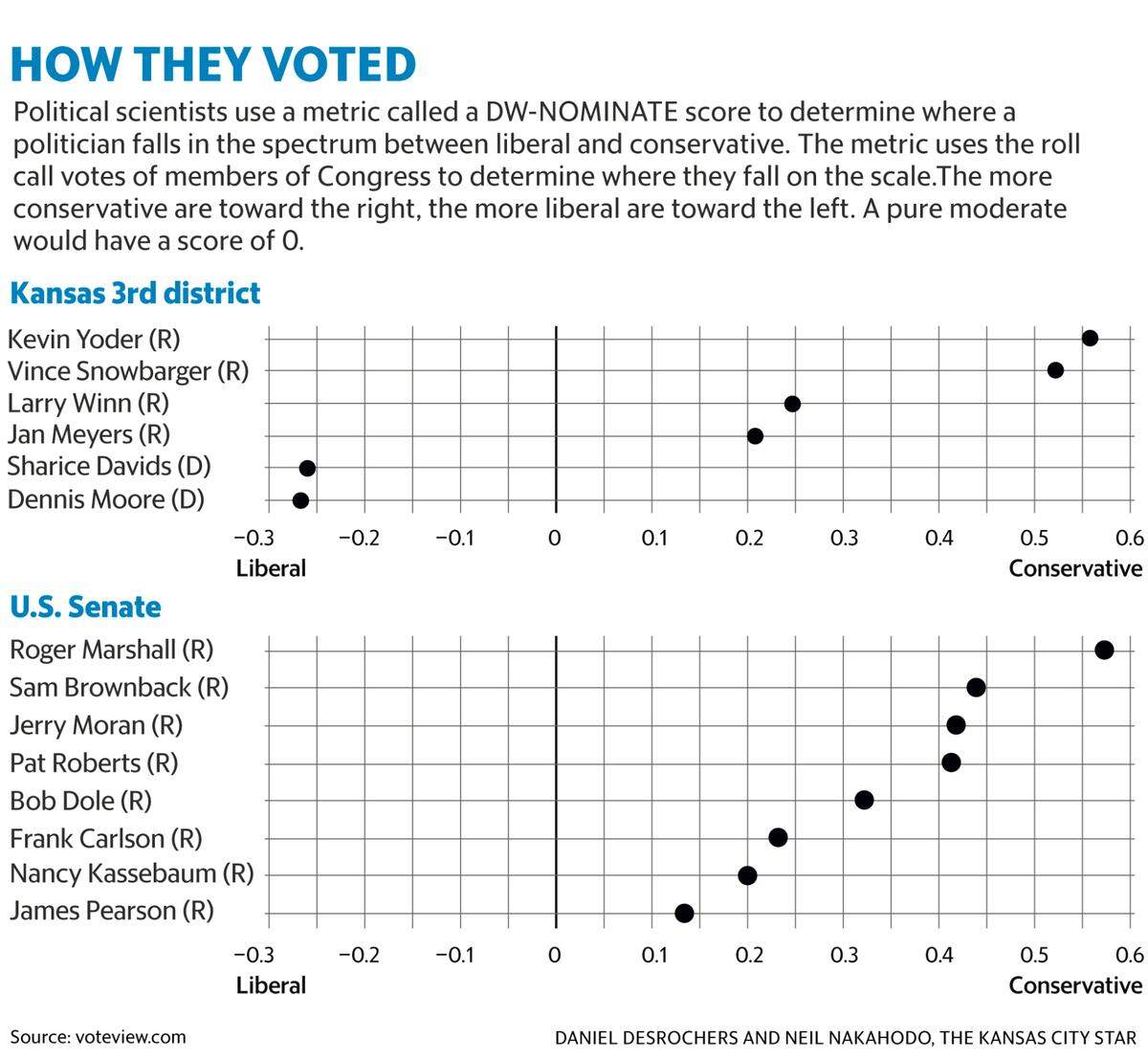
Politics have become more divided over the past three decades as politicians on the right grow increasingly conservative and those on the left have gradually gotten more liberal. As a result, the political center is falling away, making it more difficult to pass legislation and have a government responsive to the people — most of whom fall somewhere in the middle of the political spectrum.
In a system built on compromise, the lack of a political center can threaten democracy itself.
Only 7% of Americans between the ages of 18-29 in the fall of 2021 believed that the United States was a “healthy democracy.” A majority of both parties, 72% of Republicans and 63% of Democrats, believe members of the other political party are “immoral.” Around 30% of Americans believe political extremism is one of the most important issues facing the country, ranking only behind inflation and crime.
“What we’re cultivating is this generation of candidates that are narcissistic enough that they are willing to take on that risk,” Sharp said.
Some welcome the change. U.S. Sen. Josh Hawley, a Missouri Republican, said in June that the U.S. Supreme Court’s abortion ruling could restructure the Republican Party in a way that would make it more conservative, matching his ideology. Progressive Democrats, like Rep. Cori Bush, a Missouri Democrat, are increasingly challenging longstanding Democrats in the hopes that the activist branch of the party can enact more urgent change.
“It’s hard being a moderate,” said Rep. Brad Schneider, a Democrat from Illinois. “It’s hard being in the middle, knowing that you’re going to have people on both sides of you, who are going to critique what you’re trying to do.”
The pressure on moderates is clear in Kansas.
Primaries fuel polarization
The first purge of moderates from the Kansas Republican Party was over abortion.
It started after the “Summer of Mercy,” when anti-abortion activists swarmed Wichita in 1991 and staged a months-long protest, blocking access to the abortion clinic and holding rallies at night. The protests launched the political careers of a new generation of anti-abortion conservatives, painting a line within the Kansas Republican Party.
The pressure ramped up again in the 2010s, during former Gov. Sam Brownback’s term, as the Tea Party movement overtook the Republican Party.
Bob Beatty, a political science professor at Washburn University in Topeka, said that moment, when Republicans showed they would go after members of their own party in elections, fundamentally changed Kansas politics.
”It was showing Republican politicians in Kansas who are younger or even thinking of running, basically, your life is gonna be a lot more hellish as a moderate than it would be if you’re a hard conservative,” Beatty said. “Because they were they were under attack for sure.”
The result was a party driven even farther to the political right.
Primaries, the elections responsible for deciding which candidate will represent the two major political parties in the November election, generally have low turnout. Turnout in Kansas primary elections averaged 25.2 percent between 2010 and 2020.
“Most Americans don’t vote in primaries,” said Patrick Miller, a political science professor at the University of Kansas. “The people who vote in primaries tend to be more ideological, more partisan and more punishing when legislators don’t conform.”
Conservative Republicans have had more success at using primaries to drive their agenda than liberal Democrats. It’s created what political scientists call “asymmetric polarization,” where the Republican Party has been driven farther to the right than the Democratic Party has been pulled to the left.
The trend is accelerated by former President Donald Trump’s presence in the Republican Party. Because the former president has such a loyal base within his party, it has forced many Republicans, some who once criticized him as a candidate, to actively court his supporters. More than half of the Republican caucus in the U.S. House voted to overturn the results of the 2020 presidential election.
“Since Trump, there aren’t enough moderates that vote in the primaries anymore, a lot of them have changed party,” Sharp said. “Or they’re just beaten down.”
The Republican primary for U.S. Senate in Missouri featured several candidates pushing each other farther to the right as they attempted to earn Trump’s endorsement. Candidates pledged that they would fight for Trump’s agenda — brandishing blowtorches and shotguns in ads along the way.
On the eve of the election, Trump endorsed “Eric,” forcing Missouri Attorney General Eric Schmitt to celebrate a shared endorsement with former Gov. Eric Greitens, a man he called a “predator” in his stump speech.
The push to the right has leeched into general elections as well. Because Kansas is such a Republican state — it hasn’t voted for a Democrat for president since 1964 — Kansas Attorney General Derek Schmidt is running a gubernatorial campaign where he emphasizes his conservative credentials to motivate his base. He’s made culture war issues, like banning transgender athletes from girls and women’s sports.
Incumbent Democratic Gov. Laura Kelly has tried to run as a “middle of the road” candidate — literally walking down the center of a street in a television ad. She’s touted GOP endorsements throughout the campaign.
Samara Klar, a University of Arizona political science professor who studies moderates, said it’s the politicians, not the voters who are becoming more polarized.
“Americans are not becoming more ideologically extreme,” Klar said. “Only politicians are. Americans want politicians that are more moderate, because they are looking for candidates that better align with their own views.”
Moderates who are frustrated with how the primary system has affected centrist candidates found some hope in the turnout in Kansas’ primary this year, when 47% of registered voters went to the polls and a majority rejected a ballot measure that would have eliminated the right to an abortion from the Kansas constitution. Others see hope in states, like Alaska, that are changing their primary systems in an effort to more accurately reflect the views of voters.
“We need to take that momentum and we need to make sure we carry that through the November election so that common sense governance wins,” said Michael Poppa, the executive director of the Mainstream Coalition, a Johnson County-based group that works to elect moderates. The group has backed Democratic Gov. Laura Kelly and her legislative allies in recent years.
But Democrats, too, have begun facing pressure. Progressive activist candidates, like Bush in St. Louis in 2020, have been able to unseat long-time Democratic politicians. Earlier this year, a progressive Democrat attempted to unseat Rep. Henry Cuellar, an anti-abortion rights Democrat who represents a district in southern Texas. Cuellar won his primary by just 289 votes.
One of the few toss-up races this November
If you’re observing the campaign for Kansas’ 3rd Congressional District, it might appear that moderates are alive and well.
Rep. Sharice Davids, the Democratic incumbent, has made a point of highlighting areas where she’s disagreed with President Joe Biden and has run an ad showing Republican support. Amanda Adkins, her Republican opponent, has shied away from the more conservative stances of Republican leadership in Congress and has kept Trump at an arms length.
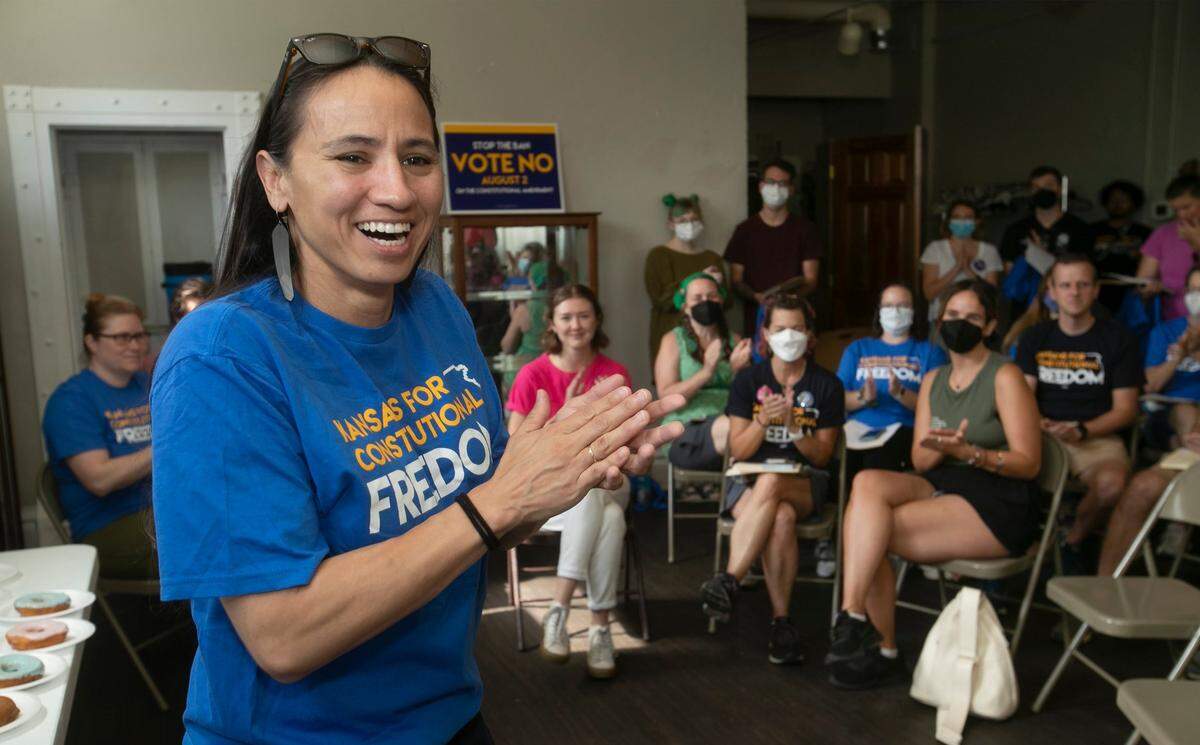
But neither of the candidates refer to themselves as a moderate, a label which once carried clout in the district.
Less than 10% of the 435 elections that determine the U.S. House for the next two years are considered competitive. The Kansas 3rd is one of the few that will. While lawmakers in neighboring districts can comfortably hold their seats by relying on their party’s base, Davids will need voters in the center to keep hers.
And Adkins will need those same voters to take it.
“Sharice Davids absolutely wants to keep that transitioning voter and Amanda Adkins wants to try to win them back,” Miller said. “So I think in this district in particular, given that it is one that has changed a fair bit, there’s that extra angle that makes appealing to moderation more important.”
Instead of calling herself a moderate, Davids says she is a pragmatic Democrat.
“I’m somebody who is interested in getting things done, which often means compromise and working in the middle, working across the aisle,” Davids said. “And I think it’s important to not be part of or contribute to the divisive rhetoric.”
She has spent her campaign trying to emphasize her bipartisan credentials. She holds small events where she touts the money she’s been able to secure for the district through things like the infrastructure law, which passed with bipartisan support. One in April had just a handful of people as television cameras focused on workers who talked about how federal money will help them repair and upgrade the Fairfax-Jersey Creek Levee.
Davids is considered one of the more moderate members of the Democratic caucus and she often sponsors bills with Republicans. Last October, she was confronted by progressive activists pushing her to support a massive Democratic spending package that stalled before Congress passed a more narrowly tailored version of the bill this August.
But she has voted with Biden’s position 100% of the time and, in her first term, only voted with former President Donald Trump’s position 7.9% of the time, according to FiveThirtyEight, a site which tracks lawmakers’ votes.
It’s a statistic the Adkins campaign has used against Davids in ads, painting her as a party politician who will fall in line with Biden and Pelosi. Davids has tried to combat the narrative. During last week’s Kansas City Chiefs game, her campaign aired an ad featuring Steven Ellis, a Republican and the former mayor of Spring Hill, saying that Davids “is not focused on politics, she’s focused on people.”
When asked which policies she supports that are different than her political party, Davids mentioned the TRUST in Congress Act, a bill that would make it more difficult for members of Congress to trade individual stock but has faced opposition from Democratic leadership. She also mentioned a bill to suspend the federal gas tax, another piece of legislation that doesn’t have support from leadership, though it did earn the support of Biden. Both bills were sponsored by Democrats and have Democratic support but have failed to get through Congress.
Where Davids has emphasized her ties to the opposite party, Adkins’ nods to the middle have been about distancing herself from more controversial stances in the Republican Party. In the aftermath of the U.S. Supreme Court eliminating the constitutional right to an abortion, Adkins wrote a guest column in The Star saying she supported leaving the issue to the states as anti-abortion advocates pushed for a federal ban on the procedure.
Adkins, a former state GOP chair and former Cerner executive, has held a series of small meet and greet events, where she’s emphasized issues national Republicans are focusing their campaigns on, like inflation and immigration at the southern border. She held an event last month at Straub Construction in Shawnee, where she invited three people to speak about inflation, crime and drug addiction as she expressed her support for House Minority Leader Kevin McCarthy’s legislative agenda. McCarthy could become the next speaker of the House if Republicans take control.
Adkins did not agree to an interview, but in a written answer to questions she called herself an “independent thinker.”
“It is not about party and it is not about labels,” Adkins wrote. “The focus needs to be on people.”
When asked for a position where she breaks with her party, Adkins said she supports more flexibility with paid family leave and allowing the government to negotiate with drug companies to bring down prices for Medicare.
Both Adkins and Davids chances may hinge on how well they can convince voters that they’ll be an independent vote in Congress.
“Some of the most successful politicians are those who can sort of portray this moderate ideal, put themselves out there as a moderate, convince people that they are moderate, even though their voting record is not necessarily moderate,” Klar said.
Note: The article has been updated to reflect which piece of legislation dealing with stock trading that Rep. Sharice Davids supports.
This story was originally published October 9, 2022 at 5:30 AM.