For 3 years, Topeka has been paying people up to $15K to move there. Is it working?
Kenyon and Stacey Gleason were already planning to move to Topeka from South Dakota.
She was accepted to Washburn University School of Law with a hefty financial aid package. He worked remotely, so could live anywhere with an internet connection. They liked Topeka: warmer weather, quiet neighborhoods and easy access to an international airport in Kansas City.
It wasn’t until they were shopping for homes with their Topeka real estate agent that they learned another financial incentive awaited them.
Kenyon could apply for Choose Topeka’s relocation program, which gives remote workers who move to Shawnee County $10,000 toward the purchase of a home.
A few months later, Kenyon happily cashed the $10,000 check.
“We’d already decided we were moving here before I was given the ‘yes’ (on the $10,000),” Gleason said, “but it was certainly part of the conversation, knowing we’d receive this not-insignificant amount of money.”
By just about any metric, the Gleasons are a net positive for Topeka. Kenyon has made friends at Billard Municipal Airport, where he keeps his 1960 Piper Comanche plane in one of the hangars. Stacey is making connections through law school. They own a home, pay taxes, and spend money in Topeka’s shops and restaurants and breweries.
But their experience also illuminates the complexities and blind spots of economic development efforts like Choose Topeka. Its approach — attempting to grow the tax base by targeting individuals rather than companies, and by using cold hard cash as opposed to convoluted subsidies — is a relatively new one, with mixed results in other areas it’s been implemented, including Tulsa, northwest Arkansas and Vermont. The Gleasons were coming to Topeka anyway: Did the city really need to write them a $10,000 check?
Bob Ross, the senior vice president of marketing for the Greater Topeka Partnership, the umbrella organization for Choose Topeka, says yes.
“Kenyon was already looking to purchase in the region, but that doesn’t necessarily mean he was going to buy in Shawnee County,” Ross said. “One of the reasons we started this program is that 40% of the people who work in Shawnee County and make more than $50,000 a year live outside the county. So part of how we see these incentive dollars is for steering people to live in Topeka and Shawnee County over neighboring counties and markets, like Lawrence and Kansas City.”
More than a third of Choose Topeka’s participants migrated to the city from elsewhere in the state, data shows, suggesting its economic incentives contribute to a kind of Border War in miniature, where Topeka sucks up talent from small Kansas towns and neighboring counties nearly as often as it attracts a remote worker from Texas or California. (Participants who work for a local company get up to $15,000.)
“We don’t deny that we’re sometimes competing with other communities across Kansas,” Ross said. “Talent attraction is changing. It’s getting pretty savage out there. Shawnee County right now has 6,000 open jobs and only 1,000 people that are unemployed. We physically do not have enough people to fill those jobs. I think we’d prefer to bring in people from out of state, but we see what we’re doing as giving some Kansans new options, new opportunities.”
Who’s coming?
The roots of the Choose Topeka program stretch back to 2014, when several economic organizations in Shawnee County — tourism, economic development, the Chamber of Commerce, and the downtown organization among them — consolidated into one large entity called the Greater Topeka Partnership.
“It allowed for a lot of synergy so that we could focus heavily on economic development, talent attraction and place-making,” Ross said. “Choose Topeka grew out of that as the community began to recognize that attracting talent needed to be a huge priority over the next 10 years.”
The money for the program is administered through Go Topeka, which is funded by the Joint Economic Development Organization, a city-county partnership. Funds come from a half-cent sales tax in Shawnee County.
“In the past, those funds all went to attract employers,” Ross said. “Now, we use a subset of those dollars to go after people.”
Choose Topeka debuted in December 2019, and initially only targeted those who would move to Shawnee County to work for an employer based there. It was a matching agreement: The employer put up half and Choose Topeka chipped in the other half, up to $15,000 for the purchase of a house or $10,000 toward lease payments on a rental.
When the pandemic hit, Choose Topeka expanded, rolling out the $10,000 initiative aimed at remote workers. “So now we’re competing for people from all across the country,” Ross said. (Both types of applicants are required to live in the county for at least one year after moving.)
The novelty of the program attracted a good amount of media attention, which has resulted in more than 60,000 applicants to date from all over the world.
“At the beginning it was like drinking out of a fire hose,” Ross said. “We had to screen everyone, then the qualifying applications had to be vetted through the employers. We had to do background checks, there was an interview process. And we weren’t just looking at their wages; we also had to think about equity and whether we’re bringing in diverse groups.”
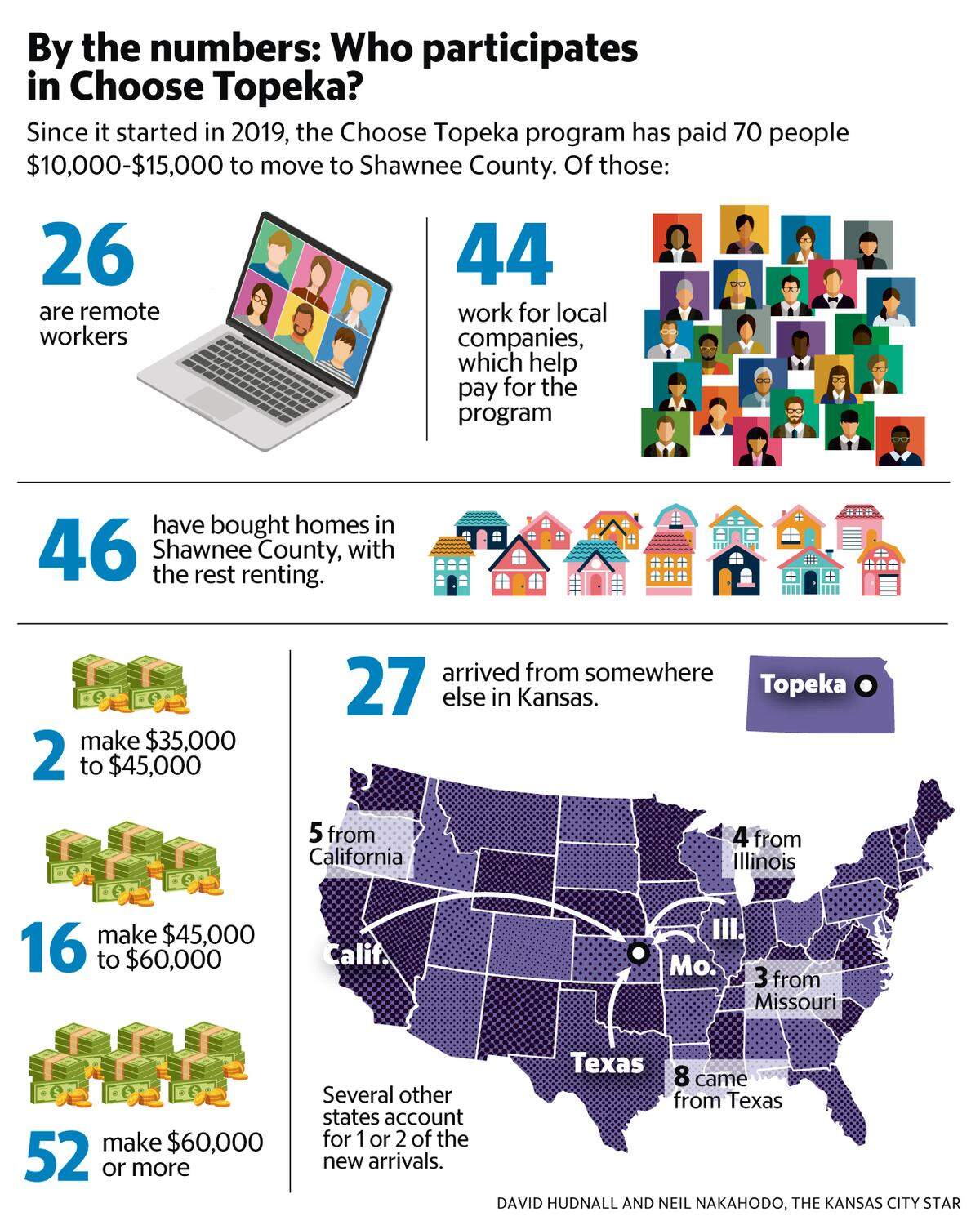
The budget for Choose Topeka continues to be capped at $300,000 per year. To date, just 70 people have been approved. Of those, 27 came from somewhere else in Kansas.
Trina Goss, who runs the day-to-day operations of Choose Topeka, said the organization doesn’t have data on the age of the participants or whether they are single. Choose Topeka did not track race data, either.
The program so far has also catered heavily toward one local company in particular: Advisors Excel, a fast-growing financial services firm with about 750 employees in Topeka.
Matt Beier, director of employee initiatives at the company, said Advisors Excel has moved 20 workers to Shawnee County through the Choose Topeka program. Of those, 11 came from somewhere else in Kansas, with the rest moving from states like Nevada, Texas, Nebraska and California.
“The program came along when we were trying to grow our wealth management business, so we jumped right in,” Beier said. “We put the information (about Choose Topeka’s program) on our careers page on our site, so people are often learning about it before they even apply for a job.”
Ross acknowledged an “awareness gap” in the program.
“We’re trying to educate more HR partners to let them know this is a tool they can use,” he said.
Still, Ross said, nearly three years in, the program has well exceeded expectations.
“We anticipated the average employee who came in would make $60,000; so far, the average salary is $90,000,” Ross said. “We initially projected a 6-times return on our investment; in just the first year, we calculated a $3.9 million impact from the program, which is a 14-times return on the investment. So there’s a real dollar value to doing this.”
Similar programs
Topeka is far from the only city dangling carrots in front of potential new residents. There is now an entire website, makemymove.com, that aggregates the various relocation incentives on offer from towns and cities across the country.
The best-known and most successful of these is Tulsa Remote, which predated Topeka’s program by about a year and which gives remote workers who move to the Oklahoma city a $10,000 grant and a year membership at a local co-working space.
“Even before the pandemic, we had a sense that technology and Zoom were going to create more remote work — that this space was only going to grow,” said Justin Harlan, managing director of Tulsa Remote. “And then with the pandemic, you had people really reflecting on their living situation and what they value in life. Like, ‘Why am I paying an outrageous amount of money for 500 square feet of space in LA, or San Francisco, or New York, or Austin. Is this really how I want to live?’”
Tulsa Remote relocated nearly as many people to Tulsa in its first year — 60, in 2019 — as Choose Topeka has in three years. In 2020, they added another 350 remote workers, then 950 in 2021. “Our goal for 2022 is 1,100,” Harlan said. “Every two weeks we bring a new cohort in.”
Tulsa’s program has a leg up on Topeka’s for a variety of reasons. It’s a much larger city, for one: about 400,000 people live there, compared to 125,000 in Topeka. Tulsa is also more of a cultural destination. The Bob Dylan Center, a world-class museum devoted to the artist’s body of work that opened in May, will draw fans from across the globe to Tulsa for decades to come. Tough competition for the Brown v. Board of Education Historic Site.
But it’s also about funding. At present, Choose Topeka can only use its $300,000 annual slice of the the city-county sales tax revenues. Tulsa’s program taps the largesse of oil billionaire George Kaiser’s family foundation, which is the sole funder of Tulsa Remote. (The George Kaiser Family Foundation is also responsible for the Bob Dylan Center and the Woody Guthrie Center, also located in Tulsa).
“We don’t have a cap on the number of folks we can bring in,” said Harlan. “We want as many as we can get.”
The Life Works Here initiative, administered by the Northwest Arkansas Council, also relies on private local wealth — in its case, the Walton family’s.
Rolled out in December 2020, Life Works Here gives remote workers $10,000 and a mountain bike to relocate to the Ozark Mountains of northwest Arkansas, home to such cities as Bentonville (where Walmart is headquartered) and Fayetteville (where the University of Arkansas is located).
Nelson Peacock, the president and CEO of the Northwest Arkansas Council, said Walmart heirs Tom and Stuart Walton gave his organization “enough funding for 100 people at $10,000 each, and we’ve awarded nearly all of those, around 85 or 90 so far.”
“We broke it into three buckets,” Peacock said of deciding which applicants to accept for the program. “One was STEM talent: coders, data science people, engineer types — basically the types of workers every industry in this country needs. The second was entrepreneurial talent: startups and scale-ups that we think represent the future. And the third was creatives: chefs, artists and such.”
The average age of Life Works Here participants was 36, with ages ranging from 21 to 63. A little more than half were single, and among those with a spouse or a partner, 23% had children. Roughly 20% came from Texas and 20% came from California, with others coming to the Ozarks from as far away as Germany and South Korea. (Unlike Choose Topeka, both the northwest Arkansas and Tulsa programs require participants to come from a different state.)
But the Life Works Here program is not being renewed, Peacock said. Once its 100th incentive package is awarded, the Northwest Arkansas Council will be allocating its talent attraction resources elsewhere.
“Part of the idea with it (the relocation incentive) was, quite frankly, to market ourselves — to get northwest Arkansas into the news media,” Peacock said. “And we’ve been really successful in terms of the number of stories and media impressions. But that’s dying down as more communities are doing this. The uniqueness of it has run its course. And we’re already one of the fastest-growing regions in the country. So as the pandemic winds down, we think there are better ways to get out and tell our story.”
The Northwest Arkansas Council will extend the Life Works Here campaign, Peacock said, but it will take the form of a branding initiative. Motorists and pedestrians in cities like Seattle, Austin, Dallas and Denver will likely soon encounter billboards and other advertising that beckon them to the Ozark hills, where the views are scenic and the homes are affordable.
Peacock also said the “concierge work” involved in running the remote worker program — connecting new transplants with good apartments, schools, real estate agents, even things to do on a Saturday night — ended up being more burdensome than they anticipated.
“Almost 70% of the people who’ve come have had no connection to northwest Arkansas whatsoever,” he said. “We didn’t think that through as much, the back end of things. In many ways, after they agreed to make the move, that’s when the work started.”
Mixed bag
Because these policy initiatives have only cropped up in recent years, their implications have not been widely studied. But there is at least one relevant study, from Vermont, where in 2018 the state legislature created the Remote Worker Grant Program.
Vermont’s program reimburses up to $10,000 in moving costs, broadband bills and co-working space rental for remote workers who moved there from other states. The legislature initially allocated $500,000 over three years for the grants, but later removed the annual limits, declaring that the Vermont Agency of Commerce and Community Development could award the grants “subject to available funding.”
A 2019 state audit of the program found a variety of faults in the way it was administered. One criticism called to mind Kenyon Gleason’s situation in Topeka. Sixteen grantees “had spouses whose Vermont-based job plans may have influenced their decision to move here.”
“The prospect of reimbursements was, at best, a minor incentive for grantees to move to Vermont,” the report concluded. “At worst, the grants were gifts to those who would have moved here regardless of financial incentives.”
Greg LeRoy, the executive director of Good Jobs First, a nonprofit watchdog that monitors — and is typically critical of — economic development incentives, said his group has been fielding questions about these remote and relocation incentive programs a lot more lately. Short answer: He’s also not convinced of their effectiveness.
“At the end of the day, a state or locality needs to attract a business with all it brings: buying power/supplier contracts, civic participation, hiring/talent pipelines, spinoffs, etc.,” LeRoy wrote in an email to The Star. “And the best way to attract promising companies is to first attract smart people, and you do that with quality of life, including good schools with adequate funding.”
In other words: Tax your citizens appropriately, invest those revenues in simple, popular government services, and more people will come.
Easier said than done in America circa 2022. Ross said Choose Topeka definitely plans to continue its employer-based incentive program, but whether the remote-worker incentive is extended will be evaluated at the end of this year. “Either way, we know that cities competing for talent and workers is going to become exponentially important over the next 10 years,” he said.
As for Gleason, he said they hope to stay in Topeka even after Stacey graduates from Washburn.
“I really feel like we got the best of everything here,” Gleason said. “We love the house, love the community. We can kayak, hike, drive into KC for a baseball game. I got my pilot buddies — there’s six of us that get together just about every week for dinner, drinks, maybe fly to Wichita and have breakfast and come back. Maybe if my wife got a job somewhere else we’d think about moving. But I can see myself in Topeka for a long time to come.”
This story was originally published July 13, 2022 at 5:00 AM.